


Professional Camera Equipment: Unlock 3 Pro Essentials
What Separates Pro Gear from the Pack?
Professional camera equipment stands apart due to its superior build quality, advanced features, and reliability. Unlike consumer gear built for casual use, pro equipment is engineered for daily abuse and critical assignments where a missed shot is not an option. Key differentiators include:
- Larger sensors (Full-frame or bigger) for superior low-light performance.
- Dual memory card slots for essential data redundancy.
- Weather-sealed construction for durability in harsh conditions.
- Advanced autofocus with sophisticated subject and eye tracking.
- High megapixel counts (24MP+) for cropping flexibility and large prints.
- Pro-grade lenses with fast apertures and exceptional optical quality.
This level of gear represents an investment mindset. While professional bodies and lenses cost thousands, the investment pays off through higher-quality client work, reduced equipment failure, and gear that holds its value.
The industry’s shift from DSLR to mirrorless has made pro features like advanced AF and silent shutters more accessible. Modern cameras from Sony, Canon, and Nikon offer incredible speed, 8K video, and hybrid capabilities, reflecting a growing market projected to reach $17.8 billion by 2030.
I’m digitaljeff, and with 20 years in digital media, I’ve seen how the right tools open up creative potential. This guide will help you build a professional toolkit to match your ambitions.
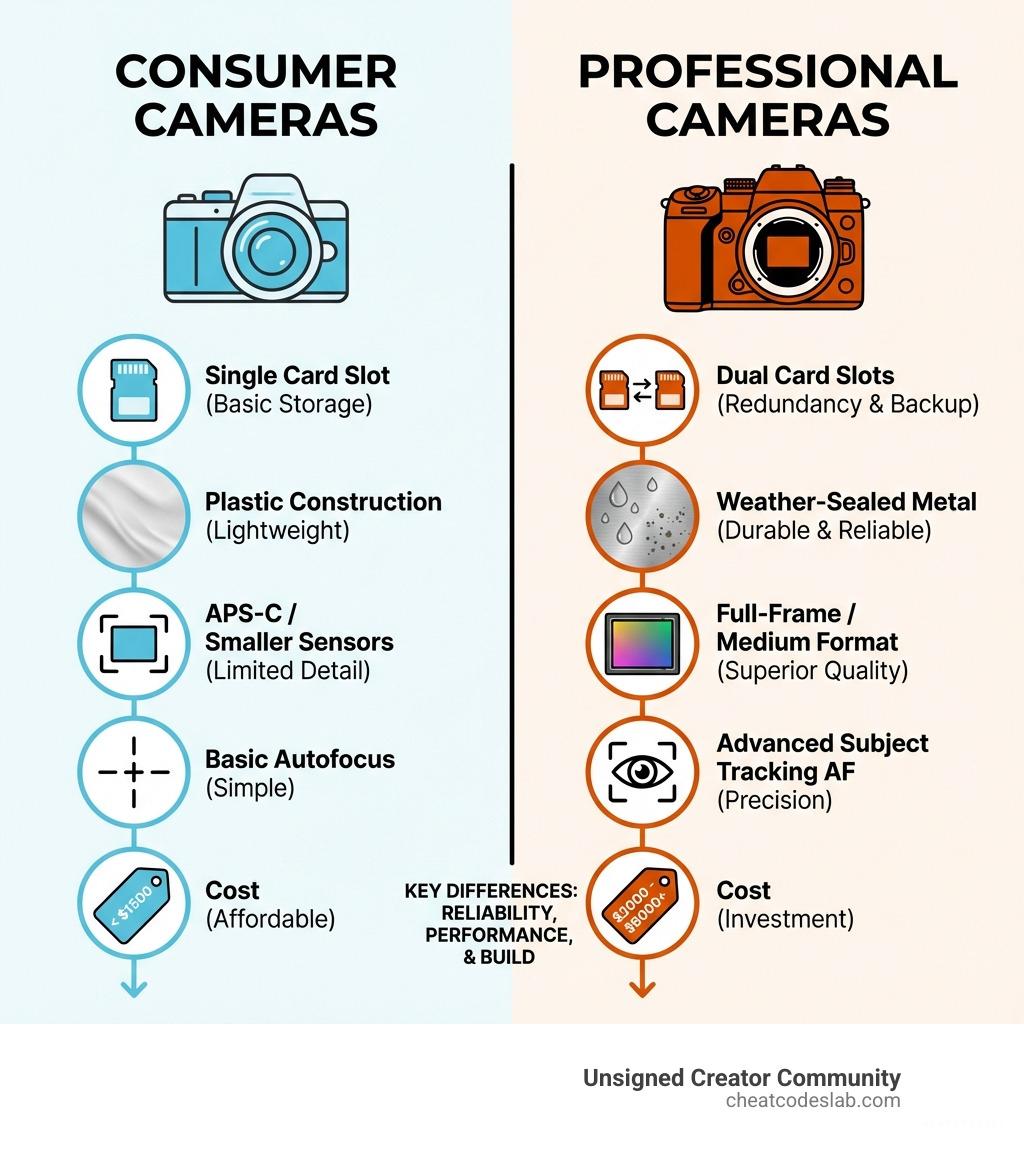
Simple guide to professional camera equipment terms:
The Essential Toolkit: Core Professional Camera Equipment
This section breaks down the must-have gear for any serious photographer or videographer, moving from the camera body to lenses and essential support systems. We focus on tools that offer both reliability and the creative flexibility needed to tackle any professional assignment.
Choosing a Professional Camera Body
The camera body is the heart of your professional camera equipment setup. Here are the key features to prioritize:
1. Sensor Size:
* Full-Frame: The professional standard, excelling in low light and offering shallow depth of field (bokeh).
* APS-C: A capable and often more affordable option, offering a crop factor that extends telephoto reach for wildlife or sports.
* Medium Format: Provides ultimate detail and resolution for studio and landscape work, with cameras like the Fujifilm GFX 50SII or Fujifilm GFX 100RF leading the pack.
2. Megapixels (24MP+): A high megapixel count, like the 45MP Nikon Z9 or 50MP Sony A1, allows for significant cropping flexibility and large-format prints.
3. Advanced Autofocus: Modern mirrorless systems offer game-changing subject recognition and eye-tracking AF, ensuring you never miss a critical shot.
4. Build Quality & Weather Sealing: A robust, weather-sealed body is crucial for reliability in challenging conditions, protecting your investment from dust, rain, and bumps.
5. Dual Memory Card Slots: This is a non-negotiable feature for professionals. It provides data redundancy, creating an instant backup that can save a client’s shoot from a card failure.
6. Silent Shutter: An electronic silent shutter is invaluable for discreet shooting at weddings, events, or performances. Cameras like the Nikon Z9 and Sony A1 feature stacked sensors that minimize rolling shutter.
Mirrorless vs. DSLR for Professional Use:
The industry has largely shifted to Mirrorless Interchangeable-Lens Cameras (MILCs) for their significant technological advantages.
| Feature | Mirrorless Cameras (MILC) | DSLR Cameras |
|---|---|---|
| Autofocus | Generally superior, faster, more accurate (eye-tracking) | Capable, but often slower and less sophisticated |
| Size & Weight | Smaller, lighter, more portable | Larger, heavier due to mirror box and prism |
| Electronic Viewfinder (EVF) | Real-time exposure preview, customizable info | Optical Viewfinder (OVF) – direct view, no digital info |
| Silent Shutter | Common, ideal for discreet shooting | Requires specific modes, often not truly silent |
| Video Capabilities | Often advanced (4K/8K, high frame rates), hybrid design | Capable, but typically less advanced, often with limits |
| Lens Selection | Growing rapidly, often with new, optimized designs | Vast, mature ecosystem, but often larger/heavier lenses |
| Image Stabilization | In-body image stabilization (IBIS) more common | Primarily lens-based, some in-body on higher-end models |
For professional use, mirrorless cameras offer clear advantages in speed, autofocus precision, and video integration, making them the preferred choice today.
Selecting High-Performance Lenses
A great lens is as important as the camera body. Look for these qualities:
- Sharpness & Rendering: Pro lenses deliver crisp detail and beautiful out-of-focus rendering (bokeh). Lenses like the Nikon 105mm f/1.4E are prized for portraiture, while others like the Nikon 58mm f/1.4G offer unique character. Learn more in our guide to the Best Lens for Portraits.
- Fast Aperture & Autofocus: Wide apertures (f/1.2, f/1.4) excel in low light, while rapid autofocus motors keep up with fast action. The Sony 50mm f/1.2 GM combines both with incredible speed and rendering.
- Durability: Look for robust, weather-sealed construction and advanced coatings for flare resistance, like those found on the Sony 35mm f/1.4 GM.
Prime vs. Zoom Lenses:
- Primes (fixed focal length): Offer wider apertures for superior low-light performance and background blur. A versatile kit might include the Sony 24mm f/1.4 GM and the Sigma 85mm f/1.4 DG DN.
- Zooms (variable focal length): Provide flexibility for events where changing lenses is impractical. Workhorse zooms include the Nikon 24-70mm f/4 S, Tamron 28-75 f/2.8 VXD G2, and the Sony 70-200 f/2.8 GM II, which can be paired with a Sony FE 2.0x TC Teleconverter for extra reach.
Mastering Light: Crucial Lighting & Support
Controlling light is what separates amateurs from pros.

- Off-Camera Strobes: These are the workhorses for professional lighting, allowing you to shape light for dramatic or natural effects. A versatile wireless system might include powerful units like the Godox AD600, the portable Godox AD300, and multiple Godox AD200 units, supplemented by on-camera speedlights like the Godox V1 and Godox V860III.
- Continuous LED Lights: Essential for video, continuous LEDs like the Godox M1 RGB LED, Godox SL150II LED, and Godox VL200 LED provide constant illumination for a real-time preview of your lighting.
- Light Modifiers & Stands: Raw light is harsh. Modifiers like softboxes (Westcott 48″ Parabolic, Angler 36″ Parabolic) and octaboxes (Glow 33″) soften and shape light. Sturdy supports like the Manfrotto Alu-master Light Stand, Manfrotto Nano Stand Plus, and a reliable Peak Design Travel Tripod are non-negotiable for safety and stability.
Assembling Your Professional Videography Kit
Modern hybrid cameras excel at both photo and video, but a dedicated professional videography setup requires specific tools.

- Hybrid Cameras: Many pro mirrorless bodies are video powerhouses. The Sony A7SIII is a low-light beast, while the Sony A1 and Nikon Z9 offer stunning 8K video.
- High-Quality Audio: Bad audio ruins good video. Invest in a versatile microphone setup, including a shotgun mic like the Rode Videomic NTG, wireless lavaliers like the Rode Wireless GO with a Rode Lavalier Mic, and a studio mic like the Shure SM7B for voiceovers. For ultimate control, use an external recorder like the Tascam DR-40 XLR Multi-track Recorder or the compact Zoom H1n Compact Recorder.
- Stabilization: Smooth, cinematic footage is key. Use a gimbal like the DJI Ronin SC for stable movement, a SmallRig Shoulder Rig for ergonomic support, and a dedicated Sirui Video Tripod or Sirui Monopod for static shots.
- ND Filters: These “sunglasses for your lens” reduce light, allowing you to use wide apertures for shallow depth of field in bright sun. We use variable NDs like the PolarPro PM Variable ND 2-5 Stop Mist Edition Filter and the PolarPro PM Variable ND 6-9 Stop Mist Edition Filter.
- Other Essentials: An external monitor like the Atomos Ninja V+ provides a better view for focus and exposure. For dynamic aerials or POV shots, a DJI Mavic 3 Pro 4K Drone and action cameras like the GoPro Hero 10 Black 5.3K Action Camera or DJI Osmo Action 4K Action Camera are invaluable. For more ideas, see our guide on the Best Tools for Reels.
Investing in Your Craft: From Gear to Career
Understanding how high-end equipment translates into better work, happier clients, and a more sustainable business is crucial. It’s not just about owning the best, but leveraging it to lift your craft.
How Gear Impacts Different Photography Genres
Different genres demand specific tools to achieve the best results.
- Portrait Photography: Success hinges on shallow depth of field and beautiful bokeh. Fast prime lenses like the Sony 50mm f/1.2 GM or Sony 85mm f/1.4 DG DN on a full-frame body are ideal.
- Wedding & Event Photography: This high-pressure field requires gear that is fast, reliable in low light, and redundant. Look for cameras with excellent high-ISO performance, rapid eye-tracking AF, high burst rates (like the Nikon Z9 or Sony A1), dual card slots, and a silent shutter.
- Real Estate Photography: Sharp, wide-angle views are key. Use high-resolution cameras with wide-angle zooms like the Tamron 17-28mm f/2.8 RXD or specialized tilt-shift lenses. Learn more in our guide on Camera Equipment for Real Estate Photography.
- Product Photography: This requires meticulous detail and color accuracy. High-resolution cameras paired with macro lenses like the Canon EF 100mm f/2.8 L Macro and controlled studio lighting are essential.
- Wildlife Photography: Reach and speed are paramount. Long telephoto lenses like the Nikon 300mm f/4E PF or a Sony 70-200 f/2.8 GM II with a teleconverter are necessary, paired with a fast, weather-sealed camera. See our picks for the Best Camera for Wildlife.
- Street Photography: Discretion and portability are key. Compact cameras with a fast prime lens, like the Leica Q2, are favored. Check out our guide on the Best Camera for Street Photography.
The ROI of Professional Camera Equipment
Investing in professional camera equipment is a strategic business decision that yields a significant return.
1. Return on Investment (ROI): The high initial cost pays for itself through:
* Higher Quality Deliverables: Justifying premium pricing.
* Increased Client Satisfaction: Reliable gear leads to consistent results and happy, referring clients.
* Improved Reputation: Using pro gear signals competence and attracts better jobs.
* Efficiency: Faster, more capable gear lets you capture more usable shots in less time.
2. Durability and Longevity: Pro equipment is built to withstand years of heavy use, reducing replacement costs and protecting your investment.
3. Essential Accessories: Don’t forget the supporting cast. Fast memory cards are crucial for high-resolution files, and multiple spare batteries are non-negotiable. Protect your investment with quality bags, like those in our guide to the Best Hard Case for Camera Gear, and keep everything pristine with a good cleaning kit.
At CheatCodesLab, we know that vision and skill are what create magic. The right professional camera equipment simply removes technical barriers, freeing you to focus on what matters: composition, lighting, and emotion. It’s an investment in creative freedom and business success.
Ready to find your gear? Shop our curated guides.


About the author

How to Archive Posts on Instagram in 4 Easy Steps
Master archiving on Instagram in 4 easy steps to organize your profile and protect your content.

Beginner’s Guide to 10k free instagram followers app
Discover how a 10k free instagram followers app works, its risks, and safe organic growth strategies for real engagement in 2026.
Beginner’s Guide to Best Instagram Report App
Discover the best Instagram report app for real-time analytics, automated reports, and data-driven decisions in 2026.
How to Master Advanced SEO Search Techniques in 7 Steps
Master advanced search techniques in SEO with 7 proven steps to boost rankings, technical audits, and organic traffic.
Cheat Sheet to the Best Business Apps
Discover the best business apps to streamline operations, boost productivity, and scale your business in 2026.

How to Get Instagram Followers Free APK in 5 Steps
Discover how instagram followers free apk 2026 download works and learn safe organic growth strategies instead of risky third-party tools.
Related
How to Archive Posts on Instagram in 4 Easy Steps
Master archiving on Instagram in 4 easy steps to organize your profile and protect your content.

Beginner’s Guide to Best Search Engine Optimization SEO
Master best search engine optimization SEO with this beginner's guide covering on-page, technical, and AI strategies for higher rankings.

Ultimate Checklist for Social Media Marketing Agency
Discover the ultimate checklist for choosing a social media marketing agency that drives real ROI and growth.

Hot Summer Caption Ideas That Spark Engagement
Discover hot summer caption ideas that boost engagement, from short aesthetic lines to funny unhinged vibes and beach photo dumps.

How to Add Text to Instagram Story in 5 Easy Steps
Learn how to add text to Instagram Story in 5 easy steps with our native tips and creative text hacks for better engagement.

How to Add Audio to Instagram Story the Right Way
Learn how to add audio clip in Instagram Story using built-in music or your own file with this step-by-step guide.