

The Best AI Tools to Help Nonprofits Get Funded
Why AI Tools for Fundraising Are Changing the Nonprofit Game
AI tools for fundraising are software platforms that help nonprofits raise more money by automating tasks, predicting donor behavior, and generating content — faster and smarter than traditional methods alone.
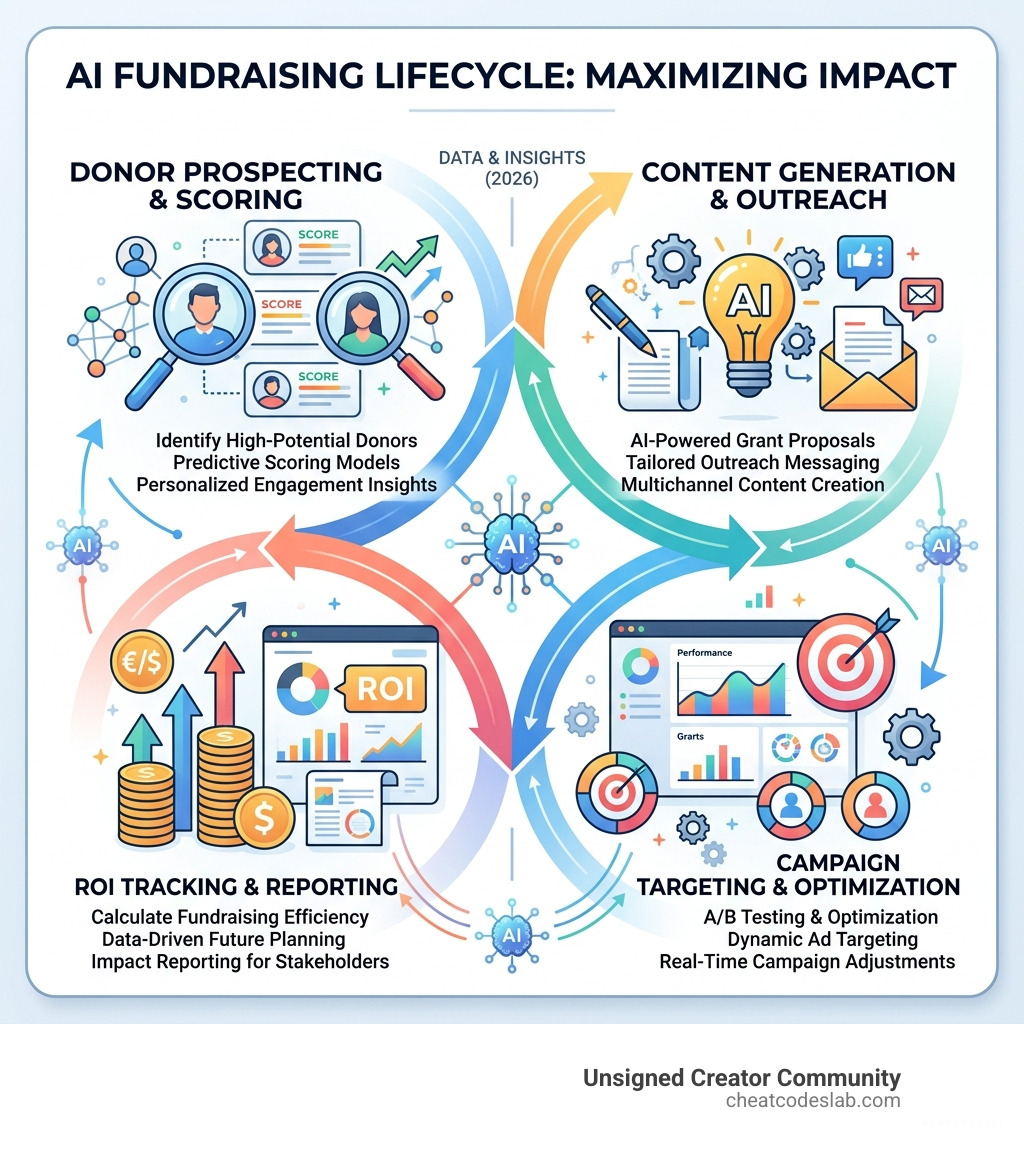
Here are the top AI tools nonprofits are using right now:
| Tool | Best For | Type |
|---|---|---|
| DonorSearch AI | Donor prospecting & scoring | Predictive |
| Dataro | Campaign targeting & ROI | Predictive |
| Squark AI | No-code donor predictions | Predictive |
| ChatGPT | Grant writing & outreach copy | Generative |
| Gemini | Content creation & event planning | Generative |
| CharityScribe | Grant writing & donor research | Generative |
| Raise by Gravyty | Donor engagement & outreach | Automation |
| Avid | End-to-end fundraising automation | Automation |
Fundraising has always been about relationships and trust. But today, nonprofits are under pressure to do more with less. Donor lists are growing. Staff capacity is shrinking. And competition for funding is fierce.
That’s where AI comes in.
Over half of nonprofits are already using AI in some capacity. And the results are hard to ignore — 30% report that AI tools have directly increased their fundraising revenue in the past year. Even more telling: 74% of online donors actually want nonprofits to use AI to improve their outreach and operations.
Yet 92% of nonprofits still feel unprepared for the shift. Most don’t even have a basic AI usage policy in place.
The gap between early adopters and everyone else is growing fast. This guide is here to help you close it.
I’m digitaljeff — futurist, tech entrepreneur, and content strategist with 20+ years helping brands use emerging technology to scale their reach and impact. My work at the intersection of digital media and innovation gives me a front-row seat to how AI tools for fundraising are reshaping what’s possible for mission-driven organizations. Let’s break down exactly which tools are worth your time.
Easy AI tools for fundraising glossary:
The Power of AI Tools for Fundraising
When we talk about AI tools for fundraising, we aren’t talking about replacing the “heart” of your mission. Instead, we’re talking about giving your team a superpower. Traditional fundraising often relies on manual spreadsheets, “gut feelings” about which donors to call, and hours of repetitive administrative work. AI flips the script by using data to tell you exactly where to focus your energy.
The primary shift is from reactive to proactive. Instead of waiting for a donor to lapse, AI can flag a “at-risk” donor before they stop giving. Instead of staring at a blank page for a grant proposal, AI can draft a solid first version in seconds. This level of administrative efficiency allows small teams to behave like massive development departments.

Predictive AI Tools for Fundraising and Donor Behavior
Predictive AI is the “crystal ball” of the nonprofit world. It looks at your historical donor data—how much they gave, how often, and their philanthropic history elsewhere—to predict what they will do next.
- DonorSearch AI: This tool is a heavy hitter for prospect research. It uses a massive proprietary database of philanthropic giving to score your donors. We’ve seen that mature users of this tech can experience up to an 85% increase in response rates. It’s particularly good at finding “hidden gems” in your database—people who have the capacity to give much more but haven’t been asked yet.
- Dataro: If you’ve ever struggled with direct mail or digital appeal lists, Dataro is a game-changer. It integrates with your CRM to generate “propensity scores.” It tells you who is most likely to give to a specific campaign, who might become a monthly sustainer, and who is likely to leave a gift in their will. Some organizations have seen an 83% increase in recurring gift conversions just by targeting the right people.
- Squark AI: We love Squark because it’s a no-code platform. You don’t need a data scientist to use it. You simply “drag and drop” your donor data, and it provides plain-language recommendations. It helps answer the question: “What should I do next for this specific donor?” This type of predictive modeling can reduce donor acquisition costs by as much as 50%.
| Feature | Predictive AI | Generative AI |
|---|---|---|
| Primary Goal | Forecast behavior & trends | Create new content |
| Best Use Case | Donor scoring & churn risk | Grant writing & emails |
| Data Source | Historical donor records | Large Language Models (LLMs) |
| Output | Probability scores & segments | Text, images, & drafts |
Generative AI Tools for Fundraising and Content Creation
While predictive AI handles the “who” and “when,” generative AI handles the “what.” This is the tech that helps you communicate your social impact effectively.
- ChatGPT & Gemini: These are the most accessible AI tools for fundraising for daily tasks. They are excellent for brainstorming event themes, drafting personalized donor outreach, and summarizing long board reports. Gemini, in particular, has a curated prompt library specifically for nonprofits to help with grant writing and donation encouragement.
- CharityScribe: This is a specialized platform built by fundraising professionals. Unlike generic AI, it’s designed specifically for the nuances of the nonprofit sector. It features tools like an “AI Prospecting Engine” to find institutional funders and a “Grant Editor” to tailor proposals to a specific funder’s mission. It’s like having a senior development consultant on staff 24/7.
- Raise by Gravyty: Think of this as an AI co-pilot for your frontline fundraisers. It analyzes your CRM data and then pops up with daily “action prompts.” It might say, “Today is the best time to email Sarah; here is a draft based on her last gift to the scholarship fund.” This helps fundraisers scale their outreach without losing the personal touch.
Top Free and Low-Cost AI Options for Nonprofits
We know that for many small organizations, even a small monthly fee can be a hurdle. The good news is that you can start using AI today without spending a dime.
- Google for Nonprofits: This is a must-have. Eligible organizations can get access to Gemini (Google’s AI assistant) and up to $10,000 per month in search ads through Google Ad Grants. This allows you to use AI-powered search marketing to drive traffic to your donation pages for free.
- Free Tiers of ChatGPT: You don’t need the paid version to get value. You can use the “custom instructions” or “memory” features to tell the AI about your nonprofit’s mission, tone, and goals. This ensures every draft it produces sounds like your organization.
- Prompt Libraries: Organizations like CharityScribe and Google offer free libraries of prompts. Instead of guessing what to ask the AI, you can copy and paste proven formulas for grant applications or social media posts.
For more resources on getting started without a budget, check out our guide on AI tools online free.
Ethical Implementation and Measuring Success
Harnessing the power of AI comes with a massive responsibility. Because fundraising is built on trust, any misuse of data can damage your reputation permanently. We always recommend that nonprofits move quickly but carefully.
Responsible AI Frameworks and Data Privacy
You shouldn’t just plug donor data into any random website. Data privacy is paramount. Organizations should look toward frameworks like Fundraising.AI, which focuses on privacy, security, and data ethics.
- Transparency: Be open with your donors about how you use tech. Most donors (74%) are fine with AI if it helps the mission, but they hate feeling “tricked” by a bot.
- Bias Mitigation: AI models can sometimes inherit biases from the data they are trained on. Always have a human review AI-generated segments to ensure you aren’t accidentally excluding certain groups.
- Compliance: If you are a healthcare or educational nonprofit, you must ensure your AI tools are HIPAA or FERPA compliant. Platforms like Raise by Gravyty prioritize these integrations to keep data secure.
If you’re just starting out, our AI tools for beginners guide covers the basics of setting up your first ethical usage policy.
Tracking ROI and Fundraising Performance Metrics
How do you know if your AI tools for fundraising are actually working? You have to track the metrics that matter.
- Response Rates: Are more people opening your emails and clicking “donate”? Dataro users often see significant lifts here because the messages are more relevant.
- Donor Journey Speed: Measure how long it takes to move a new prospect to their first major gift. On average, AI can help move donors through this pipeline about 17% faster.
- Average Gift Size: Predictive AI helps you ask for the “right” amount. Instead of a generic $50 ask, the AI might suggest $72.50 based on that specific donor’s wealth markers, leading to a 20% increase in average gift amounts.
- Retention Rate: This is the ultimate metric. AI is incredible at spotting “at-risk” donors. If you can use AI to rescue just 5% of your lapsing donors, the ROI on the software is usually covered ten times over.
For more on managing these data points, explore our insights on AI tools for CRM.
Conclusion: Scaling Your Mission with CheatCodesLab
At CheatCodesLab, we believe that technology should empower creators and change-makers, not overwhelm them. While AI can feel like magic, it’s really just a very sophisticated tool in your belt. The “secret sauce” of fundraising will always be the human connection—the coffee meetings, the heartfelt thank-you calls, and the shared passion for a cause.
AI tools like Avid and Squark AI are designed to handle the “grunt work” so you can get back to those human moments. By automating the data entry, the research, and the first drafts, you give your team the gift of time.
As you begin your journey, AI literacy is a growing skill—up 177% on LinkedIn in just the last year. Don’t be afraid to start small. Use a free tool to draft your next newsletter, or use a predictive tool to analyze your last campaign.
Ready to dive deeper into tech-driven growth? Explore our other technology categories to find the “cheat codes” your nonprofit needs to thrive in the digital age. Success isn’t about working harder; it’s about working smarter with the right tools in your corner.


About the author


How to Archive Posts on Instagram in 4 Easy Steps
Master archiving on Instagram in 4 easy steps to organize your profile and protect your content.

Beginner’s Guide to 10k free instagram followers app
Discover how a 10k free instagram followers app works, its risks, and safe organic growth strategies for real engagement in 2026.

Beginner’s Guide to Best Instagram Report App
Discover the best Instagram report app for real-time analytics, automated reports, and data-driven decisions in 2026.
How to Master Advanced SEO Search Techniques in 7 Steps
Master advanced search techniques in SEO with 7 proven steps to boost rankings, technical audits, and organic traffic.

Cheat Sheet to the Best Business Apps
Discover the best business apps to streamline operations, boost productivity, and scale your business in 2026.

How to Get Instagram Followers Free APK in 5 Steps
Discover how instagram followers free apk 2026 download works and learn safe organic growth strategies instead of risky third-party tools.
Related

The Complete Guide to BrightLocal Local SEO
Master BrightLocal local seo with rank tracking, citation management, and review tools to boost visibility in 2026.

How Machine Learning is Teaching Old Ads New Tricks
Discover how machine learning in digital advertising revolutionizes bidding, targeting, and personalization for superior ROI.

The AI Muse: A Writer’s Guide to ChatGPT
Unlock ChatGPT for writers: Master prompts, beat writer's block, build plots, characters & workflows ethically.

The Robots Are Writing Now and Other AI Content Marketing Software Secrets
Discover ai-driven saas-based content marketing software secrets. Boost SEO, scale workflows, and dominate 2026 trends now!

Ghost Murmur CIA
Ghost Murmur: The Quantum Blueprint for the Impossible Deep inside a fortified bunker in Tehran, an American soldier is breathing—and the CIA is watching that breath through a solid lead wall using a technology that technically shouldn’t exist. This isn't just a scene from a Tom Clancy novel; it’s the frontline of what CIA Director William J. Burns calls the "Technological Mission Center," a pivot where the agency is prioritizing quantum sensing to regain the edge in denied areas. We have officially entered the era of the Quantum Cold War, where physical barriers like concrete and distance are becoming obsolete. As the U.S. government pours $1.8 billion into the National Quantum Initiative to ensure "quantum supremacy," the line between hard science and the supernatural is blurring before our eyes. If you’re a solopreneur or a creator, you need to […]

Top 5 AI Risk Management Software for 2026
Discover top AI tools for risk management: MindBridge, RiskWise & more. Save 73% time, boost compliance with NIST AI RMF in 2026.