
Why ChatGPT for Writers Is Changing How Stories Get Made
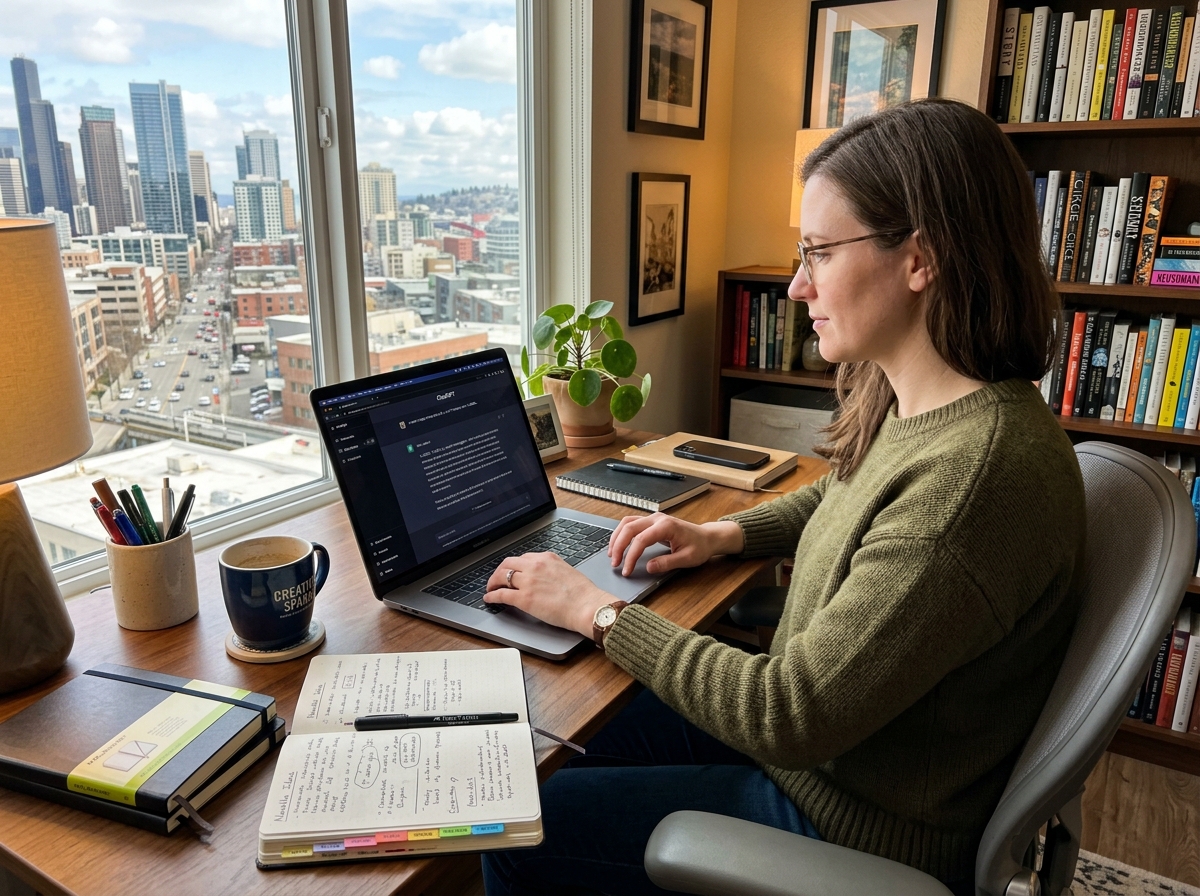
ChatGPT for writers is one of the fastest ways to generate ideas, break through creative blocks, and speed up your writing workflow — all without losing your unique voice.
Here’s a quick look at what it can help you do:
| Use Case | What ChatGPT Does |
|---|---|
| Idea generation | Brainstorms plots, characters, and premises on demand |
| Overcoming writer’s block | Suggests what happens next in a scene |
| Research | Summarizes topics, finds studies, and builds world details |
| Wordfinding | Suggests precise words, metaphors, and analogies in context |
| Marketing copy | Drafts book descriptions, headlines, and ad copy |
| Editorial feedback | Reviews beat sheets, outlines, and drafts for structure |
The results can be striking. One novelist drafted 35,000 words across two companion novels in just three weeks after using ChatGPT to generate outlines. Another writer replaced hours of Google searches and Wikipedia deep-dives with targeted AI research queries — freeing up more time for actual writing.
But ChatGPT is a tool, not a ghostwriter. The best results come when you stay in the driver’s seat.
I’m digitaljeff — futurist, content strategist, and founder of CheatCodesLab — and I’ve spent over 20 years at the intersection of technology, storytelling, and digital media, which gives me a front-row seat to how AI tools like ChatGPT for writers are reshaping the creative landscape. In this guide, I’ll break down exactly how to use it to sharpen your craft without losing what makes your writing yours.

Learn more about ChatGPT for writers:
Mastering ChatGPT for Writers: Techniques and Workflows
To truly harness ChatGPT for writers, we need to stop thinking of it as a “search engine” and start treating it as a highly literate, slightly caffeinated intern. It doesn’t just find information; it manipulates language to help us see our stories from new angles.

Plot Refinement and World-Building
When we are stuck in the “middle-of-the-book blues,” ChatGPT can act as a structural engineer. By feeding the AI our current plot points, we can ask it to identify “plot holes” or suggest three high-stakes complications that could arise from a specific character’s choice.
For world-building, the tool is a powerhouse. Instead of spending three hours researching the specific gravity of a fictional planet or the social hierarchy of a 14th-century merchant guild, we can prompt: “Given a society where water is the primary currency, describe five architectural features of a wealthy person’s home.” This moves us from dry research to atmospheric detail in seconds.
Dialogue Practice and Brainstorming Prompts
Dialogue can often feel “on the nose.” We can use ChatGPT to practice subtext. Try asking the AI to rewrite a scene where two characters are arguing about dinner, but the real tension is about a forgotten anniversary.
Here are a few effective chatgpt-writing-prompts to get the juices flowing:
- “Give me 10 unexpected story premises that juxtapose a high-tech future with ancient mythology.”
- “Act as a cynical detective. Critique this witness statement for inconsistencies.”
- “Suggest five sensory details for a scene set in a Victorian-era clockmaker’s shop.”
Overcoming Writer’s Block with ChatGPT for Writers
Writer’s block often stems from a lack of “next steps.” We find ourselves staring at a blinking cursor because the path forward is foggy. ChatGPT for writers clears the mist by providing narrative momentum.
One of the most effective techniques is the “Scene Summary Unblock.” If you are stuck at the end of Chapter 4, summarize what has happened so far and ask the AI: “Based on these events, what are three possible directions for the next scene that would increase the tension?” You don’t have to use its suggestions verbatim, but seeing the options often sparks the “real” idea in your own mind.
ChatGPT vs. Traditional Tools
While we love our dog-eared thesauruses, they are static. ChatGPT is dynamic. Here is how it stacks up against the old guard:
| Feature | Thesaurus/Google | ChatGPT for Writers |
|---|---|---|
| Context Awareness | Low (gives synonyms regardless of tone) | High (understands the mood of the sentence) |
| Speed | Medium (requires manual sifting) | Instant (generates tailored lists) |
| Creativity | None (provides data) | High (suggests metaphors and analogies) |
| Research | High (primary sources) | Medium (summaries; needs fact-checking) |
If you’re curious how it compares to other specific AI models, check out our breakdown of chatgpt-vs-claude.
Advanced Prompting for Plot and Character Development
To get the most out of ChatGPT for writers, we have to move beyond simple questions. We use “Advanced Prompting” to dive deep into the psyche of our characters.
The 10-Question Premise Instead of asking for a story idea, ask the AI to ask you questions. Use a prompt like: “I want to write a psychological thriller. Ask me 10 probing questions about the protagonist’s deepest fear and their greatest secret to help me build a premise.” This “reverse interviewing” technique ensures the story remains yours while the AI acts as the shovel to dig up the ideas.
Role-Playing and Conflict Generation We can instruct ChatGPT to “stay in character.” If you are writing a villain, ask the AI to respond to a hero’s plea for mercy in the voice of a cold, calculated antagonist. This helps us find the “voice” of our characters without burning through our own emotional energy.
For those in the comedy space, professional writers like Sarah Rose Siskind use AI to research “setups.” By asking for stereotypes or common tropes in a specific industry (like coding or deep-sea diving), writers can find the “truth” to subvert, which is the heart of all good humor.
Integrating ChatGPT for Writers into Professional Workflows
Professional writers don’t just use AI for the “fun stuff”; they use it for the “grind.”
- Editorial Feedback: Screenwriters like David Cornue use ChatGPT as a 24/7 writers’ room. You can paste a “beat sheet” (a summary of story beats) and ask: “Does the emotional arc of the protagonist feel earned here? Where does the pacing sag?”
- Marketing and Book Descriptions: Writing the book is hard; writing the “blurb” for Amazon is often harder. We use ChatGPT to draft multiple versions of book descriptions, focusing on different hooks (e.g., “The Romance Hook” vs. “The Mystery Hook”).
- Script Notes: You can ask the AI to role-play as a “veteran script doctor” to give you brutal feedback on your dialogue’s subtext.
For more hands-on help, our chatgpt-tutorials offer step-by-step guides on setting these workflows up.
Navigating the Ethics and Future of AI in Writing
As we embrace these tools, we must address the elephant in the room: ethics. Using ChatGPT for writers should feel like having a collaborator, not a replacement.
Research, Wordfinding, and the “Reverse Interview” Technique
One of the most powerful ways to use the tool ethically is for “wordfinding.” We’ve all had that moment where a word is on the tip of our tongue—a word that means “sad but in a nostalgic, slightly hopeful way.” Instead of a generic synonym, ChatGPT can provide “contextual synonyms.”
However, we must be wary of the “knowledge cutoff.” As of now, ChatGPT’s internal training data has a limit (often cited around late 2021 or 2023 depending on the version). It doesn’t know what happened this morning unless it has web-access features enabled. Even then, it can “hallucinate” facts. If it tells you a specific historical figure was in Paris in 1922, verify it. Treat AI research like a lead from a source who is occasionally prone to tall tales.
Privacy, Plagiarism, and the Human Creative Firewall
When using ChatGPT for writers, your “Moral Compass” is your best tool.
Data Security and Unpublished Work A major concern for authors is whether their unpublished manuscript will be “absorbed” into the AI’s collective brain. According to the OpenAI Privacy Policy, data sent via the consumer version of ChatGPT may be used to train future models unless you opt-out in settings.
The Human Creative Firewall To maintain originality, we recommend a “Creative Firewall” approach:
- Input ideas, not prose: Use the AI for brainstorming and structure.
- The “Golden Rule” of AI Text: If the AI writes a sentence, you must rewrite it. This ensures the rhythm, cadence, and “soul” of the writing remain yours.
- Check for Plagiarism: Because AI is trained on existing text, it can occasionally output phrases that are too close to existing works. Always run AI-assisted drafts through a plagiarism checker.
For more on the legalities, review the OpenAI Terms of Service.
The Future of Authorship in an AI-Driven Industry
The writing industry is changing. We are seeing a “market flooding” of low-quality, fully AI-generated books on platforms like Amazon. This can be scary, but it also creates an opportunity. As generic content becomes a commodity, human creativity becomes a luxury.
The writers who flourish will be those who adapt. By using ChatGPT for writers to handle the administrative and “pre-writing” tasks, we can spend more time on the deep, emotional work that machines can’t replicate.
At CheatCodesLab, we believe in empowering creators with certified AI tools for creators. We don’t want you to be replaced; we want you to be augmented.
Final Thoughts: Staying in the Driver’s Seat
ChatGPT for writers is the most significant leap in writing technology since the word processor. It can be your researcher, your editor, and your brainstorming partner. But remember: it doesn’t have a heart. It hasn’t felt heartbreak, it hasn’t tasted a perfect peach, and it doesn’t know the specific way your grandmother smelled of lavender and peppermint.
Use the AI to build the house, but you must be the one to live in it.
Ready to level up your content game? Explore our other guides:
By integrating these tools thoughtfully, you aren’t just writing faster—you’re writing smarter. See you at the finish line (or at least at the end of Chapter 10)!


About the author


How to Archive Posts on Instagram in 4 Easy Steps
Master archiving on Instagram in 4 easy steps to organize your profile and protect your content.

Beginner’s Guide to 10k free instagram followers app
Discover how a 10k free instagram followers app works, its risks, and safe organic growth strategies for real engagement in 2026.

Beginner’s Guide to Best Instagram Report App
Discover the best Instagram report app for real-time analytics, automated reports, and data-driven decisions in 2026.
How to Master Advanced SEO Search Techniques in 7 Steps
Master advanced search techniques in SEO with 7 proven steps to boost rankings, technical audits, and organic traffic.

Cheat Sheet to the Best Business Apps
Discover the best business apps to streamline operations, boost productivity, and scale your business in 2026.

How to Get Instagram Followers Free APK in 5 Steps
Discover how instagram followers free apk 2026 download works and learn safe organic growth strategies instead of risky third-party tools.
Related

The Complete Guide to BrightLocal Local SEO
Master BrightLocal local seo with rank tracking, citation management, and review tools to boost visibility in 2026.

The Best AI Tools to Help Nonprofits Get Funded
Discover top AI tools for fundraising to boost nonprofit revenue, donor engagement, and efficiency with predictive & generative AI.
How Machine Learning is Teaching Old Ads New Tricks
Discover how machine learning in digital advertising revolutionizes bidding, targeting, and personalization for superior ROI.

The Robots Are Writing Now and Other AI Content Marketing Software Secrets
Discover ai-driven saas-based content marketing software secrets. Boost SEO, scale workflows, and dominate 2026 trends now!

Ghost Murmur CIA
Ghost Murmur: The Quantum Blueprint for the Impossible Deep inside a fortified bunker in Tehran, an American soldier is breathing—and the CIA is watching that breath through a solid lead wall using a technology that technically shouldn’t exist. This isn't just a scene from a Tom Clancy novel; it’s the frontline of what CIA Director William J. Burns calls the "Technological Mission Center," a pivot where the agency is prioritizing quantum sensing to regain the edge in denied areas. We have officially entered the era of the Quantum Cold War, where physical barriers like concrete and distance are becoming obsolete. As the U.S. government pours $1.8 billion into the National Quantum Initiative to ensure "quantum supremacy," the line between hard science and the supernatural is blurring before our eyes. If you’re a solopreneur or a creator, you need to […]

Top 5 AI Risk Management Software for 2026
Discover top AI tools for risk management: MindBridge, RiskWise & more. Save 73% time, boost compliance with NIST AI RMF in 2026.