

ChatGPT and Google SEO: 2025’s Urgent Divide
The Great Traffic Vanish and the New Search Divide
ChatGPT and Google SEO are diverging, creating a new search divide that marketers must steer. Here’s the current landscape:
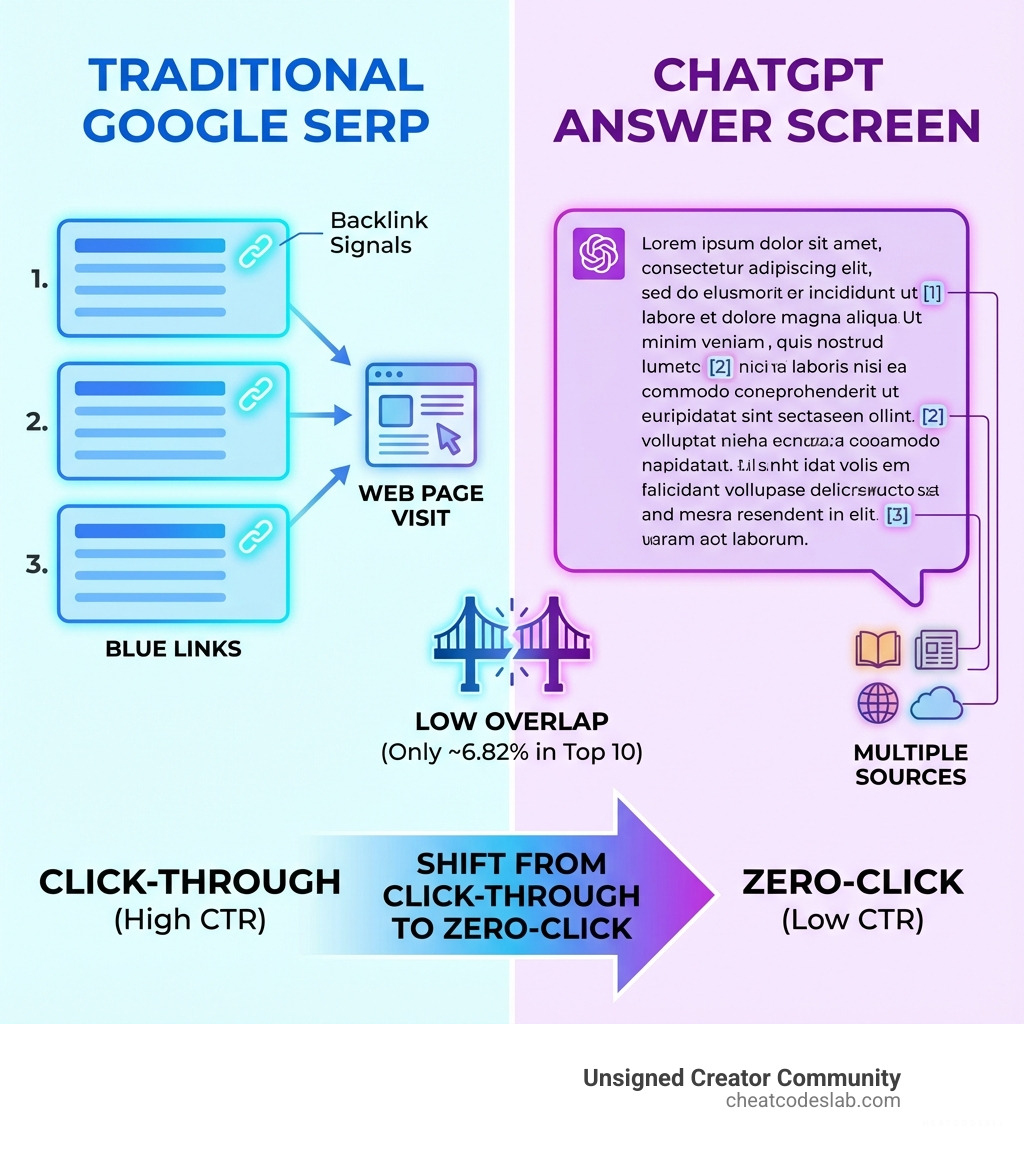
- Only 6.82% of websites ChatGPT cites appear in Google’s top 10 search results.
- Over 400 million people now use ChatGPT weekly, establishing it as a major traffic channel.
- Click-through rates can drop by up to 33% when AI summaries appear in search results.
- Over half of all searches now end in zero clicks—the “Great Traffic Vanish” is here.
- ChatGPT’s top sources rarely overlap with Google’s, especially for commercial queries.
The search landscape is splitting. Google, with 93% of organic traffic, ranks pages based on authority and technical SEO. ChatGPT synthesizes answers, often citing different sources than what appears on Google’s first page.
This creates a new challenge: your #1 Google ranking might mean nothing in ChatGPT. For queries like “best men’s running shoes,” the overlap with Google’s SERP is just 8-12%. Studies show a near-zero correlation (0.034) between Google rank and ChatGPT mention order.
This isn’t the death of SEO—it’s a call to evolve.
AI summaries are intercepting traffic before users visit your site, with informational content seeing declines of up to 64%. Traditional keyword rankings no longer guarantee visibility.
However, strong Google SEO still provides an advantage. Data shows a 61-62% overlap in presence between Google’s top results and ChatGPT’s sources. Ranking well on Google increases your chances of being cited, but the factors are shifting. ChatGPT prioritizes clear structure and credibility over backlinks alone.
As AI reshapes ChatGPT and Google SEO, creators and agencies must adapt their workflows to win on both fronts. Using data-driven strategies and AI-powered tools is key to staying ahead of the curve.
Must-know ChatGPT and Google SEO terms:
Navigating the New Frontier of ChatGPT and Google SEO
The emergence of AI chatbots like ChatGPT has created a new dichotomy in online information retrieval. We are no longer just optimizing for search engines but also for “answer engines.” This requires a dual strategy to ensure visibility in both traditional search and AI-driven responses.
Google’s Ranking vs. ChatGPT’s Reasoning: Two Different Worlds
Google and ChatGPT have fundamentally different approaches. Google’s algorithm ranks web pages based on hundreds of factors like backlinks, site authority, and E-E-A-T (Experience, Expertise, Authoritativeness, Trustworthiness). Its goal is to deliver a list of the most relevant pages.
ChatGPT, a large language model (LLM), synthesizes information to generate a direct, conversational answer. It doesn’t rank pages; it processes its training data and live web results to construct a response, often with citations. In short, Google gives you links to find answers, while ChatGPT gives you the answer directly.
This difference leads to a low overlap in sources. For commercial queries like “Best men’s running shoes?”, the overlap is only ~8%, and for informational queries like “How do I invest in stocks?”, it’s ~12%. This means a top Google ranking doesn’t guarantee a mention in ChatGPT. Interestingly, ChatGPT’s search results show a 73% similarity to Bing’s, suggesting that optimizing for Bing can indirectly improve your chances of being cited.
Despite these differences, both platforms reward clear, trustworthy, and well-structured content. This underscores the need for a holistic AI Driven Content Creation strategy that is both human-centric and AI-friendly.
What is Generative Engine Optimization (GEO)?
The rise of AI has created new disciplines: Answer Engine Optimization (AEO) and Generative Engine Optimization (GEO). GEO specifically focuses on optimizing content to be used, cited, and summarized by AI systems like ChatGPT. This is critical because over half of all searches are now zero-click, and generative summaries can cause traffic to decline by up to 64%.
Here’s how GEO differs from traditional SEO:
| Feature | Traditional SEO | Generative Engine Optimization (GEO) |
|---|---|---|
| Goal | Rank web pages, drive clicks and traffic | Get content cited/summarized by AI, shape AI responses |
| Key Factors | Keywords, backlinks, technical SEO, E-E-A-T, UX | Citable content, structured data, entity signals, clarity |
| Measurement | Rankings, organic traffic, CTR, conversions | AI mentions, sentiment, visibility in AI summaries |
| Content Focus | Comprehensive articles, keyword-rich pages | Concise answers, definitions, bullet points, FAQs |
| Technical | Crawlability, indexing, site speed, mobile-friendly | Machine-readable signals, schema, OpenAI/Bing bot access |
GEO involves creating “citable content” with clear headings, bullet points, and concise definitions that are easy for an LLM to quote. It also requires technical visibility for AI crawlers (like OAI-SearchBot) and ensuring your sitemap is submitted to Bing. This new approach makes strategies for AI for SEO Content increasingly vital.
A Unified Strategy: How to Win on Both Platforms
A unified strategy is essential. The goal is to create content that ranks well on Google while also being highly citable for AI.
- Content Quality and E-E-A-T: High-quality, trustworthy content is paramount for both. Adhering to Google’s E-E-A-T Guidelines by using expert authors and citing sources builds credibility for search engines and AI.
- Structured Data: Use a Schema Markup Guide to explicitly tell search engines and AI what your content is about. Marking up FAQs and how-to guides improves how AI processes and cites your information.
- Brand Authority: Strengthen your brand’s entity signals with consistent naming and topic associations across the web. AI models recognize this “semantic authority” beyond just backlinks.
- Conversational Tone: Write in a natural, easy-to-understand tone. This aligns with user experience priorities for Google and is the native language of ChatGPT.
- FAQs and Summaries: Include clear FAQs and summaries. These can become featured snippets on Google and provide easily extractable answers for AI.
- Original Research: Create unique, data-rich content. Original statistics and findings offer value that AI cannot simply replicate, improving visibility in LLM responses. A strong Content Creation Workflow is key to producing this material.
Optimizing for both ChatGPT and Google SEO means balancing Google’s focus on authority with ChatGPT’s preference for clear, citable content. A fast, secure, and mobile-friendly website remains a foundational requirement for all online visibility.
Your Action Plan: Future-Proofing for the AI Era
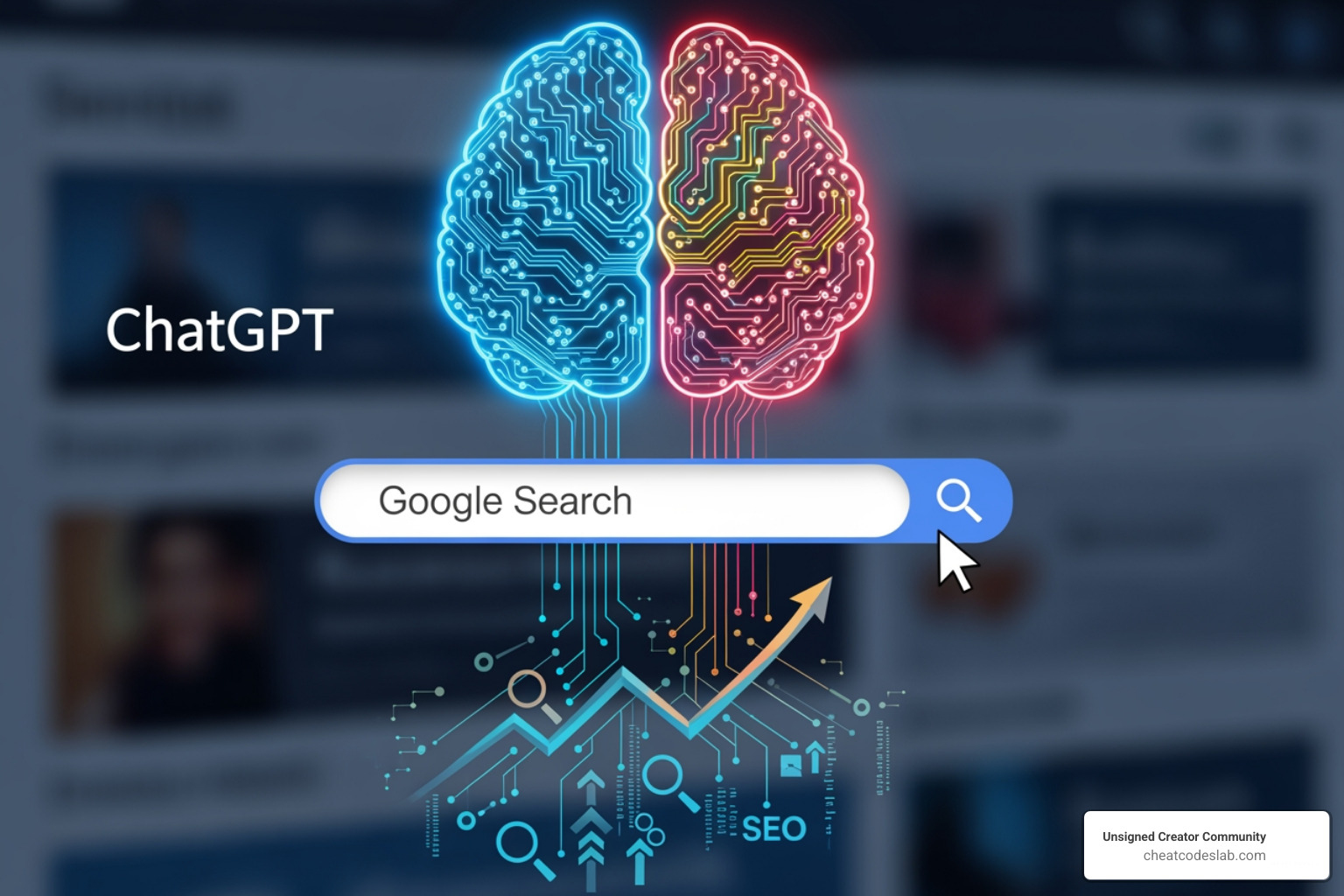
The shift to AI-driven search is here. Future-proofing your business requires a hybrid approach that integrates traditional SEO with AI-centric optimization. At CheatCodesLab, we can help you steer this evolving landscape.
The AI SEO Readiness Checklist
Use this checklist to improve your visibility across both Google and ChatGPT:
- Audit AI Visibility: Regularly ask AI tools like ChatGPT questions about your business and services to understand your current visibility and find gaps.
- Optimize for Bing: Since ChatGPT’s search results are 73% similar to Bing’s, submit your sitemap to Bing via the webmaster tool and improve your rankings there.
- Create Citable Content: Structure content with concise definitions, bullet points, and clear paragraphs that are easy for an AI to quote. Answer questions directly in the first 100 words.
- Implement Structured Data: Use schema markup (FAQPage, HowTo, etc.) to help Google and AI tools understand your content, increasing your chances of being featured.
- Build Brand Mentions: Encourage mentions on credible sites like industry publications and forums. Consistent brand information across the web builds authority for AI.
- Ensure Technical Visibility: Check your robots.txt file to ensure you aren’t blocking AI crawlers like OAI-SearchBot. Maintain a fast, mobile-friendly site.
- Update Content Regularly: Keep content fresh and accurate, as AI models prefer up-to-date information. Signal updates with visible “updated-on” dates.
- Strengthen E-E-A-T: Demonstrate your expertise and trustworthiness with expert authors, original research, and cited sources.
- Optimize Local Listings: For local businesses, keep listings on Google Business Profile, Yelp, and Apple Maps updated, as AI often uses them for recommendations.
- Publish in Multiple Formats: Repurpose content into videos, podcasts, and infographics with descriptive text and transcripts to make them AI-friendly.
These steps help you shape how AI perceives your brand and pave the way for Advanced SEO Techniques in the AI era.
Using AI as Your Ally for Traditional SEO
While optimizing for AI, you can also use it to improve traditional SEO workflows:
- Schema Generation: Prompt ChatGPT to create schema markup for different content types, saving time. Always validate the code before deployment.
- Keyword Clustering: Use AI to group large keyword lists into semantic clusters to better plan your content strategy. The API can handle large datasets for more advanced AI Tools for SEO solutions.
- Meta Description Creation: Quickly generate compelling meta descriptions by feeding page content and keywords into ChatGPT.
- Content Brief Outlines: Generate detailed content outlines to give writers a structured starting point, ensuring all key topics are covered.
- Workflow Automation: Integrate AI with tools like Zapier and Google Sheets to automate tasks like creating content briefs from a list of keywords.
Embracing AI as an assistant frees up time for strategy and the creative insights that only humans can provide.
The Future is Hybrid: Why You Can’t Choose Just One
The question “Is SEO dead?” has been asked countless times. The answer is no, but it has evolved into Generative Engine Optimization. The search landscape now demands a hybrid approach, as Google and ChatGPT serve complementary roles. Relying solely on Google rankings will lead to diminishing traffic as zero-click searches and AI summaries become more common.
Google itself is integrating AI with features like AI Overviews, making GEO strategies crucial even within its own ecosystem. Optimizing for both ChatGPT and Google SEO is essential for long-term brand building.
This dual approach helps you:
- Maximizing Visibility: Reach users whether they start their search on Google, ChatGPT, or another AI-powered assistant.
- Maintaining Authority: Establish your brand as a credible source for both traditional search engines and AI models.
- Adapting to User Behavior: Cater to users who prefer quick, summarized answers and those who want to deep-dive into detailed articles.
Success is no longer just about clicks. It’s about tracking AI mentions and brand sentiment. Brands that are consistently recognized as authorities on specific topics will win. By embracing a dual optimization strategy, you ensure your content is not only findable but also influential. Get started with the best AI Apps to stay ahead and thrive in the new era of search.


About the author


How to Archive Posts on Instagram in 4 Easy Steps
Master archiving on Instagram in 4 easy steps to organize your profile and protect your content.

Beginner’s Guide to 10k free instagram followers app
Discover how a 10k free instagram followers app works, its risks, and safe organic growth strategies for real engagement in 2026.

Beginner’s Guide to Best Instagram Report App
Discover the best Instagram report app for real-time analytics, automated reports, and data-driven decisions in 2026.
How to Master Advanced SEO Search Techniques in 7 Steps
Master advanced search techniques in SEO with 7 proven steps to boost rankings, technical audits, and organic traffic.

Cheat Sheet to the Best Business Apps
Discover the best business apps to streamline operations, boost productivity, and scale your business in 2026.

How to Get Instagram Followers Free APK in 5 Steps
Discover how instagram followers free apk 2026 download works and learn safe organic growth strategies instead of risky third-party tools.
Related

The Complete Guide to BrightLocal Local SEO
Master BrightLocal local seo with rank tracking, citation management, and review tools to boost visibility in 2026.

The Best AI Tools to Help Nonprofits Get Funded
Discover top AI tools for fundraising to boost nonprofit revenue, donor engagement, and efficiency with predictive & generative AI.
How Machine Learning is Teaching Old Ads New Tricks
Discover how machine learning in digital advertising revolutionizes bidding, targeting, and personalization for superior ROI.

The AI Muse: A Writer’s Guide to ChatGPT
Unlock ChatGPT for writers: Master prompts, beat writer's block, build plots, characters & workflows ethically.

The Robots Are Writing Now and Other AI Content Marketing Software Secrets
Discover ai-driven saas-based content marketing software secrets. Boost SEO, scale workflows, and dominate 2026 trends now!

Ghost Murmur CIA
Ghost Murmur: The Quantum Blueprint for the Impossible Deep inside a fortified bunker in Tehran, an American soldier is breathing—and the CIA is watching that breath through a solid lead wall using a technology that technically shouldn’t exist. This isn't just a scene from a Tom Clancy novel; it’s the frontline of what CIA Director William J. Burns calls the "Technological Mission Center," a pivot where the agency is prioritizing quantum sensing to regain the edge in denied areas. We have officially entered the era of the Quantum Cold War, where physical barriers like concrete and distance are becoming obsolete. As the U.S. government pours $1.8 billion into the National Quantum Initiative to ensure "quantum supremacy," the line between hard science and the supernatural is blurring before our eyes. If you’re a solopreneur or a creator, you need to […]