


ChatGPT keyword research: Ultimate Guide 2026
Why ChatGPT Keyword Research is Changing Content Strategy
ChatGPT keyword research is changing how marketers find keyword opportunities. Instead of using expensive tools or spreadsheets, you can brainstorm keywords, find long-tail variations, and explore user intent through simple AI conversations.
Here’s what ChatGPT can do for your keyword research:
- Generate keyword ideas – Create lists of primary and related keywords.
- Find long-tail keywords – Uncover specific, lower-competition phrases.
- Identify question-based keywords – Surface the exact questions your audience is asking.
- Analyze search intent – Categorize keywords by user intent.
- Create keyword clusters – Group related terms for content planning.
- Extract competitor themes – Analyze competitor content to find keyword patterns.
What ChatGPT cannot do:
- Provide real-time search volume or difficulty scores
- Access live SEO metrics
- Replace traditional keyword research tools entirely
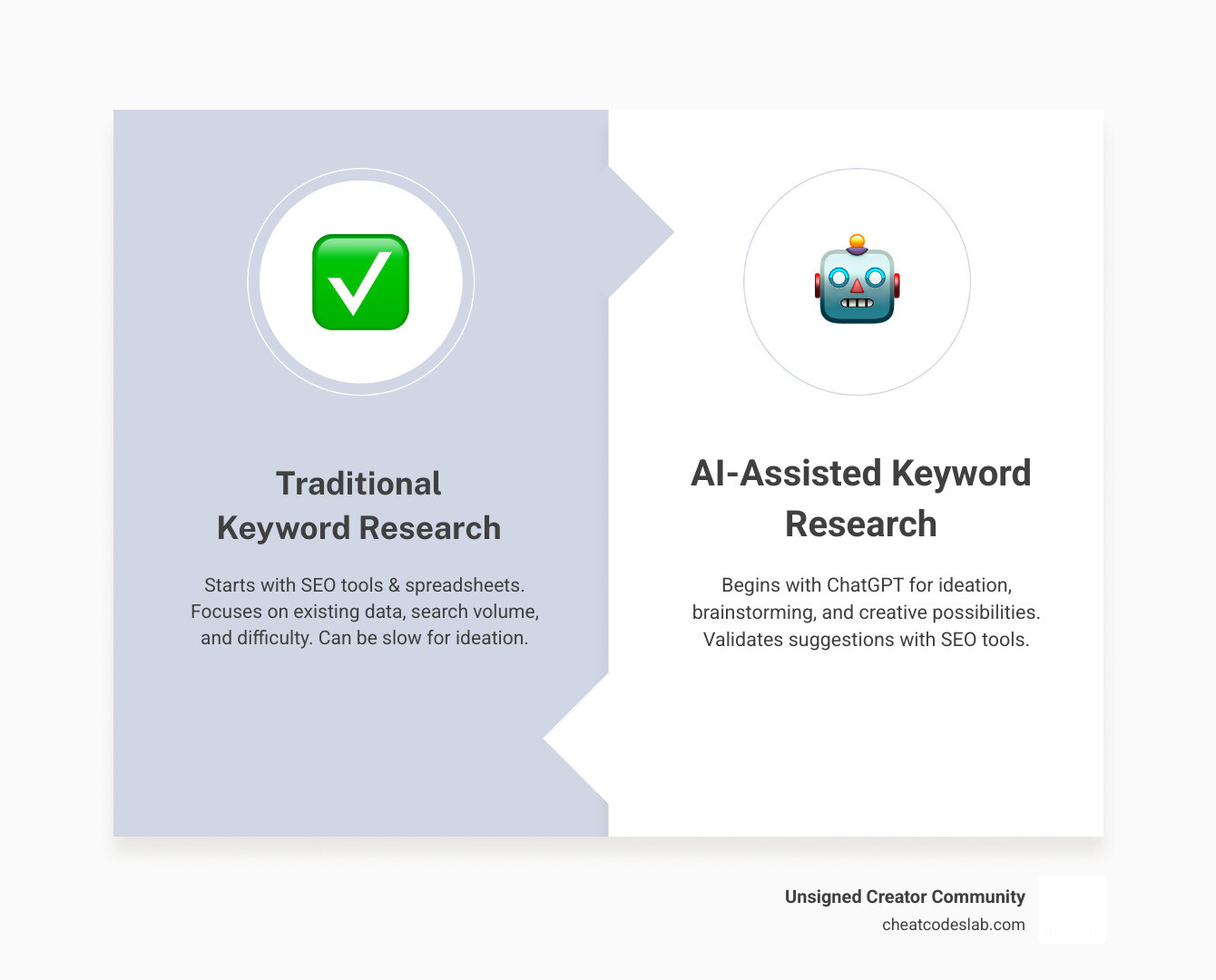
ChatGPT is an ideation engine for the start of your research. You still need to validate its suggestions with dedicated SEO tools, but AI speeds up brainstorming and helps you find new angles.
The key insight? ChatGPT’s suggestions are based on language patterns, not ranking data. This means it can find creative keywords that traditional tools miss, but it can also suggest terms with zero search demand. Validation is key.
I’m digitaljeff, a content strategist who has helped top brands build scalable content strategies. Now, I’m applying those lessons to ChatGPT keyword research. This guide will show you how to integrate AI into your keyword workflow while maintaining a data-driven SEO foundation.
Relevant articles related to ChatGPT keyword research:
Mastering ChatGPT Keyword Research: A Step-by-Step Guide
This section will guide you through integrating ChatGPT keyword research into your workflow to make it more efficient and insightful. AI handles the heavy lifting of ideation, allowing you to focus on strategy and validation. ChatGPT is a powerful assistant, but the final decisions are yours. For more ways to integrate AI, explore our AI Tools for Website SEO.

Understanding ChatGPT’s Role and Limitations
ChatGPT is an advanced Large Language Model (LLM) from OpenAI. It excels at Natural Language Processing, meaning it understands and generates human-like text based on your input.
For keyword research, ChatGPT functions as an “ideation powerhouse.” It generates creative and diverse keyword suggestions faster than many manual methods, helping you brainstorm topics, find unique angles, and uncover audience questions. This speeds up the initial stages of keyword findy.
However, ChatGPT has critical limitations. It lacks real-time search volume data, keyword difficulty scores, and live traffic estimates. Its knowledge has a cutoff date, so it is unaware of the latest trends. This means it can suggest keywords with no search demand or present plausible but incorrect information.
Here is a quick comparison to highlight the differences:
| Feature | ChatGPT (Ideation Engine) | Traditional SEO Tools (e.g., keyword planners, rank trackers) |
|---|---|---|
| Primary Function | Idea generation, brainstorming, creative suggestions | Data analysis, metric provision, competitive benchmarking |
| Data Source | Language patterns, contextual understanding, training data | Search data, historical trends, competitor rankings |
| Output Type | Keyword lists, questions, topic clusters, intent classifications | Search volume, keyword difficulty, CPC, traffic estimates |
| Strengths | Creativity, speed of ideation, uncovering niche phrasing | Accuracy of metrics, competitive insights, data validation |
| Weaknesses | No live metrics, potential for incorrect assumptions, data cutoff | Can be overwhelming, less creative for initial ideation |
In short, use ChatGPT for brainstorming and ideation. For hard data like search volume and competition, you must use dedicated SEO tools. The relationship is complementary, not a replacement.
Crafting Effective Prompts for Your First ChatGPT Keyword Research
Effective ChatGPT keyword research depends on good prompts. The better your instructions, the better the output. Here are best practices:
- Define Your Persona: Tell ChatGPT to “Act as an SEO specialist for a [niche]…” to set the context.
- State Your Objective: Be clear. “Generate a list of primary keywords for a blog about [topic].”
- Provide Context: Add details about your target audience or product.
- Use Iterative Questioning: Start broad, then ask follow-up questions to narrow the results.
- Specify Output Format: Ask for a table or list to organize the output.
- Request Explanations: Ask why it chose certain keywords for deeper insight.
- Provide Examples: Give an example of the keyword type you want.
- Be Prepared to Refine: Ask for revisions if the first output is not aligned with your needs.
Here are some starter prompt formulas:
- Primary Keyword Ideas: “Act as an SEO specialist. Generate a list of primary keywords for a blog about [topic].”
- Long-Tail Keywords: “Based on the primary keyword ‘[primary keyword]’, generate 20 long-tail keyword ideas.”
- Question-Based Keywords: “What are 15 common questions people ask on Google related to ‘[topic]’?”
- Audience-Specific Keywords: “Revise the previous list of keywords for the audience ‘[specific audience, e.g., ‘small business owners’]’.”
Prompt engineering improves with practice. To learn more, check out our guide on How to Use ChatGPT.
Applying ChatGPT to the Keyword Research Workflow
Now let us integrate ChatGPT into a practical keyword research workflow.

-
Ideation and Seed Keyword Generation:
This is where ChatGPT excels. Instead of starting with a single term in a tool, you can have a structured conversation. Start with a broad prompt like, “What are some keyword ideas for a blog about sustainable living?” Then, drill down: “Expand on ‘eco-friendly home products’ with specific product examples.” This quickly builds a foundation of seed keywords and uncovers new angles. -
Long-Tail Keyword Generation:
Long-tail keywords often have lower competition and clearer user intent. ChatGPT is effective at suggesting them. Feed it a primary keyword and ask for longer, more specific phrases.
Prompt: “Generate 20 long-tail keywords related to ‘vegan meal prep for busy professionals’.” -
Question-Based Keywords:
Many searches are questions. ChatGPT can generate these for you.
Prompt: “What questions do people ask about a ‘beginner’s guide to cryptocurrency investment’?” This helps create user-centric content that directly answers audience needs. -
Competitor Text Analysis (Ethical and Public Data):
While ChatGPT cannot scrape websites, it can analyze public content that you provide. Copy the text from a top-ranking article and use a prompt like:
Prompt: “Act as an SEO analyst. Analyze the following text and extract the top 15 keywords and themes. Suggest any content gaps. [Paste article text here]”. This supports a quick, high-level competitive analysis based on accessible information. -
Extracting Themes and Subtopics:
ChatGPT can identify themes and subtopics within a niche. Ask it to generate conference topics for a persona or analyze social media discussions (by providing the text) to find trending angles. This is valuable for planning content clusters.
Advanced Techniques: Keyword Clustering and Content Gap Analysis
ChatGPT can also assist with more sophisticated strategies like keyword clustering and content gap analysis.
-
Keyword Clustering:
Keyword clustering involves grouping related keywords by shared intent or topic to build topical authority. ChatGPT can assist by grouping by intent or topic.- Grouping by Intent:
Prompt: “Take this list of keywords and classify the search intent for each: [list of keywords].” -
Grouping by Topic:
Prompt: “I am planning content for a blog about sustainable travel. Group these keywords into 5-7 main content categories: [list of keywords].”This helps build out your content structure. Learn more about Hubspot Content Clusters.
- Grouping by Intent:
-
Content Gap Analysis:
A content gap analysis identifies topics your competitors rank for but you do not. While SEO tools are essential for detailed data, ChatGPT can help ideate gaps.- Ideating Gaps:
Prompt: “My website covers [describe existing content]. What related topics or questions am I missing?” -
Advanced Data Analysis:
With ChatGPT Plus, you can upload Google Search Console reports and ask it to find keywords with “high impressions but low clicks” or those ranking on page two. These indicate optimization opportunities.This helps pinpoint new content ideas. For more, explore our guide on Content Gap Analysis and Advanced SEO Techniques.
- Ideating Gaps:
Uncovering User Intent and Localized Keywords
Understanding user intent, the “why” behind a search, is crucial. The four main types are Informational, Navigational, Commercial Investigation, and Transactional. ChatGPT can classify keywords by intent, helping you tailor content to user needs.
Prompt: “For the following keywords, identify the user intent: [list of keywords].”
For local businesses, ChatGPT can generate location-specific keywords.
Prompt: “Generate 15 localized keyword ideas for a ‘vegan bakery’ in ‘Brooklyn, New York’.” This is valuable for local SEO. Learn more with our Local SEO Techniques.
For those with ChatGPT Plus, the Advanced Data Analysis feature can support deeper research. You can upload CSVs from Google Search Console and ask ChatGPT to analyze them.
Prompt: “I have uploaded my GSC report. Identify queries with high impressions but low clicks (CTR < 2%) where my site ranks between positions 5-10." This blends AI's pattern recognition with your site's real-world data.
Scaling, Validating, and Finalizing Your Keyword List
After brainstorming with ChatGPT, you must validate its suggestions.
-
QA and Validation Process:
ChatGPT’s ideas are directionally useful, not data-accurate. You must validate its output.- Cross-Reference with SEO Tools: Run every key suggestion through an SEO tool to get search volume and difficulty data.
- Check for Search Demand: Ensure people are actually searching for the keyword.
- Assess Difficulty: Compare keyword difficulty to your site’s authority and resources.
- Prioritize: Refine your list and prioritize based on an opportunity score (for example, solid volume and manageable difficulty).
Always apply critical judgment rather than accepting AI output at face value.
-
Ethical Considerations and Potential Pitfalls:
Be aware of these pitfalls:- AI Over-Reliance: Do not skip validation with real data.
- Data Privacy: Be careful with proprietary or sensitive information you input into the AI.
- Bias: AI models can reflect biases from their training data. Review outputs with this in mind.
- Incorrect Assumptions: Always fact-check information that influences strategy.
-
Scaling with the OpenAI API:
For larger projects, the OpenAI’s ChatGPT API allows you to automate tasks, process large keyword lists, and build custom tools. Our ChatGPT API Tutorial Guide can help you start. -
Future Implications for SEO:
AI’s evolution signals a shift in SEO. Expect increased efficiency in ideation, smarter content creation aligned with user intent, and a greater need for SEOs to focus on strategy and critical evaluation of AI output.
Conclusion: Integrating AI into Your SEO Workflow
The landscape of SEO is continually evolving, and the advent of AI tools like ChatGPT marks another pivotal moment. We’ve explored how ChatGPT keyword research isn’t about replacing the foundational principles of SEO, but rather enhancing them. It’s an indispensable partner for ideation, uncovering creative angles, generating long-tail keywords, understanding user intent, and even performing preliminary competitive and content gap analyses.
Our journey through this guide has demonstrated that while ChatGPT cannot provide the raw, real-time data of dedicated SEO tools, its power in generating ideas and structuring our thinking is unparalleled. The optimal approach involves a synergistic workflow: leveraging ChatGPT for its creative and analytical prowess in the initial stages, and then validating its suggestions with the robust data provided by traditional SEO platforms. This AI-driven strategy allows us to build comprehensive content calendars, fuel our content creation workflow, and ultimately achieve better search engine rankings.
By embracing this hybrid approach, we’re not just staying current; we’re future-proofing our SEO efforts. The key is continuous learning, smart tool integration, and always applying our expert human judgment to the insights generated by AI. At CheatCodesLab, we’re committed to providing you with the knowledge and tools to steer this exciting new era of digital marketing.
Ready to boost your SEO with the latest AI innovations? Explore more AI Apps and Tools and refine your AI-Driven Content Strategy with us.


About the author


How to Archive Posts on Instagram in 4 Easy Steps
Master archiving on Instagram in 4 easy steps to organize your profile and protect your content.

Beginner’s Guide to 10k free instagram followers app
Discover how a 10k free instagram followers app works, its risks, and safe organic growth strategies for real engagement in 2026.

Beginner’s Guide to Best Instagram Report App
Discover the best Instagram report app for real-time analytics, automated reports, and data-driven decisions in 2026.
How to Master Advanced SEO Search Techniques in 7 Steps
Master advanced search techniques in SEO with 7 proven steps to boost rankings, technical audits, and organic traffic.

Cheat Sheet to the Best Business Apps
Discover the best business apps to streamline operations, boost productivity, and scale your business in 2026.

How to Get Instagram Followers Free APK in 5 Steps
Discover how instagram followers free apk 2026 download works and learn safe organic growth strategies instead of risky third-party tools.
Related
How to Archive Posts on Instagram in 4 Easy Steps
Master archiving on Instagram in 4 easy steps to organize your profile and protect your content.

Beginner’s Guide to Best Search Engine Optimization SEO
Master best search engine optimization SEO with this beginner's guide covering on-page, technical, and AI strategies for higher rankings.

Ultimate Checklist for Social Media Marketing Agency
Discover the ultimate checklist for choosing a social media marketing agency that drives real ROI and growth.

Hot Summer Caption Ideas That Spark Engagement
Discover hot summer caption ideas that boost engagement, from short aesthetic lines to funny unhinged vibes and beach photo dumps.

How to Add Text to Instagram Story in 5 Easy Steps
Learn how to add text to Instagram Story in 5 easy steps with our native tips and creative text hacks for better engagement.

How to Add Audio to Instagram Story the Right Way
Learn how to add audio clip in Instagram Story using built-in music or your own file with this step-by-step guide.