


Snorkel, Dive, Shoot: Top Underwater Cameras for Every Adventure
Why Choosing the Right Underwater Camera Matters
The best camera for underwater photography depends on your specific needs, but here are the top picks across categories:
| Category | Top Pick | Best For | Key Feature |
|---|---|---|---|
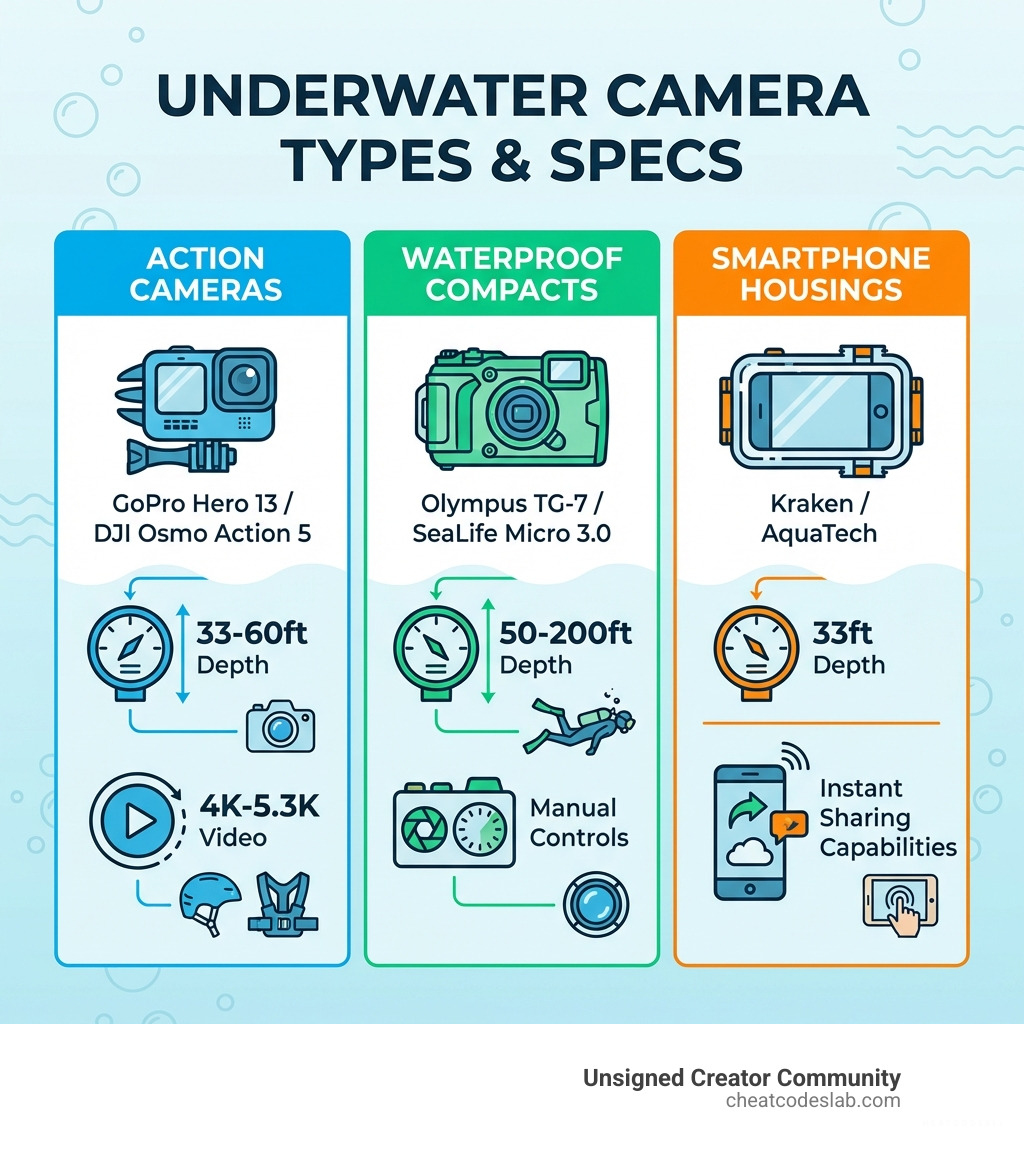
| Best Overall | GoPro Hero 13 Black | Snorkeling & versatility | 5.3K video, 33ft waterproof |
| Best for Diving | SeaLife Micro 3.0 | Scuba up to 200ft | Piano key buttons, permanent seal |
| Best Value | Canon G7X Mark III | Manual controls on budget | 20.1MP 1-inch sensor |
| Best Macro | Olympus TG-7 | Close-up marine life | Waterproof to 50ft, ring lights |
| Best Budget | Smartphone + waterproof housing | Casual use | Instant sharing, familiar interface |
Whether you’re snorkeling with sea turtles or diving deep on a scuba expedition, the right camera can transform fleeting underwater moments into stunning visual memories. The ocean presents unique challenges—limited light at depth, color loss in blue water, moving subjects, and the constant threat of water damage. Modern underwater cameras have evolved far beyond basic waterproof point-and-shoots. Today’s options range from rugged action cameras with 4K stabilization to professional compact systems with 1-inch sensors and RAW capability.
Traditional waterproof compacts offer optical zoom and manual controls for still photography. Action cameras like GoPro excel at smooth video with features like HyperSmooth stabilization and hydrophobic lenses. Smartphone housings provide a budget-friendly entry point with instant shareability. Professional divers often choose dedicated underwater compacts that operate at depths beyond 200 feet with specialized features like manual white balance and permanent seals.
The gap between these categories has narrowed significantly. Action cameras now shoot 27MP stills extracted from 5.3K video. Budget full-frame mirrorless systems deliver professional image quality at entry-level prices. Even smartphone housings incorporate vacuum seals and leak detection technology that rivals dedicated underwater gear.
Key specs matter more underwater than in regular photography. Sensor size determines low-light performance when natural light fades at depth. Video resolution and frame rates capture fast-moving marine life. Battery life impacts how long you can shoot during extended dive sessions. Waterproof depth ratings dictate whether you need additional housing. Manual controls and RAW format enable proper color correction in post-processing.
I’m digitaljeff, and over the past 20 years producing content across 74+ locations worldwide, I’ve tested countless camera systems in challenging environments—from mobile livestreaming pioneers to documentary work in Japan. Finding the best camera for underwater adventures requires balancing technical specs with real-world durability and ease of use, which I’ll break down in this guide.
Key Best camera for underwater vocabulary:
Choosing the Best Camera for Underwater Photography and Video
When we dive into underwater imaging, we aren’t just looking for a device that won’t leak; we are looking for a tool that can handle the physics of water. Water absorbs light rapidly, starting with red and orange wavelengths, which is why your photos often end up looking like a blurry soup of blue and green. To combat this, the best camera for underwater use must have specific technical capabilities.
First, let’s talk about sensor size. In photography gear, size truly matters. A 1-inch sensor, like the one found in the Sony RX100 VA or the Canon G7X III, is significantly larger than the sensors found in standard smartphones or older action cams. This larger surface area allows the camera to “see” better in the dim conditions found just a few meters below the surface.
Resolution is another major factor. While 4K has become the standard, many of the top-rated cameras now offer 5.3K or even 8K resolution. This isn’t just for showing off on a giant TV; higher resolution allows for “frame grabs.” For instance, with the GoPro Hero 12, you can pull a sharp 24.7MP still image directly from your video. This is a game-changer for snorkelers who find it difficult to time a shutter press while holding their breath.
| Feature | Action Camera | Compact Camera |
|---|---|---|
| Primary Use | High-action video | Detailed stills & macro |
| Lens Type | Fixed wide-angle | Optical zoom |
| Depth (no housing) | 33ft – 60ft | 50ft – 200ft |
| Stabilization | Electronic (Excellent) | Optical/Digital (Good) |
| Manual Control | Limited | Full Manual / RAW |
For those looking to get serious, the ability to shoot in RAW format is non-negotiable. RAW files preserve all the data captured by the sensor, allowing us to fix the white balance and recover colors during post-processing. Without RAW, you’re stuck with whatever “blue” the camera’s computer decided was correct. If you are just starting your journey, checking out a guide on best photography gear can help you understand these fundamentals.
Key Features of the Best Camera for Underwater Snorkeling
Snorkeling is all about light and ease of use. Since you are staying near the surface, you have plenty of natural sunlight, but you are also dealing with surface surge and bubbles. This is where the GoPro Hero 13 Black (and its predecessor, the Hero 12) shines as the best camera for underwater snorkeling.
One of our favorite features is the hydrophobic lens coating. There is nothing more frustrating than getting out of the water to find a giant water droplet obscured your once-in-a-lifetime shot of a whale shark. These lenses shed water instantly, ensuring clear shots the moment you break the surface.
Furthermore, the HyperSmooth stabilization in action cameras is almost magical. It smooths out the jitters caused by swimming or wave action, making your footage look like it was shot on a professional gimbal. For the social media savvy, the “Vertical Capture” mode allows you to film in 9:16 aspect ratio without having to rotate the camera—perfect for instant Reels or TikToks.
When setting up for a snorkeling trip, we always recommend a few beginner camera gear essentials. A floating grip handle (like The Handler) is a must-have; it ensures that if you drop your camera, it bobs to the surface with its bright orange tip facing up rather than sinking to the abyss.
Professional Specs for the Best Camera for Underwater Diving
Scuba diving changes the requirements entirely. Once you pass the 33-foot mark, most action cameras require an external protective housing. However, the SeaLife Micro 3.0 is a unique beast. It is depth-rated to 200 feet (60 meters) right out of the box with no O-rings to maintain and no ports to leak. It features a permanent seal, which is a massive relief for divers who have “flooded” cameras in the past.
Professional divers also need “piano key” buttons. When you are 60 feet down wearing thick neoprene gloves, trying to use a touchscreen or tiny dials is a nightmare. The SeaLife’s large, tactile buttons allow for easy navigation even in challenging conditions.
Another pro feature to look for is manual white balance. As you go deeper, the red light disappears. A camera that allows you to perform a “one-touch” white balance against a white slate or your hand will give you much more natural colors than any “auto” mode. This level of control is why many pros invest in professional camera equipment that can grow with their skill level.
Essential Accessories for Underwater Performance
The camera is only half the story. To truly capture the vibrant colors of a reef, you need the right accessories.
- Filter Kits: A filter kit is the most cost-effective way to improve your images. Red filters are essential for blue water, while magenta filters help in green, algae-rich water. These filters “trick” the camera into seeing the colors that the water has absorbed.
- Lighting: Once you go deep, even the best filters can’t help. High-lumen video lights, such as the Bigblue VL11000PB-RCP (11,000 lumens), are necessary to bring out the true reds of coral and fish.
- Storage: High-resolution video eats through storage. We use the SanDisk Extreme 256 GB because it has the write speeds necessary for 5.3K video without stuttering.
- Power: Cold water drains batteries fast. The GoPro Enduro batteries are claimed to last up to 70 minutes at 5.3K, which is a significant upgrade over standard cells.
For a deeper dive into how to modify your lens for different environments, see our guide on the best camera lens filters.
Maximizing Your Results with Smartphone Housings and Action Cams
We are living in an era where smartphones just might be the future of underwater photography. For the casual traveler, buying a dedicated $500 camera might not make sense when the iPhone in their pocket already has a world-class sensor.
Smartphone housings like the Torras IP68 Certified Waterproof Bag or the more advanced SeaLife SportDiver offer a way to take your phone down to the reef. The high-end housings feature vacuum seals and leak detection systems. You use a small pump to remove the air, creating a vacuum; if the seal breaks, an alarm sounds before water can get in.
The biggest advantage of using a smartphone is instant shareability. You can edit your photos in Lightroom Mobile and post them to Instagram before your hair is even dry. However, phones rely heavily on digital zoom, which can lead to grainy images underwater. If you’re traveling light, choosing the best camera bag for travel photographer can help keep your housing and phone safe during transit.
Action Cameras vs. Compact Waterproof Cameras
The debate between action cams and compacts usually comes down to “Video vs. Stills.”
Action cameras are built for the “set it and forget it” crowd. They offer incredible mounting options—you can strap them to your head, your chest, or even a sea scooter. Their electronic image stabilization is second to none. However, they usually have fixed wide-angle lenses. If you want to take a photo of a tiny nudibranch (a colorful sea slug), an action camera will struggle because it can’t focus closely.
Compact waterproof cameras, like the Olympus TG-6 or the newer TG-7, are the kings of “Macro” (close-up) photography. The TG series features a “Microscope Mode” that allows you to focus on subjects just centimeters away from the lens. They also offer optical zoom, which is far superior to digital zoom because it uses the glass elements of the lens to get closer to the subject without losing resolution. This makes them the best camera for wildlife encounters where you can’t get physically close to the animal.
Tips for Capturing High-Quality Underwater Media
Capturing the best camera for underwater shots requires more than just good gear; it requires technique.
- Get Close, Then Get Closer: Water is dense. The more water between you and your subject, the more color and sharpness you lose. We always say, “If you think you’re close enough, take one more kick forward.”
- Shoot with the Sun at Your Back: Just like on land, lighting is everything. Use the sun as your primary light source to illuminate the reef.
- Master Your Buoyancy: If you are kicking up sand and silt, your photos will suffer from “backscatter”—the annoying white spots caused by your flash hitting particles in the water.
- Use the “Frame Grab” Trick: If you are a beginner camera for beginners user, don’t worry about the perfect photo. Record in the highest video resolution possible and “extract” the photo later using the camera’s app.
Conclusion: Finding Your Perfect Match
Choosing the best camera for underwater adventures doesn’t have to be overwhelming. If you are a casual snorkeler who wants great video for social media, the GoPro Hero 13 Black is your best bet. If you are a scuba diver who loves the tiny details of the reef, the Olympus TG-7 or SeaLife Micro 3.0 will serve you better.
At CheatCodesLab, we believe that the best gear is the gear that stays out of your way so you can enjoy the experience. Whether you’re looking for best photography backpack for traveling to carry your rig or seeking the best place to buy used camera gear to save some money, we’ve got the resources to help.
Ready to gear up for your next aquatic adventure? Shop CheatCodesLab for the latest tools and insights to lift your content creation game. The ocean is waiting—go capture it!


About the author

How to Archive Posts on Instagram in 4 Easy Steps
Master archiving on Instagram in 4 easy steps to organize your profile and protect your content.

Beginner’s Guide to 10k free instagram followers app
Discover how a 10k free instagram followers app works, its risks, and safe organic growth strategies for real engagement in 2026.
Beginner’s Guide to Best Instagram Report App
Discover the best Instagram report app for real-time analytics, automated reports, and data-driven decisions in 2026.
How to Master Advanced SEO Search Techniques in 7 Steps
Master advanced search techniques in SEO with 7 proven steps to boost rankings, technical audits, and organic traffic.
Cheat Sheet to the Best Business Apps
Discover the best business apps to streamline operations, boost productivity, and scale your business in 2026.

How to Get Instagram Followers Free APK in 5 Steps
Discover how instagram followers free apk 2026 download works and learn safe organic growth strategies instead of risky third-party tools.
Related
How to Archive Posts on Instagram in 4 Easy Steps
Master archiving on Instagram in 4 easy steps to organize your profile and protect your content.

Beginner’s Guide to Best Search Engine Optimization SEO
Master best search engine optimization SEO with this beginner's guide covering on-page, technical, and AI strategies for higher rankings.

Ultimate Checklist for Social Media Marketing Agency
Discover the ultimate checklist for choosing a social media marketing agency that drives real ROI and growth.

Hot Summer Caption Ideas That Spark Engagement
Discover hot summer caption ideas that boost engagement, from short aesthetic lines to funny unhinged vibes and beach photo dumps.

How to Add Text to Instagram Story in 5 Easy Steps
Learn how to add text to Instagram Story in 5 easy steps with our native tips and creative text hacks for better engagement.

How to Add Audio to Instagram Story the Right Way
Learn how to add audio clip in Instagram Story using built-in music or your own file with this step-by-step guide.