


Your Data Supercharged with ChatGPT Advanced Analysis
Why ChatGPT Advanced Data Analysis Is Your Secret Weapon
A chatgpt advanced data analysis tutorial can transform how you handle data—no coding required. This feature (formerly Code Interpreter) lets you upload files, clean datasets, generate visualizations, and perform statistical analysis through simple conversational prompts. You can analyze up to 10 files at once (up to 512 MB each), create interactive charts, and download cleaned datasets or Python code—all within ChatGPT’s secure sandbox environment.
Quick Start Guide:
- Access: Get ChatGPT Plus, select GPT-4, and click the paperclip icon
- Upload: Add CSV, Excel, PDF, or JSON files (up to 50MB for spreadsheets)
- Analyze: Use natural language prompts like “Clean this data and show trends”
- Visualize: Generate bar charts, scatter plots, heatmaps automatically
- Export: Download cleaned files, Python code, or visualizations as PNG/ZIP
ChatGPT uses Python libraries like Pandas for data manipulation and Matplotlib for charts. It can handle everything from removing duplicates to running regressions—tasks that once required hours of coding now take minutes. With 112,777 learners already enrolled in related courses and a 4.8 rating, this tool is proving essential for marketers, content creators, and business analysts who need quick insights without a data science degree.
The platform addresses common pain points: messy spreadsheets, time-consuming manual analysis, and the need for expensive software. You can merge datasets, detect outliers, forecast trends, and even get explanations of the underlying code. The secure environment means your data stays private (though you should avoid uploading sensitive PII), and the 13-hour session lifecycle ensures your analysis remains accessible throughout your workday.
I’m digitaljeff, and over the past 20 years building digital brands and content strategies, I’ve seen countless tools promise to simplify complex workflows—ChatGPT Advanced Data Analysis actually delivers on that promise, making this chatgpt advanced data analysis tutorial essential for anyone looking to turn raw data into actionable insights. Let’s explore exactly how to master this powerful feature.
Quick look at chatgpt advanced data analysis tutorial:
ChatGPT Advanced Data Analysis Tutorial: Master Your Data
When we talk about mastering your data, we are talking about moving beyond simple text generation. Advanced Data Analysis (ADA) is essentially a junior data scientist living inside your chat window. It doesn’t just “guess” the next word; it writes and executes actual Python code to find the truth in your numbers.
The popularity of this tool is staggering. Courses focusing on this specific feature have seen over 112,777 learners enroll, maintaining a 4.8-star rating. Why? Because it works. 97% of learners reported that the course helped them automate tasks that used to take hours.
To help you understand the leap in capability, here is a quick comparison:
| Feature | Standard ChatGPT | Advanced Data Analysis |
|---|---|---|
| Logic Basis | Language Prediction | Executable Python Code |
| File Handling | Text Copy-Paste Only | Direct Upload (CSV, XLSX, PDF, etc.) |
| Math Accuracy | Prone to Hallucination | High (Calculated via Script) |
| Visuals | ASCII Art/Text Tables | Interactive Charts & PNG Exports |
| Data Cleaning | Manual/Instructional | Automated via Pandas |
Accessing the ChatGPT Advanced Data Analysis Tutorial Interface
To get started, you’ll need to head over to chat.openai.com. While some features of data analysis have trickled down to free users in GPT-4o, the full-throttle experience—including higher file limits and more robust processing—is best accessed via a ChatGPT Plus subscription.
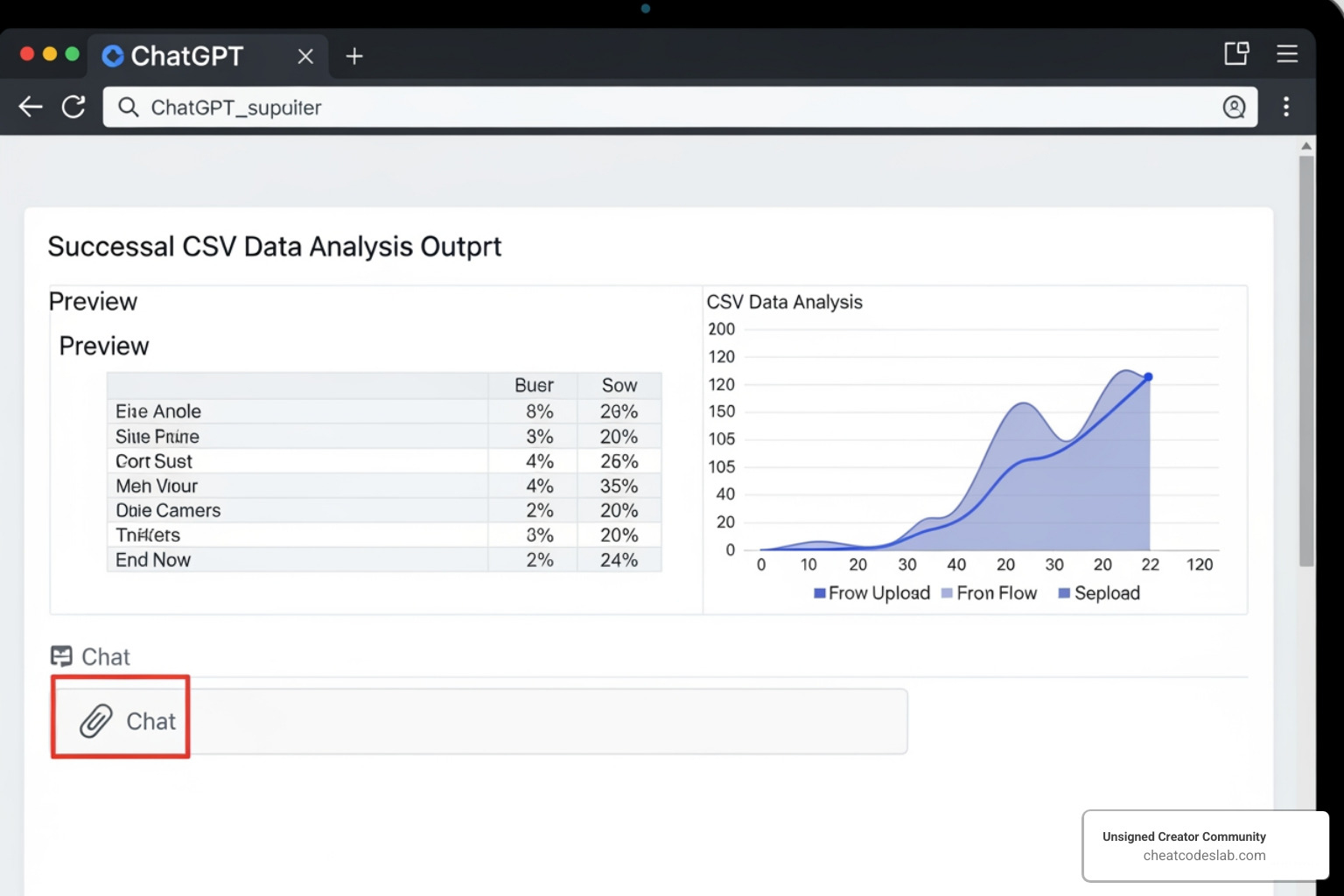
Once you are logged in, ensure you have selected the GPT-4 or GPT-4o model from the dropdown menu. Look for the small “paperclip” icon in the message bar. This is your gateway to the chatgpt advanced data analysis tutorial workflow. Clicking this allows you to attach files directly from your computer, or even link to your Google Drive or Microsoft OneDrive.
For those looking to integrate these capabilities into their own apps, checking out a ChatGPT API tutorial is a great next step. If you’re just starting your AI journey, we recommend our chatgpt-tutorials for a solid foundation.
Supported File Types and Upload Limits
One of the most common questions we get is, “What can I actually throw at this thing?” The answer is: almost anything.
- Data Files: .csv, .xlsx, .tsv, .json
- Documents: .pdf, .docx, .pptx, .txt
- Images: .jpg, .png, .gif (Yes, it can “see” charts and turn them into data!)
- Code: .py, .js, .html
- Archives: .zip (It can unzip files, analyze the contents, and zip them back up for you).
The Limits: You can upload files up to 512 MB each. However, for spreadsheets like CSVs, we recommend keeping them under 50MB for the smoothest performance. In a single conversation, you can upload up to 10 files. If you are building a custom GPT, you can attach up to 20 files as “Knowledge.”
Understanding these limits is crucial for chatgpt and google seo tasks, where you might be analyzing massive keyword exports or backlink audits.
ChatGPT Advanced Data Analysis Tutorial: Cleaning and Transformation
Raw data is almost always “dirty.” It has missing values, duplicate rows, and incorrectly formatted dates. In a traditional workflow, you’d spend 80% of your time cleaning. With ChatGPT, you just ask.
We often use the Kaggle Google Play Store Apps dataset to demonstrate this. You can upload the CSV and simply say: “Clean this data. Remove duplicates, fill missing price values with the median, and ensure the ‘Installs’ column is a number, not a string.”
ChatGPT will use the Pandas library to:
- Identify Nulls: Spotting where data is missing.
- Deduplicate: Removing those annoying double entries.
- Type Conversion: Changing “1,000+” into the number 1000.
- Filter: For example, cleaning the NASA meteorite landings dataset to only include sightings after the year 2000 with a mass greater than 0.
It is a best practice to ask ChatGPT to “Show your work.” By clicking the “View Analysis” button at the end of its response, you can see the exact Python code it used. This is vital for verifying accuracy, especially since scientific research on data privacy reminds us that while the sandbox is secure, we must always be the final judge of the output’s logic.
Advanced Techniques and Best Practices
Once your data is clean, the real magic begins. This is where we move from “what happened” to “why did it happen?” and “what will happen next?”
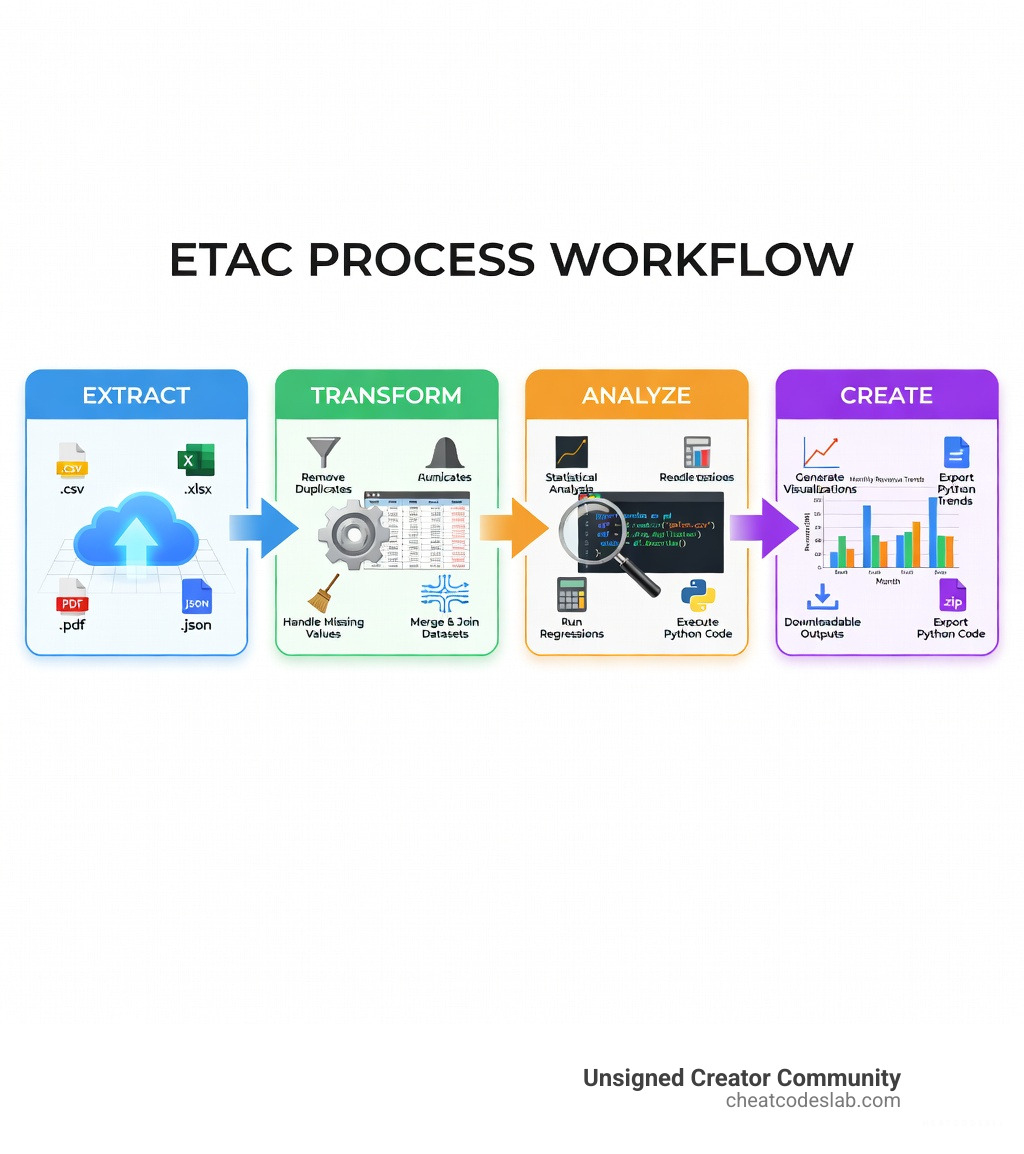
Using libraries like Matplotlib and Seaborn, ChatGPT can perform exploratory data analysis (EDA) that would normally require a mid-level Python developer. The key here is the Extract-Transform-Analyze-Create (ETAC) process. We provide the data (Extract), ChatGPT cleans it (Transform), runs the numbers (Analyze), and gives us a chart or a new file (Create).
Visualizing Insights with Interactive Charts
Static images are great, but interactive charts are better. When you ask for a visualization, ChatGPT defaults to a static PNG. However, for bar charts, scatter plots, line graphs, and pie charts, you can often toggle an “Interactive” mode.
- Customization: You don’t have to settle for default colors. Tell it, “Make the bar chart use our brand colors: #FF5733 and #C70039.”
- Format: Need it for a presentation? Ask it to “Export all these charts into a single ZIP file as high-resolution PNGs.”
- Complexity: It can handle more than just bars. Ask for heatmaps, treemaps, or even waterfall charts to show budget changes.
If you’re using these visuals for content creation, pair them with effective chatgpt writing prompts to explain the data to your audience in a compelling way.
Performing Advanced Statistical Analysis
This is where the “Advanced” in Advanced Data Analysis really shines. You aren’t limited to averages and sums. You can perform:
- Regressions: “Is there a statistically significant relationship between my ad spend and conversion rate?”
- T-Tests/ANOVA: “Compare the performance of our three marketing campaigns. Is the difference in engagement due to chance or is one actually better?”
- Time Series Forecasting: Using ARIMA models, you can ask, “Based on the last two years of sales data, what are our projected numbers for Q4?”
- Correlation Matrices: Quickly see which variables move together.
According to scientific research on AI in education, using AI for these tasks helps bridge the gap for students and professionals who understand the concepts of statistics but struggle with the syntax of coding.
Privacy, Security, and Troubleshooting
We take privacy seriously at CheatCodesLab. When you use ADA, your files are uploaded to a secure, isolated sandbox. This environment has no access to the internet, meaning ChatGPT cannot “leak” your data to other websites while it’s processing.
However, keep these points in mind:
- PII (Personally Identifiable Information): Avoid uploading files with social security numbers, residential addresses, or private health data. Even in a secure sandbox, it’s best practice to anonymize your data first.
- Model Training: You can go into your ChatGPT settings and turn off “Chat History & Training” if you don’t want your interactions used to improve the model.
- The “Error Analyzing” Message: If you see this, don’t panic. It usually means the sandbox timed out or the data was too messy for the initial script. Try a fresh chat or ask ChatGPT to “Try a different approach to loading this file.”
- 13-Hour Rule: Your Python environment is temporary. If you leave the chat for more than 13 hours, the “state” is wiped. You’ll still see the text, but if you want to do more analysis, you’ll need to re-upload the file so ChatGPT can “re-learn” the context.
For more specialized tools, check out our category/ai-apps/ section to find the right fit for your specific workflow.
By following this chatgpt advanced data analysis tutorial, you are no longer just a spectator in big data. You are a creator, an analyst, and a strategist. Whether you’re cleaning a small CSV or forecasting a million-row sales sheet, the power of Python is now just a prompt away.
Explore our guide on how to use chatgpt for more expert tips!


About the author


How to Archive Posts on Instagram in 4 Easy Steps
Master archiving on Instagram in 4 easy steps to organize your profile and protect your content.

Beginner’s Guide to 10k free instagram followers app
Discover how a 10k free instagram followers app works, its risks, and safe organic growth strategies for real engagement in 2026.

Beginner’s Guide to Best Instagram Report App
Discover the best Instagram report app for real-time analytics, automated reports, and data-driven decisions in 2026.
How to Master Advanced SEO Search Techniques in 7 Steps
Master advanced search techniques in SEO with 7 proven steps to boost rankings, technical audits, and organic traffic.

Cheat Sheet to the Best Business Apps
Discover the best business apps to streamline operations, boost productivity, and scale your business in 2026.

How to Get Instagram Followers Free APK in 5 Steps
Discover how instagram followers free apk 2026 download works and learn safe organic growth strategies instead of risky third-party tools.
Related

The Complete Guide to BrightLocal Local SEO
Master BrightLocal local seo with rank tracking, citation management, and review tools to boost visibility in 2026.

The Best AI Tools to Help Nonprofits Get Funded
Discover top AI tools for fundraising to boost nonprofit revenue, donor engagement, and efficiency with predictive & generative AI.

How Machine Learning is Teaching Old Ads New Tricks
Discover how machine learning in digital advertising revolutionizes bidding, targeting, and personalization for superior ROI.

The AI Muse: A Writer’s Guide to ChatGPT
Unlock ChatGPT for writers: Master prompts, beat writer's block, build plots, characters & workflows ethically.

The Robots Are Writing Now and Other AI Content Marketing Software Secrets
Discover ai-driven saas-based content marketing software secrets. Boost SEO, scale workflows, and dominate 2026 trends now!

Ghost Murmur CIA
Ghost Murmur: The Quantum Blueprint for the Impossible Deep inside a fortified bunker in Tehran, an American soldier is breathing—and the CIA is watching that breath through a solid lead wall using a technology that technically shouldn’t exist. This isn't just a scene from a Tom Clancy novel; it’s the frontline of what CIA Director William J. Burns calls the "Technological Mission Center," a pivot where the agency is prioritizing quantum sensing to regain the edge in denied areas. We have officially entered the era of the Quantum Cold War, where physical barriers like concrete and distance are becoming obsolete. As the U.S. government pours $1.8 billion into the National Quantum Initiative to ensure "quantum supremacy," the line between hard science and the supernatural is blurring before our eyes. If you’re a solopreneur or a creator, you need to […]