

How content marketers use ai: Unlock 5 Superpowers
The AI Revolution in Content Marketing
How content marketers use AI is reshaping the digital marketing landscape. Marketers now leverage AI across their entire workflow to boost productivity and results, from ideation and creation to optimization and analysis.
The numbers tell a compelling story. With global AI marketing revenue projected to exceed $107.5 billion by 2028, AI has moved from experimental to essential. Nearly 80% of marketers report a positive ROI from AI-powered content writing, and 74% say AI tools make them more productive. However, the human touch remains critical, as 97% of marketers still review AI content before publishing. The most effective approach combines AI’s speed with human creativity and strategic oversight.
The shift is already happening, with 71% of social marketers integrating AI into their workflows. This doesn’t mean robots are taking over. Instead, AI handles time-consuming tasks like research and drafting, freeing marketers to focus on strategy, storytelling, and authentic audience connections.
I’m digitaljeff, and with over 20 years of experience building brands, I’ve seen how content marketers use AI to scale their impact. This guide distills practical insights to help you harness AI’s power effectively.
Handy how content marketers use ai terms:
What is AI in Content Marketing?
Let’s start with the basics. Google defines AI as technologies enabling computers to perform functions like understanding language, analyzing data, and making recommendations. In content marketing, AI refers to using these technologies to create, optimize, and distribute content more effectively.
At its core, AI in content marketing involves several key components:
- Generative AI: These models are trained on massive datasets to create new, original content—from text to images and video. They can draft articles, write social media updates, and generate product descriptions in seconds.
- Machine Learning (ML): A subset of AI, ML enables systems to learn from data without explicit programming. For marketers, ML algorithms power predictive analytics, helping to understand audience behavior and forecast trends.
- Data Analysis: AI can process and analyze vast amounts of data to uncover hidden insights from customer interactions, website behavior, and social media. This helps us make data-backed decisions instead of relying on guesswork.
- Content Automation: AI allows us to automate repetitive tasks like generating ad copy variations or scheduling posts. This frees up human time for more strategic and creative work.
Essentially, AI in content marketing means leveraging intelligent systems to produce higher-quality, more relevant content at a scale that was previously unimaginable. For a deeper dive, check out our guide on More info about AI in Content Marketing.
Primary Benefits of Using AI
The benefits of AI are numerous and impactful, changing both daily tasks and long-term strategies.
- Efficiency and Time-Savings: AI excels at automating repetitive tasks. Imagine generating headline options or summarizing research in minutes instead of hours. For example, some teams report saving over 70 hours per quarter on content performance reporting by using AI.
- Improved SEO and Content Performance: AI is an SEO wizard. It helps identify high-value keywords, analyze competitor content, and optimize writing for search performance. AI-generated content can rank in search results, proving its viability for SEO.
- Better Audience Insights and Personalization: AI processes consumer data quickly, providing deep insights into behavior and preferences. This allows for hyper-personalized campaigns that resonate with audiences. As Sim Aulakh, founder of EstablishCred, puts it, “AI enables us to craft more personalized stories that resonate deeply with their audiences, drive engagement, and ultimately, build stronger, more credible brands.”
- Creativity Boost and Idea Generation: AI can be a fantastic brainstorming partner, suggesting new topics and angles to overcome writer’s block. By handling the initial idea generation, AI frees up our creative energy for refinement and storytelling.
- Positive ROI: AI is delivering results. Nearly 80% of marketers surveyed report a positive ROI on their content writing tasks, and 74% agree that AI tools help them be more productive.
For more insights into how AI drives marketing success, explore our resources on More info about AI-Driven Marketing Insights.
How Content Marketers Use AI Across the Workflow
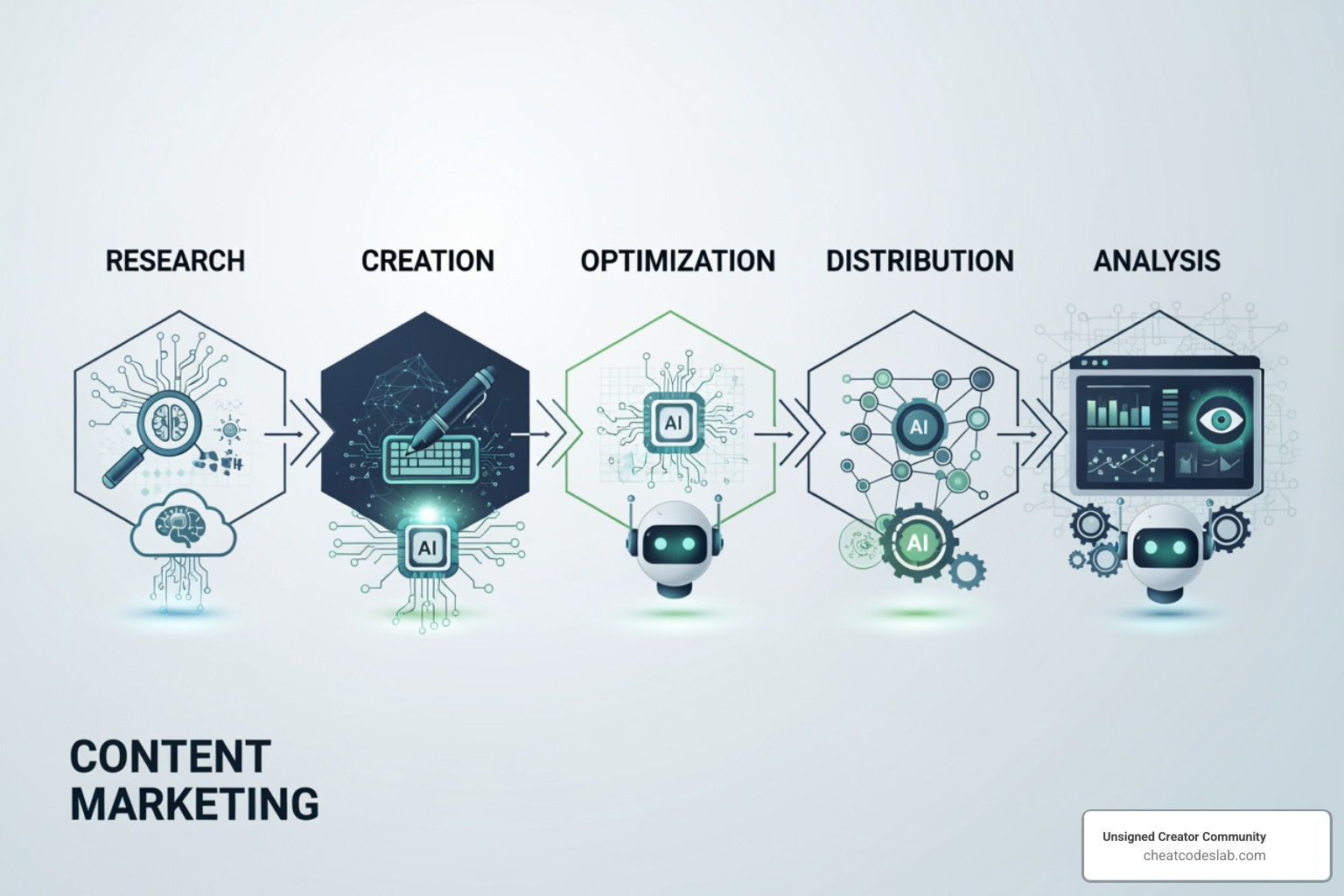
The beauty of AI is its versatility. It can be woven into every stage of the content marketing lifecycle, acting as a powerful co-pilot for creation, optimization, distribution, and performance tracking. Let’s explore how marketers are integrating AI into their daily workflows.
Practical Applications: How Content Marketers Use AI for Research and Creation
When getting content ideas off the ground, how content marketers use AI is truly remarkable. It streamlines processes that were once labor-intensive, allowing a greater focus on quality and strategy.
- Content Ideation and Brainstorming: AI can banish writer’s block by suggesting topics, story angles, and headlines based on trends and audience interests. It’s an efficiency driver that helps sketch out ideas quickly.
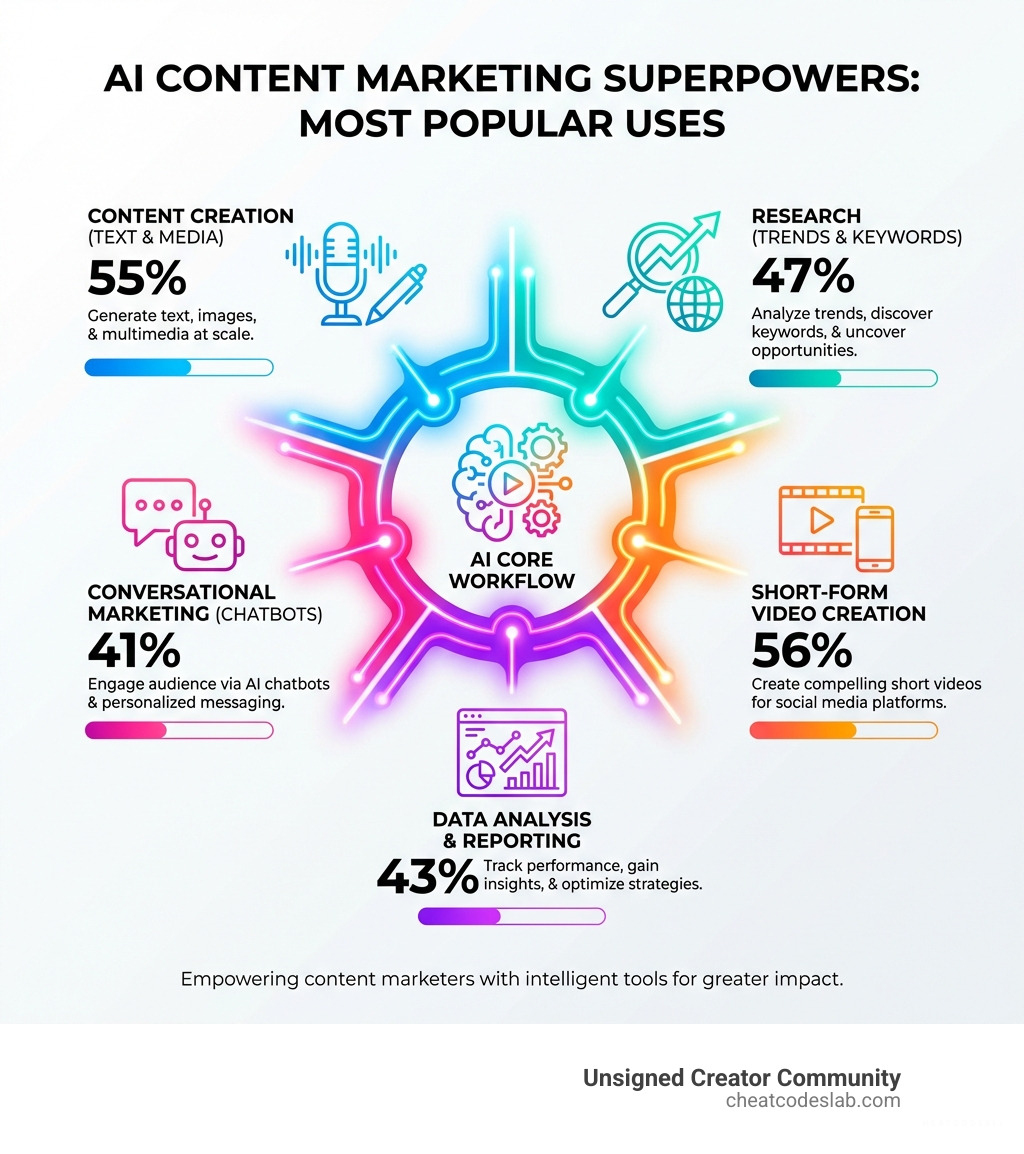
- Keyword Research and Trend Analysis: This is where AI shines. 47% of marketers use AI for research, and for good reason. AI tools can analyze search trends, identify high-performing keywords, and spot content gaps. They can even cluster keywords and topics to build more organized content strategies.
- Text Generation and Drafting: This is the most popular use case, with 55% of marketers using AI for content creation. Generative AI can produce initial drafts for blogs, social media captions, and emails. While few marketers publish AI content without edits, most use it as a powerful starting point, significantly accelerating the drafting process.
- Media Creation (Images, Videos, Audio): AI is a game-changer for multimedia content.
- Images: 53% of marketers use AI to generate images. AI image generators can create professional graphics and unique visuals from text prompts, saving significant time.
- Videos: AI is making waves in video, with 56% of marketers using it for short-form videos. AI video tools can ideate and produce clips for social media, while other platforms help generate more complex video content. 70% of marketers are eager to use new AI video creation tools.
- Audio: AI audio tools can remove background noise from recordings, ensuring professional-sounding podcasts and voiceovers.
- Automated Conversational Marketing: AI-powered chatbots are changing audience interaction. 74% of consumers prefer chatbots for quick answers, and 41% of brands use AI for customer service. These bots can handle queries and guide users 24/7, offering a seamless experience.
These applications highlight how AI acts as an invaluable assistant. For more detailed strategies, explore our guides on More info about AI-Driven Content Creation and More info about Content Marketing AI Tools.
Measuring Success: How Content Marketers Use AI for Analytics & SEO
Creating great content is only half the battle; knowing if it’s working is the other. This is another area where how content marketers use AI is changing the game, enabling proactive, data-driven decisions.
- Performance Analysis and Data Reporting: AI-powered analytics tools can evaluate content performance and generate detailed reports in a fraction of the time. Marketers can use AI to summarize trends and identify patterns from performance data, with some teams saving dozens of hours per quarter on reporting alone.
- Predictive Analytics and Insights: AI doesn’t just report on the past; it helps predict the future. By analyzing historical data and current trends, AI can anticipate audience demand and help adjust campaigns in real-time.
- SEO Optimization and Content Strategy: AI is a powerful ally for search engine visibility.
- Keyword Optimization: AI helps identify high-value keywords, analyze search intent, and optimize content for better rankings.
- On-Page SEO: AI can suggest and even rewrite meta descriptions, title tags, and headings to be optimized for search engines.
- AI Search and E-E-A-T: As search engines incorporate AI, visibility in AI-generated answers (AEO) is critical. This requires content that demonstrates Expertise, Experience, Authoritativeness, and Trustworthiness (E-E-A-T), key Google SERP demands. AI can’t generate expertise, but it can help format content to highlight it.
- A/B Testing and Lead Scoring: AI can quickly test content variations to see what resonates best. It also improves lead scoring accuracy by analyzing audience engagement and behavior.
The integration of AI into analytics and SEO makes our efforts smarter and more impactful. To dig deeper, visit our guides on More info about AI for SEO Content and More info about AI Tools for Analytics.
Navigating Challenges and Mastering the Human-AI Partnership

While AI offers incredible “superpowers,” it’s not a magic bullet. The real mastery lies not just in knowing how content marketers use AI, but in understanding its limitations and forging a strong, ethical partnership between human creativity and artificial intelligence.
Overcoming Key AI Limitations and Ethical Problems
As pioneers in this new landscape, we must steer its challenges responsibly.
- Inaccurate Information (Hallucinations): AI models can generate false information, a phenomenon known as “hallucination.” With 43% of marketers struggling with AI inaccuracies, we can never blindly trust AI output. Rigorous human fact-checking is non-negotiable.
- Plagiarism and Copyright Issues: Since AI models learn from existing content, their output can be derivative, raising plagiarism and copyright concerns. The ongoing legal complexities surrounding AI training data highlight this risk. Always run AI-generated content through plagiarism detectors.
- AI Bias: AI systems can reflect and perpetuate biases present in their training data. 34% of marketers agree that AI can be biased, leading to discriminatory or off-brand content. To combat this, carefully review output for non-inclusive language and choose tools trained on diverse datasets.
- Data Privacy Concerns: Sharing sensitive brand or audience data with AI tools is a major concern for 41% of marketers. With AI largely unregulated, ensure compliance with data protection laws like GDPR, work with tools that prioritize encryption, and be transparent about data practices.
- Generic and Bland Outputs: Without careful prompting and human refinement, AI content can sound generic. It’s built to be “average” unless we push it to be exceptional, which is why human editing remains vital.
Understanding the nuances between different AI writing assistants can also help mitigate these risks.
The Irreplaceable Human Element: Your Role in an AI World
What’s left for humans? Everything that truly matters. AI is a tool, not a replacement for our unique capabilities. Our role is evolving to be more strategic and creative than ever.
- Strategic Oversight: AI executes tasks, but humans formulate the innovative content strategy that aligns with business goals, market nuances, and brand values.
- Fact-Checking and Quality Control: We are the ultimate arbiters of truth and quality. Every piece of AI-generated content needs a human review to verify claims and ensure originality.
- Editing and Refining: The data is clear: 97% of marketers review AI content. Most make significant revisions to refine the tone, improve clarity, and inject personality. We transform a good draft into a great final piece.
- Prompt Engineering: Getting quality output from AI is an art. Crafting clear, specific, and contextual prompts is a crucial skill for guiding the AI to produce the desired results. For tips, explore our guide on More info about ChatGPT Writing Prompts.
- Brand Voice and Consistency: We are the guardians of our brand’s voice, ensuring every piece of content resonates authentically with our audience.
- Human Creativity and Empathy: This is where we are truly irreplaceable. Our ability to tell compelling stories, connect emotionally, and understand cultural subtext is a uniquely human skill that AI cannot replicate.
AI frees us from the mundane, allowing us to focus on the strategic and creative aspects of our work. Mastering your More info about Content Creation Workflow will be key.
The Future: Augmentation, Not Replacement
The question isn’t if AI will replace content creators, but how it will augment them. The consensus is that the future of how content marketers use AI is one of powerful partnership.
- AI as an Assistant: Think of AI as your ultimate assistant. It handles repetitive tasks, allowing you to focus on higher-value activities like strategy and creative thinking. As some companies have learned, replacing human oversight entirely can lead to customer dissatisfaction.
- Hyper-Personalization at Scale: AI enables us to analyze vast amounts of data to create hyper-personalized experiences, tailoring content and recommendations in real-time to make every interaction feel unique.
- Building AI Expertise: To thrive, marketers must build AI expertise. This means understanding its capabilities, experimenting with applications, and staying current on trends. Professionals who master skills like generative AI and marketing automation will have a competitive advantage.
- Organizational Readiness: Successfully integrating AI requires organizational readiness. This involves educating the workforce, developing clear use policies, and fostering a culture of experimentation. As some tech leaders have emphasized, leveraging AI is becoming foundational for all employees.
The content marketing world is evolving. Our creativity and strategic thinking will be amplified by AI, not diminished. By embracing it responsibly, we can open up new levels of efficiency and innovation.
For those ready to build their AI skills, CheatCodesLab offers certified AI tools and cheat codes for content marketing and SEO. Explore Content Creation Resources to fuel your growth and stay at the forefront of this revolution.


About the author


How to Archive Posts on Instagram in 4 Easy Steps
Master archiving on Instagram in 4 easy steps to organize your profile and protect your content.

Beginner’s Guide to 10k free instagram followers app
Discover how a 10k free instagram followers app works, its risks, and safe organic growth strategies for real engagement in 2026.

Beginner’s Guide to Best Instagram Report App
Discover the best Instagram report app for real-time analytics, automated reports, and data-driven decisions in 2026.
How to Master Advanced SEO Search Techniques in 7 Steps
Master advanced search techniques in SEO with 7 proven steps to boost rankings, technical audits, and organic traffic.

Cheat Sheet to the Best Business Apps
Discover the best business apps to streamline operations, boost productivity, and scale your business in 2026.

How to Get Instagram Followers Free APK in 5 Steps
Discover how instagram followers free apk 2026 download works and learn safe organic growth strategies instead of risky third-party tools.
Related

The Complete Guide to BrightLocal Local SEO
Master BrightLocal local seo with rank tracking, citation management, and review tools to boost visibility in 2026.

The Best AI Tools to Help Nonprofits Get Funded
Discover top AI tools for fundraising to boost nonprofit revenue, donor engagement, and efficiency with predictive & generative AI.

How Machine Learning is Teaching Old Ads New Tricks
Discover how machine learning in digital advertising revolutionizes bidding, targeting, and personalization for superior ROI.

The AI Muse: A Writer’s Guide to ChatGPT
Unlock ChatGPT for writers: Master prompts, beat writer's block, build plots, characters & workflows ethically.

The Robots Are Writing Now and Other AI Content Marketing Software Secrets
Discover ai-driven saas-based content marketing software secrets. Boost SEO, scale workflows, and dominate 2026 trends now!

Ghost Murmur CIA
Ghost Murmur: The Quantum Blueprint for the Impossible Deep inside a fortified bunker in Tehran, an American soldier is breathing—and the CIA is watching that breath through a solid lead wall using a technology that technically shouldn’t exist. This isn't just a scene from a Tom Clancy novel; it’s the frontline of what CIA Director William J. Burns calls the "Technological Mission Center," a pivot where the agency is prioritizing quantum sensing to regain the edge in denied areas. We have officially entered the era of the Quantum Cold War, where physical barriers like concrete and distance are becoming obsolete. As the U.S. government pours $1.8 billion into the National Quantum Initiative to ensure "quantum supremacy," the line between hard science and the supernatural is blurring before our eyes. If you’re a solopreneur or a creator, you need to […]