

How Startups Can Master Content Strategy with AI
Why AI-Powered Content Creation Is a Game-Changer for Startups
AI-powered content creation is the use of artificial intelligence tools to generate, optimize, and scale content — from blog posts and social media copy to videos and images — faster and at a fraction of the traditional cost.
Here’s a quick look at how startups can leverage it:
- Generate content faster — AI can draft a 500-word post in minutes vs. the ~4 hours it typically takes manually
- Cut costs — reduce reliance on large content teams for routine writing tasks
- Scale output — publish across multiple channels without burning out your team
- Improve SEO — AI tools can research keywords and align content with search intent
- Stay consistent — train AI on your brand voice to maintain a unified tone
More than 75% of marketers already use AI tools to some degree — and 80% plan to increase their use in the next 12 months. That’s not a trend. That’s a shift.
For startups, this matters even more. You’re competing with bigger brands that have larger teams and bigger budgets. AI levels the playing field.
The good news? You don’t need to be a tech expert to get started. The right tools and the right workflow can help a lean team punch well above its weight.
I’m digitaljeff — a content strategist and tech entrepreneur who has spent over 20 years building brands and scaling content distribution across emerging platforms, generating over 1 billion views on social media in the last year alone, and AI-powered content creation is now at the core of every growth strategy I recommend. Let’s break down exactly how your startup can use it.
Basic AI-powered content creation vocab:
The Core Pillars of AI-Powered Content Creation
To master AI-powered content creation, we first need to understand the engine under the hood. It isn’t magic; it’s math. Most modern tools are built on Large Language Models (LLMs) that use deep learning to predict the most likely next word in a sequence. When we type a prompt, the AI scans billions of parameters to provide a response that mimics human conversation.
The three main pillars are:
- Machine Learning (ML): This allows the software to improve over time by analyzing successful content patterns.
- Natural Language Processing (NLP): This is the tech that helps computers understand, interpret, and generate human language in a way that feels natural, not robotic.
- Data Analysis: AI can process vast amounts of audience data in seconds—something that would take a human team weeks—to tell us exactly what topics are trending.

For a startup, the difference between manual work and AI-assisted work is staggering. We aren’t just talking about saving a few minutes here and there; we are talking about a total transformation of your output capacity.
| Task | Manual Drafting | AI-Assisted Drafting |
|---|---|---|
| 500-Word Blog Post | 4 Hours | 15 Minutes |
| Social Media Captions (10) | 90 Minutes | 5 Minutes |
| SEO Keyword Research | 3 Hours | 10 Minutes |
| Email Newsletter Draft | 60 Minutes | 2 Minutes |
Streamlining Workflows with AI-Powered Content Creation
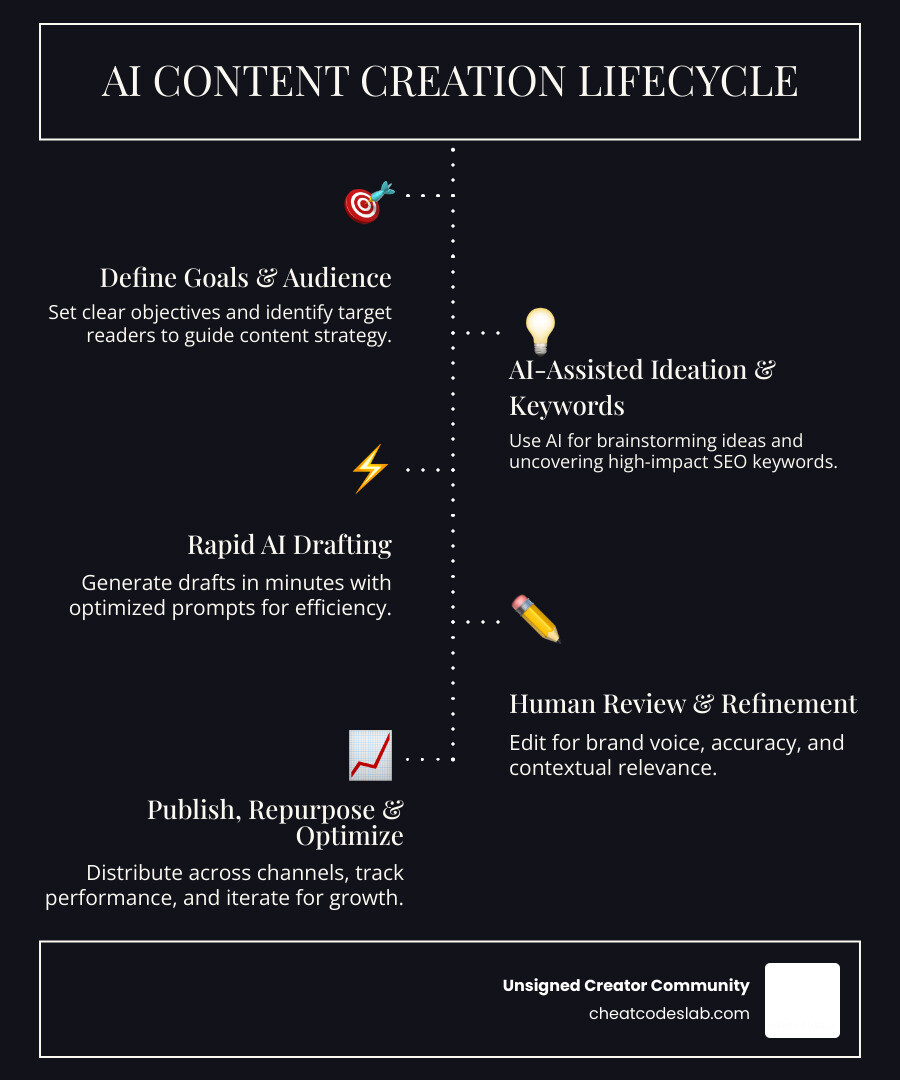
The biggest hurdle for any startup founder is “The Blank Page Syndrome.” We’ve all been there—staring at a cursor, waiting for inspiration to strike. AI-powered content creation solves this by acting as a high-speed brainstorming partner.
We can use AI to generate dozens of content pillars and headlines in seconds. Once we have an outline, the AI can flesh out a rapid first draft. This “draft-first” approach allows our team to move straight into the refinement phase, which is where the real value is added.
Furthermore, content repurposing becomes effortless. We can take one long-form blog post and ask an AI tool to turn it into five LinkedIn posts, three Twitter threads, and a script for a short-form video. This ensures our message reaches every corner of the internet without requiring us to write every single word from scratch. To find the right fit for your team, check out this AI content tools guide.
Maximizing SEO Performance via AI-Powered Content Creation
SEO used to be a dark art, but AI has turned it into a science. Modern AI-powered content creation tools don’t just write; they optimize. They can analyze the top-ranking pages for any given keyword and tell us exactly which subheadings, terms, and structures we need to include to compete.
However, search engines like Google have raised the bar. They now prioritize E-E-A-T (Experience, Expertise, Authoritativeness, and Trustworthiness). While AI is great at gathering data, it needs us to provide the “Experience” and “Expertise” parts. We use AI to handle the heavy lifting of keyword research and structural alignment, but we always add our own unique startup insights to ensure the content feels authoritative.
For those interested in the technical side, you can read more about the scientific research on natural-language processing to see how these models are evolving to understand human intent better than ever before.
Balancing Human Oversight and Brand Consistency
One of the biggest mistakes we see startups make is hitting “publish” on a raw AI draft. While AI is smart, it lacks a soul. It doesn’t know your brand’s “inside jokes,” your specific mission, or the nuanced tone that makes your community love you.
Human oversight is the “quality gate.” We recommend a “Human-in-the-loop” workflow:
- The AI generates the structure, the research, and the initial draft.
- The Human reviews for fact-checking, adds personal anecdotes, and ensures the brand voice is consistent.
Without this, you risk sounding like every other generic company on the web. Our goal is to use AI to handle the repetitive 80% of the work so we can spend our energy on the creative 20% that actually converts. For a deeper dive into this balance, see our guide on beyond the bots a humans guide to automated content generation.
Overcoming Challenges in Originality and Accuracy
We have to talk about the elephant in the room: AI “hallucinations.” Sometimes, AI tools get a little too confident and make up facts, statistics, or quotes that don’t exist. This is why fact-checking is non-negotiable.
Another challenge is originality. Because AI is trained on existing data, it can sometimes produce “echo chamber” content—stuff that sounds exactly like what’s already out there. To stand out, we must use AI as a foundation, not a finished product.
To avoid plagiarism and maintain contextual nuance, we should:
- Cross-reference facts: Always verify stats through a trusted source like Perplexity or a manual Google search.
- Add “The Human Element”: Include original case studies or customer testimonials that an AI couldn’t possibly know.
- Check for “AI-isms”: Words like “delve,” “tapestry,” or “unleash” are often dead giveaways of unedited AI text.
Ethical Considerations and Detection Risks
As we integrate AI-powered content creation into our startups, we must remain ethical. Transparency is key. While you don’t necessarily need a disclaimer on every social post, you should be honest with your community about how you use technology.
Google’s guidelines are clear: they don’t punish AI content as long as it is high-quality and helpful to the user. However, if you use AI to spam low-quality pages just to “game” the system, you will eventually see a drop in rankings.
Data privacy is another massive consideration. Never feed sensitive company data, trade secrets, or private customer information into a public AI model. Most tools have privacy settings, but it’s better to be safe than sorry. Many popular tools like ChatGPT have earned high marks for reliability, with G2 reviews showing 4.7 out of 5 stars, but always check the privacy policy of any new tool you adopt.
Scaling with Automated Systems
Scaling is where the magic happens. For a startup, being able to produce multi-modal assets (text, image, and video) simultaneously is a superpower. We can use tools to generate on-brand images for our blogs, create AI-voiced audio versions of our articles for accessibility, and even produce 3D assets for marketing.
This level of automation supports a aggressive Go-to-Market (GTM) strategy. Instead of launching one campaign every quarter, we can launch localized, personalized campaigns every week. By automating the “GTM bloat”—the tedious tasks of scheduling, resizing, and distributing—we allow our marketing team to focus on high-level strategy.
Integrating these systems doesn’t just save time; it creates a more professional and polished brand image. You can learn more about building these pipelines in our article on AI-driven content creation.
Future-Proofing Your Startup Strategy
The future of AI-powered content creation is hyper-personalization. Imagine a world where every visitor to your website sees a different version of your content, tailored specifically to their interests and browsing history. We are moving toward a “segment of one,” where AI helps us speak directly to each individual customer.
To stay ahead, startups need to embrace continuous learning. The AI landscape moves fast, and the “cheat codes” that work today might be updated tomorrow. That’s where we come in. At CheatCodesLab, we specialize in providing certified AI tools and strategies that ensure you aren’t just using AI, but mastering it.
Don’t let your startup get left behind in the manual era. The tools are here, the data is clear, and the competitive edge is yours for the taking. Whether you are a solopreneur or leading a growing team, the goal is the same: use the tech to amplify your human genius.
Ready to find the perfect stack for your team? Explore the latest software solutions for creators and start building your automated content empire today.


About the author


How to Archive Posts on Instagram in 4 Easy Steps
Master archiving on Instagram in 4 easy steps to organize your profile and protect your content.

Beginner’s Guide to 10k free instagram followers app
Discover how a 10k free instagram followers app works, its risks, and safe organic growth strategies for real engagement in 2026.

Beginner’s Guide to Best Instagram Report App
Discover the best Instagram report app for real-time analytics, automated reports, and data-driven decisions in 2026.

How to Master Advanced SEO Search Techniques in 7 Steps
Master advanced search techniques in SEO with 7 proven steps to boost rankings, technical audits, and organic traffic.

Cheat Sheet to the Best Business Apps
Discover the best business apps to streamline operations, boost productivity, and scale your business in 2026.

How to Get Instagram Followers Free APK in 5 Steps
Discover how instagram followers free apk 2026 download works and learn safe organic growth strategies instead of risky third-party tools.
Related

The Complete Guide to BrightLocal Local SEO
Master BrightLocal local seo with rank tracking, citation management, and review tools to boost visibility in 2026.

The Best AI Tools to Help Nonprofits Get Funded
Discover top AI tools for fundraising to boost nonprofit revenue, donor engagement, and efficiency with predictive & generative AI.

How Machine Learning is Teaching Old Ads New Tricks
Discover how machine learning in digital advertising revolutionizes bidding, targeting, and personalization for superior ROI.

The AI Muse: A Writer’s Guide to ChatGPT
Unlock ChatGPT for writers: Master prompts, beat writer's block, build plots, characters & workflows ethically.

The Robots Are Writing Now and Other AI Content Marketing Software Secrets
Discover ai-driven saas-based content marketing software secrets. Boost SEO, scale workflows, and dominate 2026 trends now!

Ghost Murmur CIA
Ghost Murmur: The Quantum Blueprint for the Impossible Deep inside a fortified bunker in Tehran, an American soldier is breathing—and the CIA is watching that breath through a solid lead wall using a technology that technically shouldn’t exist. This isn't just a scene from a Tom Clancy novel; it’s the frontline of what CIA Director William J. Burns calls the "Technological Mission Center," a pivot where the agency is prioritizing quantum sensing to regain the edge in denied areas. We have officially entered the era of the Quantum Cold War, where physical barriers like concrete and distance are becoming obsolete. As the U.S. government pours $1.8 billion into the National Quantum Initiative to ensure "quantum supremacy," the line between hard science and the supernatural is blurring before our eyes. If you’re a solopreneur or a creator, you need to […]