


Don’t Let Your AI Strategy Develop a Latency Problem
Why Your AI Strategy Is Already Falling Behind
AI strategy is the structured plan that connects artificial intelligence tools, data, and talent to real business outcomes — so your organization doesn’t just experiment with AI, but actually wins with it.
Here’s what an effective AI strategy covers:
- Principles – Define your values, ethics, and guardrails
- Business goals – Tie every AI initiative to measurable outcomes
- Governance – Manage risk without killing innovation
- Operating model – Build cross-functional teams and clear workflows
- Talent – Upskill your people and close skill gaps
- Technology – Choose the right tools and infrastructure
- Activation – Turn your plan into a live roadmap with milestones
The pressure is real. A full 92% of C-suite executives expect to digitize workflows and use AI-powered automation by 2026. That means the window to build a deliberate AI strategy — instead of a reactive one — is closing fast.
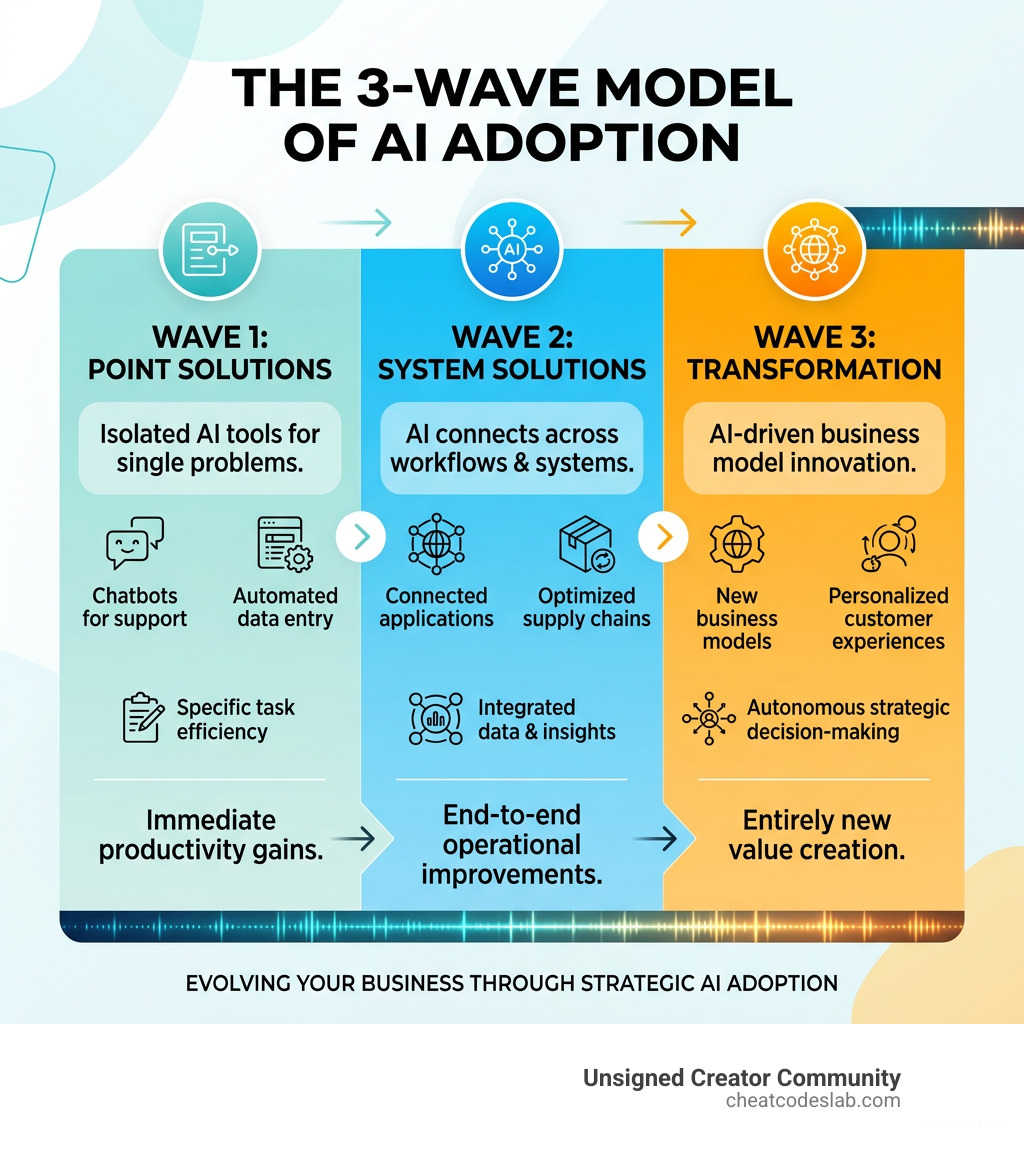
Most organizations are still stuck in what researchers call Wave 1: deploying isolated AI tools that solve single problems. Very few have reached Wave 2, where AI connects across entire workflows. And Wave 3 — full business model transformation — hasn’t been achieved by anyone yet.
The gap between where most teams are and where AI is going creates a latency problem. Not technical latency. Strategic latency. The longer you wait to build a coherent AI strategy, the harder it becomes to catch up.
I’m digitaljeff — tech entrepreneur, futurist, and content strategist who has spent over two decades building and scaling digital brands across emerging technology platforms. My work at the intersection of content, distribution, and innovation gives me a front-row seat to how AI strategy is reshaping competitive advantage for creators and marketers. Let’s break down exactly what it takes to build one that works.
Ai strategy glossary:
The Core Components of a High-Performance AI Strategy
To build a high-performance ai strategy, we need to move beyond “playing with prompts” and start building a robust framework. Think of this as a strategic blueprint for your digital future. Without these components, you aren’t building a strategy; you’re just buying subscriptions to tools you’ll forget to use in six months.

According to leading frameworks from organizations like Forrester, an effective ai strategy consists of seven core components that must work in harmony:
- Principles: These are your “hard” and “soft” values. Hard values might include revenue growth or cost reduction, while soft values focus on ethics, safety, and societal norms.
- Business Strategy: This is where you define your mission. What are the specific project opportunities? What is the expected ROI?
- Governance: This is the “brakes” on your car. You can only drive fast if you know the brakes work. It involves managing risks, ensuring data privacy, and staying compliant with regulations like the EU AI Act.
- Operating Model: How will your teams actually work? We recommend moving away from rigid hand-offs toward cross-functional, collaborative teams that share data and insights.
- Talent: You can’t run a Ferrari on lawnmower fuel. You need to assess current skills, set literacy benchmarks, and invest in continuous education.
- Technology: This involves evaluating tools for reusability. Instead of buying ten different tools for ten different tasks, look for platforms that offer shared capabilities to reduce technical debt.
- Activation: This is the “living” part of the strategy. It’s the roadmap with clear milestones that turns abstract ideas into real-world outcomes.
When selecting your technological stack, the choice often comes down to the level of control versus the speed of deployment. Here is a quick comparison of the three primary service models:
| Model | Description | Best For | Responsibility |
|---|---|---|---|
| SaaS (Software as a Service) | Ready-to-use applications like Microsoft 365 Copilot. | General productivity and quick wins. | Provider manages everything. |
| PaaS (Platform as a Service) | Development platforms like Azure AI Foundry. | Building custom RAG applications or agents. | Shared; you manage the app/data. |
| IaaS (Infrastructure as a Service) | Raw GPU power and virtual machines. | Custom model training and high-compliance needs. | You manage the OS and stack. |
For those looking to dive deeper into the technical side of things, check out our guide on AI tools for analytics. Furthermore, it is essential to ground your approach in recognized safety standards, such as the Scientific research on AI risk management provided by NIST.
Aligning Your AI Strategy with Business Goals
We often see companies get “shiny object syndrome.” They implement the latest chatbot because it’s cool, not because it helps the bottom line. A successful ai strategy must be anchored to quantified business objectives.
Ask yourself: “If our organization were founded today as an AI-native business, what would it look like?” This thought experiment helps strip away legacy thinking. Would you still have a massive call center, or would you have an AI-driven support ecosystem that frees humans for high-level problem solving?
Alignment means performing “decision audits.” Identify where high-value decisions are made and determine if AI can provide predictive analytics to make those decisions faster or more accurate. For example, in search, Gartner projects a 25% drop in traditional search engine volume by 2026. If your business goal is “organic traffic,” your ai strategy must pivot toward Generative Engine Optimization (GEO) to ensure your brand is cited in AI-generated answers.
To get a head start on this, explore our AI-driven marketing insights to see how data can transform your decision-making process.
Balancing Governance and Innovation in AI Strategy
One of the biggest hurdles in any ai strategy is the perceived conflict between “playing it safe” and “moving fast.” We believe governance shouldn’t be a roadblock; it should be an enabler.
Responsible AI is about building trust. If your customers don’t trust how you use their data, your AI initiatives will fail long-term. This requires breaking down data silos. Data that is trapped in one department is useless for an enterprise-wide AI model. We need to follow the “FAIR” principles: making data Findable, Accessible, Interoperable, and Reusable.
Governance also means staying ahead of the law. The Apply AI Strategy from the European Commission highlights the importance of human-centric, trustworthy AI. By implementing a “graded approach” to risk—where high-impact use cases get more oversight than low-risk productivity tools—you can innovate without fear.
For creators looking to streamline their workflows while staying within ethical bounds, our resources on AI SEO automation provide practical ways to scale responsibly.
Building an AI-Ready Workforce and Infrastructure
You can have the best software in the world, but if your team doesn’t know how to use it, your ai strategy has a zero-percent chance of success. Talent development is the defining element of strategic victory.
We suggest a “two-for-one” rule: for every dollar you spend on technology, spend two dollars on people and change management. This includes:
- Upskilling: Teaching your current team about prompt engineering and AI literacy.
- Recruitment: Bringing in specialists in data engineering and LLM management.
- Culture: Fostering an environment where experimentation is rewarded and “failing fast” is part of the learning process.
On the infrastructure side, the scale is staggering. As of 2025, the U.S. Department of Energy operates the world’s three fastest supercomputers to handle massive scientific AI workloads. While you might not need a supercomputer, you do need a “data foundation.” This means having clean, structured data that AI models can actually read.
If you’re just starting this journey, our AI for everyone guide is the perfect place to begin building that foundational knowledge.
Activating Your Roadmap for Autonomous Transformation
How do we turn all this theory into action? We use a method called “Wavemapping.” This involves looking at your AI journey in three distinct phases:
- Wave 1 (Efficiency): Focus on point solutions. Use AI to summarize documents, generate social media posts, or automate invoice classification. These are your “quick wins.”
- Wave 2 (System Solutions): This is where AI connects different parts of your business. For example, a forecasting model that automatically triggers a replenishment order in your supply chain.
- Wave 3 (Transformation): This is the “future-back” vision. You aren’t just doing things better; you’re doing better things. This might mean moving from selling a product to selling an AI-powered “decision service” based on outcomes.
Activation requires a clear roadmap with 90-day, 1-year, and 3-year goals. It also involves exploring “Agentic AI”—systems that don’t just answer questions but can actually execute tasks and make adaptive decisions. To see how this applies to your content, check out our strategies for AI-driven content strategy.
Conclusion: Future-Proofing Your Digital Authority
The world of search and content is undergoing an “autonomous transformation.” We are moving into a “zero-click” environment where users get their answers directly from AI interfaces like ChatGPT or Perplexity. In this new world, your ai strategy shouldn’t just be about “ranking” — it must be about “citation.”
This is the “Authority Feedback Loop.” When AI systems consistently find your content to be high-quality, authoritative, and trustworthy (following E-E-A-T principles), they cite you more often. This citation builds more authority, leading to even more citations. It’s a compounding competitive advantage that traditional SEO can’t match.
At Unsigned Creator Community, we believe that the brands that thrive in the next decade won’t be the ones with the most tools, but the ones with the most coherent strategy. We partner with CheatCodesLab to provide you with the “cheat codes” — the certified AI tools and frameworks — you need to win.
Don’t let strategic latency kill your competitive edge. Start building your data foundations, upskilling your team, and optimizing for the generative future today.
Unlock your AI potential and join the community of creators who are building the future, one prompt at a time.


About the author


How to Archive Posts on Instagram in 4 Easy Steps
Master archiving on Instagram in 4 easy steps to organize your profile and protect your content.

Beginner’s Guide to 10k free instagram followers app
Discover how a 10k free instagram followers app works, its risks, and safe organic growth strategies for real engagement in 2026.

Beginner’s Guide to Best Instagram Report App
Discover the best Instagram report app for real-time analytics, automated reports, and data-driven decisions in 2026.
How to Master Advanced SEO Search Techniques in 7 Steps
Master advanced search techniques in SEO with 7 proven steps to boost rankings, technical audits, and organic traffic.

Cheat Sheet to the Best Business Apps
Discover the best business apps to streamline operations, boost productivity, and scale your business in 2026.

How to Get Instagram Followers Free APK in 5 Steps
Discover how instagram followers free apk 2026 download works and learn safe organic growth strategies instead of risky third-party tools.
Related

The Complete Guide to BrightLocal Local SEO
Master BrightLocal local seo with rank tracking, citation management, and review tools to boost visibility in 2026.

The Best AI Tools to Help Nonprofits Get Funded
Discover top AI tools for fundraising to boost nonprofit revenue, donor engagement, and efficiency with predictive & generative AI.

How Machine Learning is Teaching Old Ads New Tricks
Discover how machine learning in digital advertising revolutionizes bidding, targeting, and personalization for superior ROI.

The AI Muse: A Writer’s Guide to ChatGPT
Unlock ChatGPT for writers: Master prompts, beat writer's block, build plots, characters & workflows ethically.

The Robots Are Writing Now and Other AI Content Marketing Software Secrets
Discover ai-driven saas-based content marketing software secrets. Boost SEO, scale workflows, and dominate 2026 trends now!

Ghost Murmur CIA
Ghost Murmur: The Quantum Blueprint for the Impossible Deep inside a fortified bunker in Tehran, an American soldier is breathing—and the CIA is watching that breath through a solid lead wall using a technology that technically shouldn’t exist. This isn't just a scene from a Tom Clancy novel; it’s the frontline of what CIA Director William J. Burns calls the "Technological Mission Center," a pivot where the agency is prioritizing quantum sensing to regain the edge in denied areas. We have officially entered the era of the Quantum Cold War, where physical barriers like concrete and distance are becoming obsolete. As the U.S. government pours $1.8 billion into the National Quantum Initiative to ensure "quantum supremacy," the line between hard science and the supernatural is blurring before our eyes. If you’re a solopreneur or a creator, you need to […]