
The Secret Sauce of Personal Branding Ideas for Professionals
Why Personal Branding Ideas Are Your Biggest Career Advantage Right Now
Personal branding ideas are strategies professionals use to shape how others perceive their expertise, values, and unique story online and offline. Here are the most impactful ones to get started:
Top Personal Branding Ideas at a Glance:
- Define your positioning — Write a one-sentence statement: “I help [audience] achieve [outcome] through [method].”
- Pick one platform first — LinkedIn for professionals, YouTube for educators, TikTok/Instagram for storytellers.
- Build a content pillar system — One main topic (60%), two supporting themes (40%).
- Start an email list on Day 1 — Email converts 40x better than social media.
- Share your story, not just your wins — Authenticity builds trust faster than credentials.
- Create a simple digital product or service — Validate it in under a week.
- Post consistently — 3-5 times per week minimum on your primary platform.
- Engage daily — Comment on 5 posts, reply to your audience, send 2-3 DMs.
Think about this: 83% of employers check your digital presence before hiring you. Yet most professionals leave their online reputation entirely to chance.
Your personal brand exists whether you manage it or not. The only question is who’s controlling the narrative — you, or the silence.
As Jeff Bezos put it: “Your brand is what people say about you when you’re not in the room.”
A strong personal brand is not just a polished headshot or a clever LinkedIn bio. It’s a trust mechanism. It’s a traffic source. It shapes how clients, employers, and collaborators perceive your value before you ever speak a word.
Professionals with strong personal brands earn 48% more than those without. Consultants with recognized expertise charge 3-10x more than generalists. And a highly engaged audience of just 1,000 followers in the right niche can generate real, meaningful income.
The gap between invisible and influential is smaller than you think — it just takes the right ideas and a clear plan.
I’m digitaljeff — futurist, tech entrepreneur, content strategist, and filmmaker with 20+ years building personal brands for some of the world’s top creators and professionals, making personal branding ideas the core of everything I do. I’ve helped generate over 1 billion social media views in the last 12 months alone, and I’m here to share exactly what works.
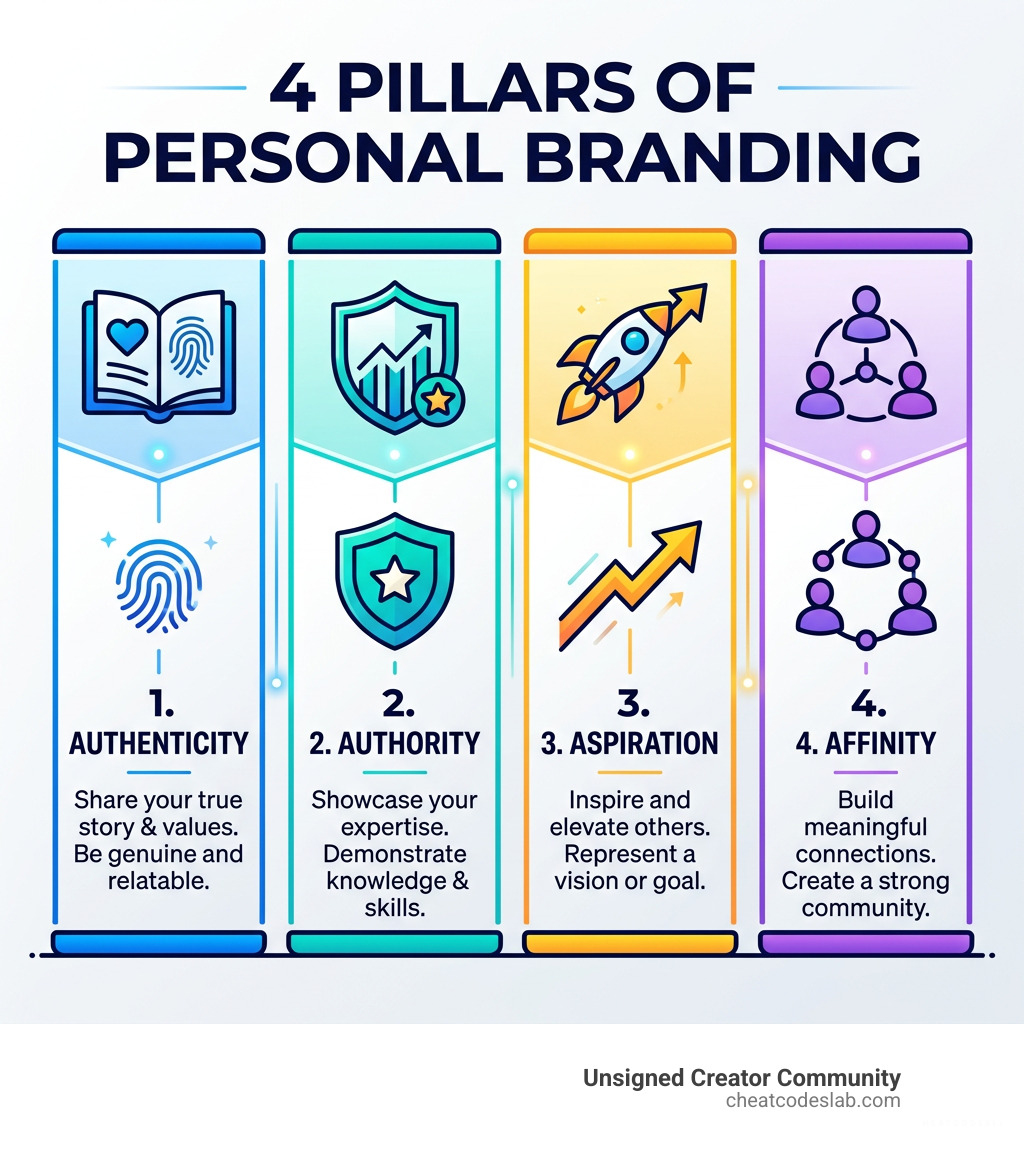
Terms related to Personal branding ideas:
High-Impact Personal Branding Ideas to Stand Out in 2026
As we move toward 2026, the digital landscape is becoming increasingly crowded. To rise above the noise, we must realize that a personal brand isn’t just a business model—it’s a way to build equity in our expertise. Whether we are branding for real estate agents or branding for artists, the fundamental mechanics remain the same: we are building a trust mechanism that attracts opportunities.

To succeed, we use the Trust Matrix, which consists of three core pillars:
- Growth: This is our ability to articulate ideas clearly. We study high-performers and analyze why their content works, then replicate those successful structures to improve our own reach.
- Authenticity: This is where we share our core beliefs and stories. Authenticity is magnetic because it repels the wrong people and attracts the right ones.
- Authority: We establish this through persuasive education. By teaching through a unique lens or solving specific pain points, we change the behavior of our audience and build deep credibility.
One of the biggest hurdles for beginners is understanding how a personal brand differs from a traditional business brand. While a business brand focuses on a product or service, a personal brand is built on a human being.
| Feature | Personal Brand | Business Brand |
|---|---|---|
| Core | Individual’s personality & story | Products, services, & mission |
| Trust Factor | Built through vulnerability & relatability | Built through quality & reliability |
| Flexibility | Can evolve with the person’s interests | Usually tied to a specific industry |
| Connection | Human-to-human | Entity-to-consumer |
For those working within a corporate structure, leveraging your team can amplify these results. You can Try EveryoneSocial’s employee advocacy platform for FREE to help your team members become brand advocates, which humanizes the company while boosting their individual professional profiles.
Defining Your Core Positioning and Personal Branding Ideas
Before we start posting, we need a foundation. We use a simple positioning formula to define our place in the market: “I help [Target Audience] achieve [Specific Outcome] through [Unique Method].” This prevents us from being “too broad,” which is a common mistake that makes a brand forgettable.
Effective personal branding ideas often center on a strong “Hero’s Journey.” We should be prepared to share where we were, what sparked our change, and where we are now. This narrative is far more compelling than a list of degrees. When we look at Personal Brand Statement Examples, we see that the most effective ones use specific language and avoid generic buzzwords.
Take Madalyn Sklar’s unique branding approach as an example. She has branded herself as a leading Twitter expert by infusing her personality—like her “rockstar” results and tattoo-wearing style—into her professional advice. This specificity makes her unforgettable.
We should also define our core beliefs. What are the hills we are willing to die on? These beliefs act as a filter, ensuring we attract clients and followers who align with our values. If we are liked by everyone, we are likely not standing for anything.
Content Creation Strategies and Personal Branding Ideas for Social Media
Content is the fuel for our brand. In 2026, the most successful creators use “Edutainment”—a mix of educational and entertaining content. We don’t just want to be a textbook; we want to be a mentor who is fun to follow.
To keep our content organized, we use Content Pillars. A great framework is to have one Main Pillar (60% of our content) and two supporting themes (25% and 15%). For example, if our main pillar is “Remote Work,” our themes might be “Productivity Hacks” and “Travel Adventures.” This ensures we are known for one thing while still showing our multifaceted personality.
For those struggling with what to say, we recommend the 2-Hour Research Method:
- Spend time on Reddit, Quora, and YouTube comments.
- Look for the exact questions people are asking.
- Create a “Voice of Customer” document to record their specific pain points and language.
- Turn those insights into content that addresses their needs directly.
This approach is vital for any personal branding content creator. A great example of this in action is Jay Clouse’s creator brand examples. Jay helps creators find independence by providing incredibly high-value, research-backed content that speaks directly to their struggles with scaling and sustainability.
Real-World Success Stories Across Industries
Looking at Personal Branding Success Stories helps us see how these theories apply in the real world. Personal branding isn’t just for influencers; it’s for anyone who wants to control their professional destiny.
- Business: Elon Musk’s brand on X is a masterclass in transparency and risk-taking. His personal brand is so strong that it often drives the stock price of his companies more than traditional PR ever could. Similarly, Richard Branson of the Virgin Group uses his adventurous spirit to humanize a massive conglomerate.
- Media & Journalism: Oprah Winfrey’s empowerment brand is built on empathy and resilience. She transitioned from a talk show host to a global media mogul by staying true to her core mission of helping people live their best lives. In the independent space, journalists like Faye D’souza have carved out successful paths by sticking to their values and building direct-to-audience platforms on YouTube.
- Niche Experts: Tori Dunlap has built a massive brand helping women with financial planning. By focusing on a specific audience and a clear mission (fighting the patriarchy through financial literacy), she has created a movement, not just a business.
These examples show that whether you are the “Oracle of Omaha” like Warren Buffett or a freelance designer like Alice Thorpe, your brand is your most valuable asset.
Choosing the Right Platforms for Your Brand Architecture
We don’t need to be everywhere. In fact, trying to master every platform at once is a recipe for burnout. We suggest a “3-Layer Strategy”:
- Primary Platform: Where you post your main content (e.g., LinkedIn or YouTube).
- Secondary Platform: Where you repurpose content or engage in a different format (e.g., X or Instagram).
- Owned Channel: This is your email list. It is non-negotiable because you own the data and the distribution.
Personal Brand Awareness starts with being where your audience lives. If you are a B2B professional, LinkedIn is your goldmine. If you are a visual creator, Instagram or TikTok might be better.
A brilliant example of platform strategy is John Hu’s Stan Store example. John used his personal brand on social media to drive traffic to a simple “link in bio” store where he sold a resume template. He turned his past success into a digital product and used a creator-friendly platform to monetize his expertise instantly. This is a perfect example of how your brand acts as a traffic source for your offers.
Your 90-Day Action Plan for Career Freedom
Building a brand doesn’t have to take years. With a focused 90-day sprint, we can lay a foundation that generates inbound opportunities and career freedom. This plan is about moving from “invisible expert” to “recognized authority.”
- Days 1-30: The Foundation. Define your positioning, audit your digital footprint, and set up your primary profile. This is the stage of personal brand development where you decide what you want to be known for.
- Days 31-60: The Content Engine. Start publishing 3-5 times a week. Focus on “visible proof”—articles, videos, or case studies that show you know your stuff.
- Days 61-90: The Monetization Phase. This is where we learn how to monetize your personal brand. Whether it’s through consulting, coaching, or a digital product, we want to create a path for our audience to pay us for our value.
During this time, we should also focus on building a self branding strategy that includes regular engagement. Spending 15 minutes a day commenting on other people’s posts and replying to our own comments can do more for our growth than any paid ad.
Step-by-Step Execution and Monetization
Monetization should happen sooner rather than later. We recommend creating your first digital product in under a week. It doesn’t need to be a massive course; it could be a simple 30-minute training, a template, or a checklist.
For a deeper dive, you can check out this mega guide to building a digital product. The goal is validation. If you can get a few people to pay $10-$50 for your expertise, you have a viable brand.
As your brand grows, you can move toward high-ticket services. Personal branding for freelancers often involves moving from low-priced gigs to “productized services” where you solve a specific problem for a specific price. This allows you to scale your income without scaling your hours.
The goal of personal brand awareness is to make the “sale” happen before you ever get on a call. When people already trust your expertise because of your content, the conversion rate for your services will skyrocket.
Conclusion: Scaling with the CheatCodesLab Community
Building a personal brand is a journey of constant evolution. As you grow, your brand will change, and that’s okay. The key is to start and stay consistent. Whether you’re looking for a personal branding coach or a career branding coach, the most important step is taking control of your own narrative.
At CheatCodesLab, we specialize in providing certified AI tools and “cheat codes” for content marketing and SEO. We know that the right technology can make the process of building a brand much faster and more efficient. By using AI to assist with keyword research, content drafting, and strategy, you can spend more time on what matters most: connecting with your audience and sharing your unique story.
If you’re ready to dive deeper into personal branding ideas and strategies, explore our Category: Personal Branding for more guides and expert insights. Your expertise is valuable—it’s time the world knew about it. Reach out to us at CheatCodesLab to see how our tools can help you scale your influence and turn your personal brand into a predictable revenue engine.


About the author

How to Archive Posts on Instagram in 4 Easy Steps
Master archiving on Instagram in 4 easy steps to organize your profile and protect your content.

Beginner’s Guide to 10k free instagram followers app
Discover how a 10k free instagram followers app works, its risks, and safe organic growth strategies for real engagement in 2026.
Beginner’s Guide to Best Instagram Report App
Discover the best Instagram report app for real-time analytics, automated reports, and data-driven decisions in 2026.
How to Master Advanced SEO Search Techniques in 7 Steps
Master advanced search techniques in SEO with 7 proven steps to boost rankings, technical audits, and organic traffic.
Cheat Sheet to the Best Business Apps
Discover the best business apps to streamline operations, boost productivity, and scale your business in 2026.

How to Get Instagram Followers Free APK in 5 Steps
Discover how instagram followers free apk 2026 download works and learn safe organic growth strategies instead of risky third-party tools.
Related
How to Archive Posts on Instagram in 4 Easy Steps
Master archiving on Instagram in 4 easy steps to organize your profile and protect your content.
Beginner’s Guide to Best Search Engine Optimization SEO
Master best search engine optimization SEO with this beginner's guide covering on-page, technical, and AI strategies for higher rankings.

Ultimate Checklist for Social Media Marketing Agency
Discover the ultimate checklist for choosing a social media marketing agency that drives real ROI and growth.

Hot Summer Caption Ideas That Spark Engagement
Discover hot summer caption ideas that boost engagement, from short aesthetic lines to funny unhinged vibes and beach photo dumps.

How to Add Text to Instagram Story in 5 Easy Steps
Learn how to add text to Instagram Story in 5 easy steps with our native tips and creative text hacks for better engagement.

How to Add Audio to Instagram Story the Right Way
Learn how to add audio clip in Instagram Story using built-in music or your own file with this step-by-step guide.