

Fixing the Web, One Broken Link at a Time with Ahrefs
What is Broken Link Building & Why Ahrefs is Your Go-To Tool
Ahrefs broken link building is a white-hat SEO tactic where you find dead pages on the web that still have backlinks, then reach out to the linking websites and suggest your own relevant content as a replacement. It’s a win-win: the site owner fixes a frustrating user experience issue, and you earn a high-quality backlink.
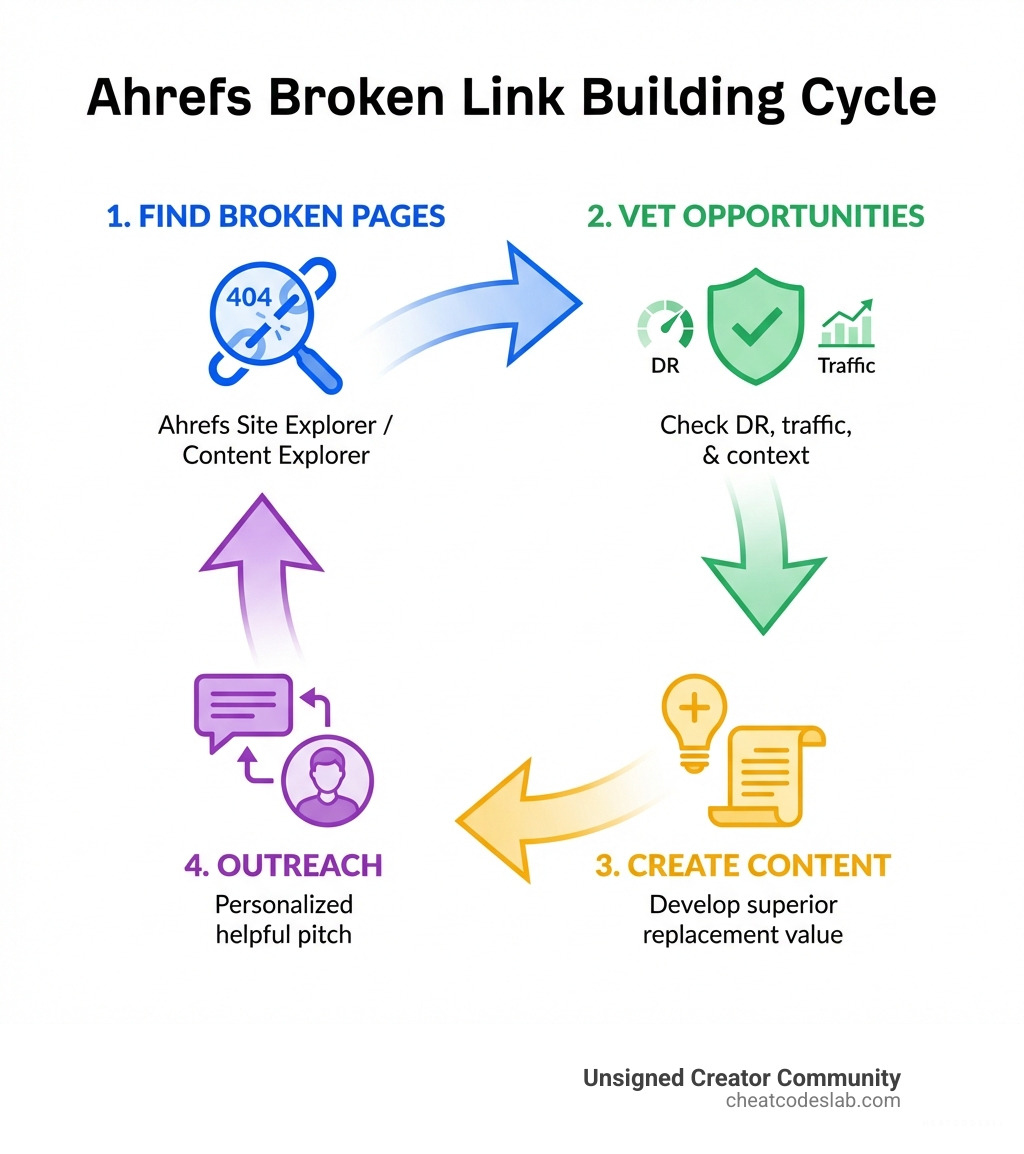
Quick Answer: The Ahrefs Broken Link Building Process
- Find broken pages using Ahrefs Site Explorer or Content Explorer (filter for 404 errors with existing backlinks).
- Vet the opportunities by checking Domain Rating, referral traffic, and link context.
- Create superior replacement content that provides more value than the original.
- Reach out personally to webmasters with a helpful pitch highlighting the broken link and your solution.
This strategy works because you’re reclaiming wasted link equity and genuinely helping site owners, which can lead to high success rates. The challenge is that most marketers execute this tactic poorly. They send generic mass emails, target low-quality links, or create mediocre replacement content. The tactic isn’t failing—it’s just being done wrong.
I’m digitaljeff, and over the past 20 years building brands, I’ve learned that Ahrefs broken link building is one of the most effective white-hat strategies when you focus on genuine value creation. Let me show you exactly how to do it right.
Ahrefs broken link building terms to know:
The Complete Ahrefs Broken Link Building Workflow
Alright, buckle up! We’re diving into the nitty-gritty of building high-quality backlinks using Ahrefs. This isn’t just about finding a broken link; it’s about a strategic, step-by-step process that ensures we’re building durable, impactful links. This section details the step-by-step process for a successful campaign.

Step 1: How to Find Broken Links for Your Ahrefs Broken Link Building Campaign
This is where Ahrefs truly shines. Its massive, constantly updated backlink database is the engine behind our search. Ahrefs’ crawler is the second most active after Google, and its database is updated with fresh data every 15 minutes, giving you a real-time advantage in finding new opportunities.
Here’s how to find those broken links:
Using Site Explorer to Uncover Broken Pages with Backlinks: This is the primary method for identifying broken pages that still hold valuable “link juice.”
- Identify Relevant Domains: Start by identifying authoritative websites within your niche.
- Steer to “Best by Links”: In Ahrefs Site Explorer, enter a relevant domain. Then, go to the “Pages” report and click on “Best by Links.”
- Filter for 404s: Apply an “HTTP code: 404 not found” filter. This instantly shows all broken pages on that domain with backlinks. Sort by “Referring domains” to prioritize the best opportunities.
- Check Outgoing Broken Links: You can also use Site Explorer to find broken outgoing links from authoritative sites. Steer to
Site Explorer -> [relevant-domain.com] -> Outgoing links -> Broken links.This is a great indicator of sites that are likely to fix broken links.
Leveraging Content Explorer for Topic-Specific Broken Links: If you’re looking for broken links around a specific topic, Content Explorer is your secret weapon.
- Search Your Topic: Enter a broad topic related to your content into Content Explorer.
- Filter for Broken Pages: Switch to “In title” mode to find highly relevant articles, then apply the “Broken pages” filter. This reveals broken articles across the web relevant to your topic.
- Filter by Referring Domains: Again, filter these results by “Referring domains” to identify the most promising opportunities.
Finding Broken Links on Resource Pages: Resource pages are goldmines. Use Google search operators to find them:
[KEYWORD] intitle:resources inurl:links.html[KEYWORD] inurl:links[KEYWORD] "recommended reading"
Once you find these pages, you can manually check for broken links or use Ahrefs’ Site Explorer on the domain to see its outgoing broken links. We also find value in using Competitive Analysis Tools to understand the landscape of linking opportunities.
Step 2: Evaluating Opportunities & Creating Superior Replacement Content
Finding broken links is just the first step. Now you need to vet these prospects to ensure you’re pursuing high-quality, relevant backlinks.
Vetting the Link Prospects: Determine if a broken page has good backlinks worth pursuing and why people linked to it in the first place.
- Link Quality: In Ahrefs Site Explorer, go to the broken page’s “Backlinks” report. Apply filters to target desirable links: “Dofollow” only, a minimum Domain Rating (DR) of 10+, and a minimum amount of domain traffic. If a broken page doesn’t have good backlinks after filtering, move on.
- Understanding Link Context: Examine the anchor text and surrounding content of the backlinks to understand why the original page was linked. Use the Wayback Machine to see how the broken page used to look. This deep dive helps you create a compelling replacement page.
Creating Superior Replacement Content: Once you’ve identified a promising broken link, create a replacement page that is significantly better than the original.
- Fulfill the Original Purpose: Your replacement content must fulfill the same purpose as the original broken page.
- Improve and Improve: Ask yourself: how can you make this more valuable? Can you simplify complex topics, add new data, include visual aids, provide templates, or update outdated information?
- Incorporate Linkable Assets: Based on your vetting, strategically embed elements that naturally attract links, like a specific statistic that was popular on the old page.
This meticulous approach ensures that when you reach out, you’re offering a genuine upgrade that benefits the linking site’s audience. This process also ties into our broader content strategy, which we discuss further in our guide to Content Gap Analysis.
Step 3: Crafting Effective Outreach That Gets Replies
This is where the human touch comes in. A poorly executed outreach can sink your efforts. One article mentions reclaiming 31 backlinks from just 166 outreach emails—an 18.67% conversion rate, which is impressive for link outreach!
Personalization is Key (No Mass Blasts!): Generic emails are ignored. Make every email feel personal.
- Custom Templates: Segment your prospects based on how they linked to the broken page and create custom outreach templates for each.
- AI-Powered Personalization: Use AI tools to generate unique icebreakers based on their website or recent articles. This shows you’ve done your homework. Our AI Tools for Email Marketing can help craft these unique touches.
- Show, Don’t Just Tell: Include a screenshot of the broken link on their website within your email to clearly illustrate the problem.
Highlight the Value Proposition: Your pitch is about them, not you. Focus on how you’re helping.
- Identify the Problem: “I noticed a broken link on your [Page Name].”
- Offer the Solution: “We recently published an updated guide on [Topic] that would be a perfect replacement.”
- Emphasize Improvement: “Our guide is more [detailed/up-to-date] than the original, ensuring your audience gets the best information.”
Finding Contact Information: Ahrefs can help here. Look for author names in reports, or find contact info on the site’s contact page, LinkedIn, or social media profiles.
Follow-Up Strategy: Persistence pays off. Plan a polite, value-driven follow-up sequence. A gentle reminder after a few days can often get a response.
By focusing on genuine help and leveraging smart personalization, you significantly increase your chances of success.
Step 4: Measuring Success & Avoiding Common Pitfalls
Once your outreach is underway, actively measure your success and learn from your efforts. Be aware of common pitfalls that can derail an Ahrefs broken link building campaign.
Measuring Success: Track your campaigns rigorously to understand what’s working.
- Tracking New Backlinks: In Ahrefs Site Explorer, regularly check the “Backlinks” report, filtering for “New” backlinks to verify successful link replacements.
- Monitoring Referral Traffic: Track this in Google Analytics to see if your new links are bringing in engaged visitors.
- Keyword Ranking Changes: Keep an eye on your target keyword rankings for pages that received new backlinks.
Avoiding Common Pitfalls: Success in broken link building depends heavily on execution. Avoid these common mistakes:
- Mass Outreach with Generic Emails: This is the quickest way to get ignored. Prioritize quality over quantity.
- Targeting Low-Quality Replacements: Chasing links from low-authority or irrelevant sites is a waste of time.
- Mediocre Replacement Content: If your content isn’t genuinely better, there’s no reason for someone to link to it.
- Ignoring the “Why”: If you don’t understand why the original page was linked, your replacement and outreach will miss the mark.
By diligently measuring progress and avoiding these errors, you can ensure your campaigns are truly effective. For more insights on tracking SEO efforts, check out our Automated SEO Reporting Tool Guide.
Advanced Tactics & Best Practices for Ahrefs Broken Link Building
Now that we’ve covered the core workflow, let’s look at how to scale your Ahrefs broken link building efforts and ensure they contribute to a robust, long-term SEO strategy. This section covers scaling your efforts and ensuring long-term success.
Scaling Your Efforts with Analysis & Governance
Scaling broken link building isn’t just about sending more emails; it’s about smarter analysis and a strong framework, especially when dealing with multiple markets.
Leveraging Ahrefs’ Database for Strategic Analysis: Ahrefs’ large backlink database is a powerful tool for strategic analysis. Its crawler is the second most active after Google, and its database is updated with fresh data every 15 minutes. This means you have unparalleled data to:
- Analyze Backlink Profiles of Defunct Websites: When a website in your niche goes offline, its entire backlink profile becomes a target. Use Ahrefs to find all the broken links that used to point to it, which can yield hundreds of opportunities.
- Identify “Link Rot” Trends: Spot patterns of link decay within specific industries to proactively create replacement content for topics prone to becoming outdated.
Implementing a Framework for Scalability: For businesses operating across different markets, a consistent framework is crucial.
- Maintain Strategic Intent: Ensure every backlink you acquire is bound to a specific Page, a Target Keyword, and an Audience. This keeps your efforts aligned with your goals.
- Ensure Localization Fidelity: For international campaigns, adapt your content and outreach to local languages and cultural norms. This guarantees your efforts are effective and respectful across different regions. For more on this, explore our International SEO Guide.
By integrating these advanced analytical and governance practices, you can transform broken link building from a simple tactic into a strategic asset that builds durable, high-quality backlinks.
Final Best Practices for a Durable Link Building Strategy
To truly master Ahrefs broken link building, embed these key best practices into your workflow. This isn’t just about getting links; it’s about building a resilient online presence.
Here’s our list of best practices for long-term success:
- Understand the Tactic Thoroughly: Know its nuances; it’s incredibly powerful when executed well.
- Vet Link Prospects Rigorously: Stick to your filtering criteria for Domain Rating, traffic, and relevance.
- Create Superior Replacement Pages: Your content must be an upgrade, not just a substitute.
- Improve Content Beyond the Original: Add more value through better visuals, updated data, or clearer explanations.
- Use Personalized Outreach Templates: Segment prospects and craft highly personalized messages.
- Focus on Providing Value: Your primary goal is to help the webmaster fix a problem on their site.
- Diversify Targets and Formats: Target various types of broken links and offer diverse content formats as replacements.
- Maintain Signal Health: Regularly monitor your acquired backlinks to ensure they remain active.
- Align with Global Standards: For international operations, ensure your links meet local cultural expectations.
- Continuously Learn and Adapt: Stay updated on Google’s guidelines and new Ahrefs features to refine your strategy.
At CheatCodesLab, we believe in providing certified AI tools and cheat codes for content marketing and SEO. Our approach to Ahrefs broken link building embodies this philosophy: leveraging powerful tools with smart, ethical strategies to achieve measurable results. By following these best practices, you’re not just fixing broken links; you’re building a stronger, more authoritative web. For more insights, explore our Advanced SEO Techniques.


About the author


How to Archive Posts on Instagram in 4 Easy Steps
Master archiving on Instagram in 4 easy steps to organize your profile and protect your content.

Beginner’s Guide to 10k free instagram followers app
Discover how a 10k free instagram followers app works, its risks, and safe organic growth strategies for real engagement in 2026.

Beginner’s Guide to Best Instagram Report App
Discover the best Instagram report app for real-time analytics, automated reports, and data-driven decisions in 2026.
How to Master Advanced SEO Search Techniques in 7 Steps
Master advanced search techniques in SEO with 7 proven steps to boost rankings, technical audits, and organic traffic.

Cheat Sheet to the Best Business Apps
Discover the best business apps to streamline operations, boost productivity, and scale your business in 2026.

How to Get Instagram Followers Free APK in 5 Steps
Discover how instagram followers free apk 2026 download works and learn safe organic growth strategies instead of risky third-party tools.
Related

How to Add Swipe Up to Instagram Story Fast by Using Linktree
Learn how to add swipe up to Instagram Story fast using Linktree and link stickers without needing 10k followers.

Stop the Scroll with the Best Instagram Growth Service Reviews
Discover the Best Instagram growth service in 2026: organic, human-powered strategies, AI targeting, safety tips & reviews to boost followers fast.

Carousel App for Instagram: Which One Should You Choose?
Find the best carousel app for Instagram! Compare features, AI vs. manual, and customization to elevate your content strategy.

From Zero to Hero: Apps That Actually Boost Your Instagram Following
Discover the best app to boost Instagram followers! Learn how AI, analytics, and safe strategies can skyrocket your growth from zero to hero.

Unlock Thousands of Instagram Followers with bigtakip.com Your Secret Weapon
Explore bigtakip com followers & their risks. Discover why organic growth builds real, lasting Instagram success. Choose wisely.

Unleash Your Inner Content Creator with These AI Tools
Unleash creativity & boost productivity. Discover the best ai content creation tools to save time, cut costs, and enhance quality.