

Claude 3 Opus: Powerhouse AI for 2025
Understanding Claude 3 Opus: The Pinnacle of Anthropic’s AI Evolution
Claude 3 Opus represents Anthropic’s most advanced AI model, designed for complex reasoning and analytical tasks. Here’s what you need to know:
Key Features:
- Most Intelligent Model: Outperforms peers on cognitive benchmarks like MMLU, GPQA, and GSM8K
- 200K Context Window: Can process approximately 150,000 words or entire documents
- Near-Perfect Recall: Achieves 99% accuracy in “Needle In A Haystack” evaluations
- Multimodal Capabilities: Processes both text and images with sophisticated vision features
- Improved Reasoning: Demonstrates near-human comprehension for complex tasks
Best For:
- Research and development projects
- Complex analysis and forecasting
- In-depth content creation
- Advanced coding tasks
- Strategic business analysis
When Anthropic announced the Claude 3 family in March 2024, they set “new industry benchmarks across a wide range of cognitive tasks.” Unlike its faster sibling Claude 3.5 Sonnet, Opus prioritizes analytical depth over speed, making it the go-to choice for tasks requiring sophisticated reasoning.
The model represents the culmination of Anthropic’s Constitutional AI approach, which trains models to be both helpful and harmless using a set of guiding principles. This method has resulted in fewer unnecessary refusals and improved accuracy compared to previous generations.
As digitaljeff, I’ve spent over 20 years in digital media and tech innovation, helping brands steer emerging technologies and AI tools like Claude 3 Opus for content strategy and distribution. My experience with AI evolution from Web 2.0 to today’s large language models gives me unique insight into how these tools transform creative workflows.
Claude 3 opus terms to know:
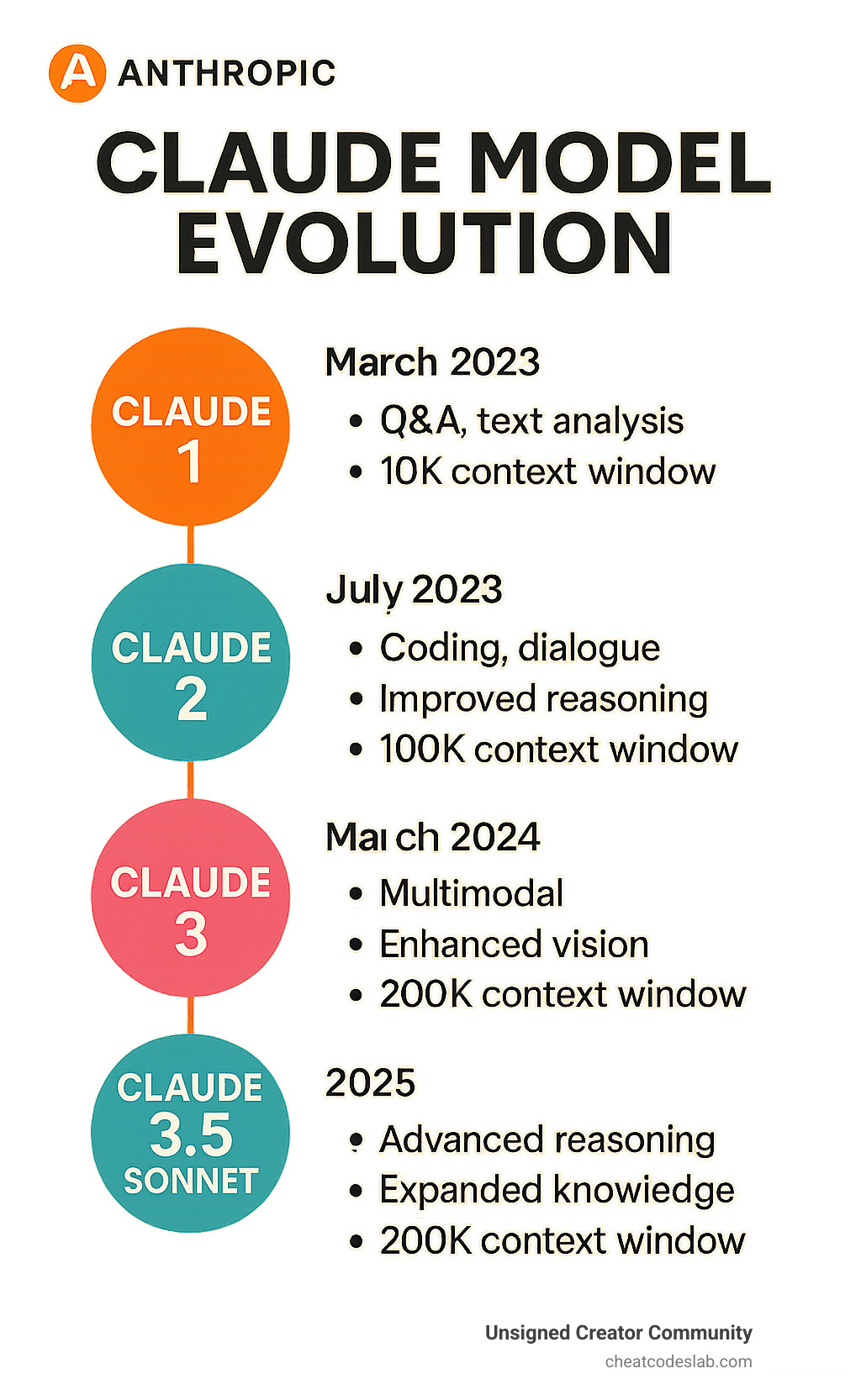
The Evolution of Claude: From Early Models to the Claude 3 Family
Understanding Claude 3 Opus means taking a step back to see how Anthropic built something truly remarkable. Like watching a talented artist perfect their craft over years, Claude’s evolution tells a story of continuous innovation and learning.
The Foundation: Claude 1 and Claude 2
Every great AI has humble beginnings, and Claude’s story started with Claude 1. While it didn’t make headlines like today’s models, it established something crucial: Anthropic’s commitment to building AI that’s both powerful and safe from day one.
The real breakthrough came with Claude 2 in July 2023. This wasn’t just an upgrade – it was a game-changer. With its impressive 100,000-token context window (roughly 75,000 words), Claude 2 could suddenly handle entire documents without breaking a sweat. You could upload PDFs and watch it digest complex reports like a speed-reading scholar.
But Claude 2 had a quirky personality trait that sometimes frustrated users. Due to what critics called the “alignment tax,” it would occasionally refuse perfectly innocent requests. Ask it “How can I kill all Python processes on my Ubuntu server?” and it might politely decline, worried about the word “kill.” While admirable in its caution, this over-protective nature sometimes got in the way of getting things done.
Anthropic listened to feedback and released Claude 2.1 in November 2023. This version was like Claude 2’s wiser, more experienced sibling. The context window doubled to an astounding 200,000 tokens – imagine processing 500 pages of text without losing track of anything. Even better, Claude 2.1 significantly reduced hallucinations, making it far more reliable for serious work.
A New Standard: Introducing the Claude 3 Model Family
March 2024 marked a pivotal moment when Anthropic unveiled the Claude 3 family. Instead of one-size-fits-all, they created three distinct personalities, each designed for different needs.

Claude 3 Haiku is the speed demon of the family. It can tear through a 10,000-token research paper with charts and graphs in under three seconds. Perfect for live customer support or when you need quick answers without the wait.
Claude 3 Sonnet strikes the perfect middle ground. It’s twice as fast as Claude 2 while being significantly smarter. Think of it as your reliable daily driver – great for data processing, content moderation, and most everyday AI tasks.
And then there’s Claude 3 Opus – the crown jewel. This is where Anthropic pulled out all the stops, creating their most intelligent model for complex reasoning and analysis that demands near-human comprehension.
The performance benchmarks tell an impressive story. Claude 3 Opus consistently outperformed competitors on critical tests like MMLU (undergraduate-level knowledge), GPQA (graduate-level reasoning), and GSM8K (mathematical problem-solving). These aren’t just numbers – they represent real-world capabilities.
What makes the Claude 3 family even more exciting is their vision capabilities. They can analyze photos, interpret charts, understand technical diagrams, and make sense of visual data. This opens up entirely new possibilities for industries dealing with visual information.
Perhaps most importantly, the Claude 3 models dramatically reduced unnecessary refusals. Remember Claude 2’s over-cautious nature? That’s largely been fixed. These models are more helpful and cooperative while maintaining their ethical foundations.
For the complete story behind this groundbreaking release, check out Anthropic’s official announcement: Introducing the next generation of Claude.
The Role of Constitutional AI in Training
Behind every great AI model lies a training philosophy, and Anthropic’s Constitutional AI approach is genuinely fascinating. Instead of relying purely on human feedback (which can be inconsistent and time-consuming), they gave their AI a set of guiding principles – essentially, a constitution.

Here’s how it works: the AI generates a response, then critiques itself against its constitutional principles. If something doesn’t align, it revises and improves. This self-correction process, powered by Reinforcement Learning from AI Feedback (RLAIF), creates a continuous cycle of improvement.
The constitutional principles draw from sources like the UN Universal Declaration of Human Rights, ensuring a solid ethical foundation. These principles emphasize harmlessness (avoiding dangerous content), helpfulness (providing useful information), honesty (being truthful), reducing bias, and respecting privacy.
This approach is what makes Claude 3 Opus not just powerful, but trustworthy. It’s trained to be both brilliant and responsible – a combination that’s essential for AI systems handling complex, real-world tasks.
The methodology is so innovative that it’s worth exploring the original research: Constitutional AI: Harmlessness from AI Feedback.
This careful, principled approach to AI development sets the stage for understanding why Claude 3 Opus represents such a significant leap forward in artificial intelligence capabilities.
A Deep Dive into Claude 3 Opus: Capabilities and Comparisons
After exploring the journey from Claude’s early days to today’s sophisticated family of models, it’s time to really dig into what makes Claude 3 Opus such a remarkable achievement. Think of it as the difference between a reliable family car and a high-performance sports car – both will get you where you need to go, but one is built for the demanding curves and challenging terrain ahead.
What Makes Claude 3 Opus a Powerhouse?
Claude 3 Opus isn’t just another AI model in the crowded landscape of language models. It’s Anthropic’s flagship creation, designed specifically for those moments when you need an AI that can truly think through complex problems with near-human comprehension.
What sets Claude 3 Opus apart is its advanced reasoning capabilities. When you’re facing a challenging business strategy decision or trying to untangle a complex research problem, Opus doesn’t just give you surface-level answers. It dives deep, analyzing multiple angles and considering nuances that other models might miss. It’s like having a brilliant colleague who never gets tired and can process enormous amounts of information without losing focus.
The mathematics and strategic analysis capabilities are particularly impressive. Users have reported asking Claude 3 Opus to generate complete applications from scratch – we’re talking over 300 lines of coherent code, complete with user interface elements and logical flow. That’s not just copying and pasting from training data; that’s genuine problem-solving in action.
One of the most practical advantages is the 200K context window. Imagine being able to upload an entire research paper, a complete business plan, or even a full novel, and having Claude 3 Opus remember every detail throughout your conversation. That’s roughly 150,000 words or about 500 pages of text that it can keep track of simultaneously. For some specialized use cases, Anthropic has even tested extending this to 1 million tokens – that’s like having a conversation about an entire library of documents.
But here’s where things get really interesting: the “Needle In A Haystack” test. Researchers hide specific information deep within massive amounts of text, then ask the AI to find it. Claude 3 Opus achieves 99% recall accuracy on these tests. Even more impressively, it can detect when researchers artificially insert fake information to try to trick it. That level of awareness and attention to detail is genuinely remarkable.
This combination of improved coding, complex analysis, and near-human comprehension makes Claude 3 Opus feel less like a tool and more like a thinking partner for your most challenging projects.
Claude 3 Opus vs. Claude 3.5 Sonnet: Speed vs. Power
Choosing between Claude 3 Opus and Claude 3.5 Sonnet often comes down to a fundamental question: Do you need the AI equivalent of a marathon runner or a sprinter? Both are incredibly capable, but they’re optimized for different types of challenges.

| Feature | Claude 3 Opus | Claude 3.5 Sonnet |
|---|---|---|
| Performance | Deep analysis, complex reasoning, high accuracy | Balances capability & performance, fast, versatile |
| Speed | Delivers similar speeds to Claude 2/2.1 | Operates at twice the speed of Claude 3 Opus |
| Coding Proficiency | Improved programming capabilities, 38% internal problem-solving | Marked improvement, 64% internal problem-solving |
| Vision Capabilities | Sophisticated, processes visual formats | Excels in chart interpretation, superior vision |
| Task Suitability | Research, strategy, high-level content, complex analysis | Real-time customer support, rapid content, visual data interpretation, general tasks |
| Cost-effectiveness | Higher capability for critical, complex, high-value tasks | More cost-effective for general and high-volume tasks |
Claude 3.5 Sonnet operates at twice the speed of Claude 3 Opus. When you need quick responses for customer support, rapid content generation, or fast coding assistance, Sonnet delivers impressive results without the wait. In coding proficiency, Sonnet actually outperforms Opus, solving 64% of programming problems compared to Opus’s 38% in internal evaluations.
Where Claude 3 Opus truly shines is in vision capabilities and sophisticated analysis. While Sonnet excels at interpreting charts and visual data quickly, Opus brings a deeper level of understanding to complex visual information. Think of the difference between quickly identifying what’s in a photo versus understanding the deeper implications and context of what you’re seeing.
Here’s a simple way to think about it: Analysis equals Opus; Creation equals Sonnet. When you’re developing a comprehensive business strategy, conducting in-depth research, or need to understand complex relationships in data, Claude 3 Opus is your go-to choice. When you’re generating social media content, handling real-time conversations, or need quick coding solutions, Sonnet’s speed and efficiency make it the better option.
The cost-effectiveness consideration is straightforward – Sonnet’s efficiency makes it more economical for high-volume tasks, while Claude 3 Opus justifies its use when accuracy and comprehensive understanding are non-negotiable.
Real-World Applications and Safety Considerations
The capabilities of Claude 3 Opus translate into transformative applications across virtually every industry. Let’s explore how this powerful AI is already changing the way people work and create.
In software development, Claude 3 Opus serves as an invaluable partner for complex architectural decisions and algorithm design. Developers use it to think through challenging technical problems, design system architectures, and even generate complete applications. Meanwhile, Claude 3.5 Sonnet handles the day-to-day coding tasks – debugging scripts, writing functions, and rapid prototyping.
Content creation showcases the models’ complementary strengths beautifully. Claude 3 Opus excels at producing comprehensive whitepapers, detailed research reports, and in-depth analysis pieces that require extensive background knowledge and nuanced understanding. Sonnet handles the rapid-fire content needs – social media posts, product descriptions, and quick summaries.
The healthcare applications are particularly exciting. Claude 3 Opus demonstrates impressive capabilities in medical contexts, achieving 62.0% accuracy in radiology quiz cases and helping with complex patient report generation. It can analyze clinical histories and assist with interpreting medical research. Sonnet supports more immediate healthcare communications and standard documentation tasks.
In the legal industry, Claude 3 Opus assists with complex document analysis, case law research, and drafting sophisticated legal arguments. Sonnet streamlines client communications and generates standard forms. Of course, any AI-generated legal content should always be reviewed by qualified legal professionals.
Education benefits tremendously from both models. Claude 3 Opus helps educators develop comprehensive curricula and detailed lesson plans, while Sonnet assists with grading, quiz generation, and providing quick explanations to students.
Safety remains paramount in Anthropic’s approach to AI development. Claude 3 Opus is classified as AI Safety Level 2 (ASL-2), indicating negligible catastrophic risk potential. Anthropic conducts extensive red teaming evaluations, where experts actively try to identify harmful behaviors or vulnerabilities. This process aligns with their Responsible Scaling Policy, demonstrating their commitment to developing AI safely.
The Constitutional AI training methodology we discussed earlier plays a crucial role in these safety measures. By embedding ethical principles directly into the model’s training process, Claude 3 Opus demonstrates improved harmlessness while maintaining helpfulness.
At CheatCodesLab, we’re passionate about helping you steer the exciting world of AI tools and find the perfect solutions for your content marketing and SEO needs. To continue exploring the possibilities of AI and find more helpful guides, Explore more AI tools and guides.


About the author


How to Archive Posts on Instagram in 4 Easy Steps
Master archiving on Instagram in 4 easy steps to organize your profile and protect your content.

Beginner’s Guide to 10k free instagram followers app
Discover how a 10k free instagram followers app works, its risks, and safe organic growth strategies for real engagement in 2026.

Beginner’s Guide to Best Instagram Report App
Discover the best Instagram report app for real-time analytics, automated reports, and data-driven decisions in 2026.
How to Master Advanced SEO Search Techniques in 7 Steps
Master advanced search techniques in SEO with 7 proven steps to boost rankings, technical audits, and organic traffic.

Cheat Sheet to the Best Business Apps
Discover the best business apps to streamline operations, boost productivity, and scale your business in 2026.

How to Get Instagram Followers Free APK in 5 Steps
Discover how instagram followers free apk 2026 download works and learn safe organic growth strategies instead of risky third-party tools.
Related

The Complete Guide to BrightLocal Local SEO
Master BrightLocal local seo with rank tracking, citation management, and review tools to boost visibility in 2026.

The Best AI Tools to Help Nonprofits Get Funded
Discover top AI tools for fundraising to boost nonprofit revenue, donor engagement, and efficiency with predictive & generative AI.

How Machine Learning is Teaching Old Ads New Tricks
Discover how machine learning in digital advertising revolutionizes bidding, targeting, and personalization for superior ROI.

The AI Muse: A Writer’s Guide to ChatGPT
Unlock ChatGPT for writers: Master prompts, beat writer's block, build plots, characters & workflows ethically.

The Robots Are Writing Now and Other AI Content Marketing Software Secrets
Discover ai-driven saas-based content marketing software secrets. Boost SEO, scale workflows, and dominate 2026 trends now!

Ghost Murmur CIA
Ghost Murmur: The Quantum Blueprint for the Impossible Deep inside a fortified bunker in Tehran, an American soldier is breathing—and the CIA is watching that breath through a solid lead wall using a technology that technically shouldn’t exist. This isn't just a scene from a Tom Clancy novel; it’s the frontline of what CIA Director William J. Burns calls the "Technological Mission Center," a pivot where the agency is prioritizing quantum sensing to regain the edge in denied areas. We have officially entered the era of the Quantum Cold War, where physical barriers like concrete and distance are becoming obsolete. As the U.S. government pours $1.8 billion into the National Quantum Initiative to ensure "quantum supremacy," the line between hard science and the supernatural is blurring before our eyes. If you’re a solopreneur or a creator, you need to […]