

The AI Writing Tool Showdown: Finding Your Perfect Content Partner
Why AI Writing Tools Have Become Essential for Content Creators
What is the best ai content writing tool for your content needs? Here’s the quick answer:
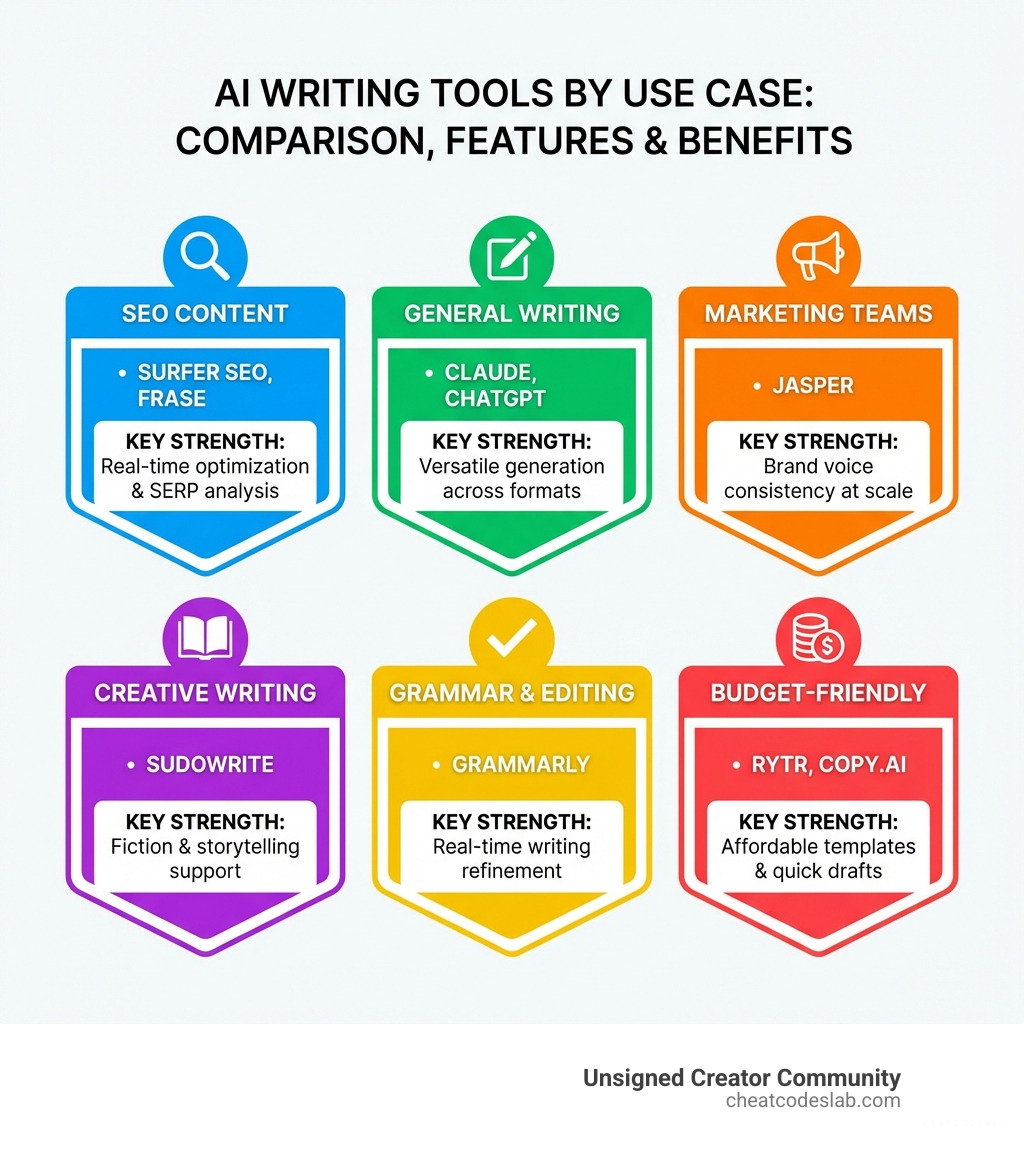
Top AI Writing Tools by Use Case:
| Best For | Recommended Tool | Key Strength |
|---|---|---|
| SEO Content | Surfer SEO, Frase | Real-time optimization and SERP analysis |
| General Writing | Claude, ChatGPT | Versatile content generation across formats |
| Marketing Teams | Jasper | Brand voice consistency at scale |
| Creative Writing | Sudowrite | Fiction and storytelling support |
| Grammar & Editing | Grammarly | Real-time writing refinement |
| Budget-Friendly | Rytr, Copy.ai | Affordable templates and quick drafts |
The content creation landscape has shifted dramatically. What used to take 5-6 hours for a single 2,000-word article can now be completed in 2-3 hours with AI assistance. According to SurveyMonkey, 90% of marketers use AI for faster decision-making, and Semrush reports that 65% of companies have noted better SEO results when using AI.
But here’s the challenge: not all AI writing tools are created equal.
Some excel at SEO optimization but produce robotic copy. Others generate human-like content but miss the mark on search rankings. Many creators waste time and money testing tools that promise the world but deliver generic, unusable drafts.
The truth? The “best” AI writing tool depends entirely on what you’re creating and how you work. A solo blogger needs different features than a marketing team managing brand voice across dozens of campaigns. An SEO-focused content shop requires different capabilities than a creative writer drafting fiction.
The real question isn’t which tool is objectively best—it’s which tool is best for you.
This guide cuts through the hype. We’ll break down the leading AI writing tools by specific use cases, compare their strengths and limitations, and help you build a practical AI content workflow that actually works. You’ll learn which tools excel at SEO optimization, which ones handle creative copy, and how to integrate AI into your existing process without sacrificing quality.
I’m digitaljeff, and over the last 20 years building brands and generating over 1 billion views across social platforms, I’ve tested dozens of solutions to determine what is the best ai content writing tool for different content challenges. Let me show you what actually delivers results.
Simple guide to what is the best ai content writing tool terms:
Evaluating What is the Best AI Content Writing Tool for Your Business
When we sit down to choose a tool, we aren’t just looking for a “text generator.” We are looking for a partner that understands our goals. In 2025 and 2026, the market has matured. We no longer just ask if an AI can write; we ask how well it integrates into our business.
To find what is the best ai content writing tool for your specific needs, we have to look at several pillars of performance:
- Content Quality: Does the output sound like a human, or does it feel like a repetitive robot?
- SEO Capabilities: Can it analyze the Search Engine Results Pages (SERPs) and tell us exactly which keywords to include?
- Brand Voice Adaptation: Can we “train” the tool to speak in our specific tone—whether that’s professional, snarky, or warm?
- Workflow Efficiency: Does it connect with Google Docs, WordPress, or our social media schedulers?
According to semrush.com, 65% of companies have noted better SEO results when using AI. This isn’t just because the AI writes faster; it’s because it can process data that would take a human hours to research. For those of us focused on organic growth, checking out AI for SEO Content is a great way to understand this synergy.
| Feature | General LLMs (Claude/ChatGPT) | Specialized Marketing Tools (Jasper/Copy.ai) | SEO Optimizers (Surfer/Frase) |
|---|---|---|---|
| Primary Goal | Versatility & Reasoning | Brand consistency & Speed | Search Rankings |
| Ease of Use | High (Chat-based) | Medium (Template-heavy) | Medium (Data-rich) |
| Customization | Infinite (via Prompts) | High (Brand Voice features) | Low (Focus on Keywords) |
| Best For | Research & Drafting | Social Media & Ad Copy | Long-form Blog Posts |
Top Picks: What is the Best AI Content Writing Tool for SEO?
If your main goal is to show up on the first page of Google, your requirements are very specific. You don’t just need “good writing”; you need “optimized writing.”
In our experience, Surfer SEO and Frase are the heavy hitters here. These tools don’t just guess what keywords you need. They scrape the top 10-20 results currently ranking for your target keyword and build a blueprint. They look at “entities”—the specific concepts and terms that search engines expect to see in a high-quality article on that topic.
- Surfer SEO: Known for its “Content Score.” As you write, the score increases in real-time as you add recommended terms. It also provides “Topical Maps” to help you build authority across an entire subject.
- Frase: Excellent for the research phase. It can automatically generate a content brief by pulling questions from Reddit, Quora, and the “People Also Ask” section of Google.
- NeuronWriter: A fantastic budget-friendly alternative that offers entity-first optimization and multilingual support, which is perfect for solo bloggers.
Using an AI SEO Content Generator allows us to stop guessing and start following a data-driven path to the top of the search results.
Specialized Solutions: What is the Best AI Content Writing Tool for Creative and Marketing Copy?
Writing a novel or a high-converting Facebook ad requires a different kind of “brain” than writing a technical SEO guide.
For those of us in the creative and marketing trenches, we need tools that understand emotion and persuasion.
- Sudowrite: This is the undisputed king of fiction. Unlike general models, it has features like “Story Bible” and “Sensory Descriptions.” If you want your AI to describe the smell of a rain-soaked forest or the tension in a room, Sudowrite is built for exactly that. It uses a model specifically trained on fictional storytelling.
- Anyword: If you are a performance marketer, Anyword is your best friend. It uses “Predictive Scoring” to tell you how well your copy will perform with your target audience before you even hit “publish.” It’s like having a focus group inside your computer.
- Copy.ai: With over 10 million users, it has evolved into a “GTM” (Go-To-Market) platform. It’s perfect for taking a single webinar transcript and turning it into a blog post, ten social media snippets, and a follow-up email sequence in seconds.
For a deeper dive into these specialized engines, we recommend exploring AI Content Generation Tools.
Key Features to Look for in AI Writing Software
With hundreds of tools popping up, it’s easy to get “shiny object syndrome.” To stay grounded, we always look for these core features:
- Large Language Models (LLMs): Does the tool use GPT-4o, Claude 3.5 Sonnet, or its own proprietary model? Top-tier tools usually give you a choice.
- Brand Voice: Can the tool analyze your previous blog posts and mimic your style? This is essential for maintaining consistency as you scale.
- Template Library: While we love a blank chat box, sometimes we just need a “Product Description” or “YouTube Script” template to get moving.
- Plagiarism Checks: Even though AI creates original text, it can occasionally mirror existing phrases too closely. Built-in checks (like those in Grammarly or AI-Writer) provide peace of mind.
- Multi-language Support: If you are targeting a global audience, look for tools like WriteSonic or SEO.ai that support 50+ languages natively.
For a complete breakdown of what to prioritize, our AI Content Creation Tools Guide covers the technical “must-haves” in detail.
Free vs. Paid AI Writing Tools: Which Offers Better Value?
We get asked this all the time: “Can’t I just use the free version of ChatGPT?”
The answer is: Yes, for about 90% of basic writing tasks. If you are a solo creator just starting out, free tools like Claude, ChatGPT, and ParagraphAI (which offers a “free forever” tier) are more than enough. They allow you to brainstorm, outline, and draft without a monthly bill.
However, once you hit a bottleneck, paid tools become worth the investment. You are usually paying for:
- Higher Usage Limits: No more “at capacity” messages during your peak work hours.
- Advanced Models: Access to reasoning-heavy models that produce much better long-form content.
- SEO Integration: Tools that connect directly to search data.
- Brand Governance: Keeping a team of five writers all sounding like the same brand.
If you’re on a tight budget, check out our list of the Best Free AI Writing Software to see which platforms offer the most generous free tiers.
Integrating AI into Your Professional Content Workflow
The “best” tool in the world is useless if it makes your life harder. We believe the secret to high-output content creation is a “lean stack.”
Here is our favorite “Recipe” for a professional blog post:
- Research: Use Frase or Surfer to generate a SERP-driven brief.
- Drafting: Take that brief into Claude or Jasper. Use a detailed prompt that specifies your tone and audience.
- Optimization: Paste the draft back into your SEO tool to close “entity gaps” and add internal links.
- Polish: Run the final version through Grammarly or ProWritingAid to catch typos and tone inconsistencies.
Many of these tools now offer Google Docs integrations or browser extensions. This means you don’t have to constantly switch tabs. You can have your SEO score and your AI assistant right there in your writing surface. This “integrated drafting” is the future of AI in Content Creation.
The Future of AI and Human Collaboration in Writing
Will AI replace writers? In our opinion: No. But writers who use AI will replace writers who don’t.
We like to think of AI as a “Co-Pilot.” It handles the “busywork”—the research, the initial drafting, the formatting—so we can focus on the “Strategy.”
Google’s “Helpful Content” guidelines now emphasize E-E-A-T (Experience, Expertise, Authoritativeness, and Trustworthiness). AI can provide the information, but it cannot provide your experience. It hasn’t lived your life, it hasn’t talked to your customers, and it doesn’t have your unique “human weirdness.”
Our rule of thumb is the 70/30 Rule:
- 70% AI: Use it for the heavy lifting, the research, and the first draft.
- 30% Human: This is where the magic happens. We add personal anecdotes, fact-check the AI’s “hallucinations,” and ensure the emotional resonance is there.
As we move toward AI-Driven Content Creation, the most successful creators will be those who act as “Editors-in-Chief” of their AI assistants.
Conclusion: Mastering Your AI Content Strategy
Finding what is the best ai content writing tool isn’t about finding a magic button that does all the work for you. It’s about finding the right gear for your specific engine.
Whether you choose Claude for its natural reasoning, Surfer SEO for its search dominance, or Jasper for its marketing prowess, the goal remains the same: to create content that truly connects with your audience while saving you from the “blinking cursor” syndrome.
At CheatCodesLab, we specialize in providing certified AI tools and “cheat codes” for content marketing and SEO. We know that the landscape changes fast, which is why we focus on top-tier solutions that ensure SEO success for online creators and agencies.
Ready to level up your production? Explore More info about AI content services and find the perfect partner for your content journey. The best tool is the one you actually use to ship better work, faster. Happy writing!


About the author


How to Archive Posts on Instagram in 4 Easy Steps
Master archiving on Instagram in 4 easy steps to organize your profile and protect your content.

Beginner’s Guide to 10k free instagram followers app
Discover how a 10k free instagram followers app works, its risks, and safe organic growth strategies for real engagement in 2026.

Beginner’s Guide to Best Instagram Report App
Discover the best Instagram report app for real-time analytics, automated reports, and data-driven decisions in 2026.
How to Master Advanced SEO Search Techniques in 7 Steps
Master advanced search techniques in SEO with 7 proven steps to boost rankings, technical audits, and organic traffic.

Cheat Sheet to the Best Business Apps
Discover the best business apps to streamline operations, boost productivity, and scale your business in 2026.

How to Get Instagram Followers Free APK in 5 Steps
Discover how instagram followers free apk 2026 download works and learn safe organic growth strategies instead of risky third-party tools.
Related
Beginner’s Guide to Best Instagram Report App
Discover the best Instagram report app for real-time analytics, automated reports, and data-driven decisions in 2026.
Cheat Sheet to the Best Business Apps
Discover the best business apps to streamline operations, boost productivity, and scale your business in 2026.

The Ultimate Guide to AI Generated SEO Content Tools
Master ai generated seo content with proven tools, Google guidelines, and GEO strategies that boost rankings and drive real results.

The Complete Guide to 1k Followers App
Discover how a 1k followers app can help you reach TikTok Live and boost Instagram growth fast with safe, organic strategies.
The Ultimate Guide to Best Local SEO Tools
Discover the best local seo tools to boost visibility, manage citations, and optimize your Google Business Profile in 2026.

Backlink Building Tool Survival Guide
Discover top backlink building tool strategies: Compare Ahrefs, Semrush, AI outreach like Linkee, free options, and penalty recovery tips for 2026 SEO success.