

Why CBT Works: The Enduring Influence of Stoic Philosophy on Modern Therapy
The Ancient Secret to Modern Resilience
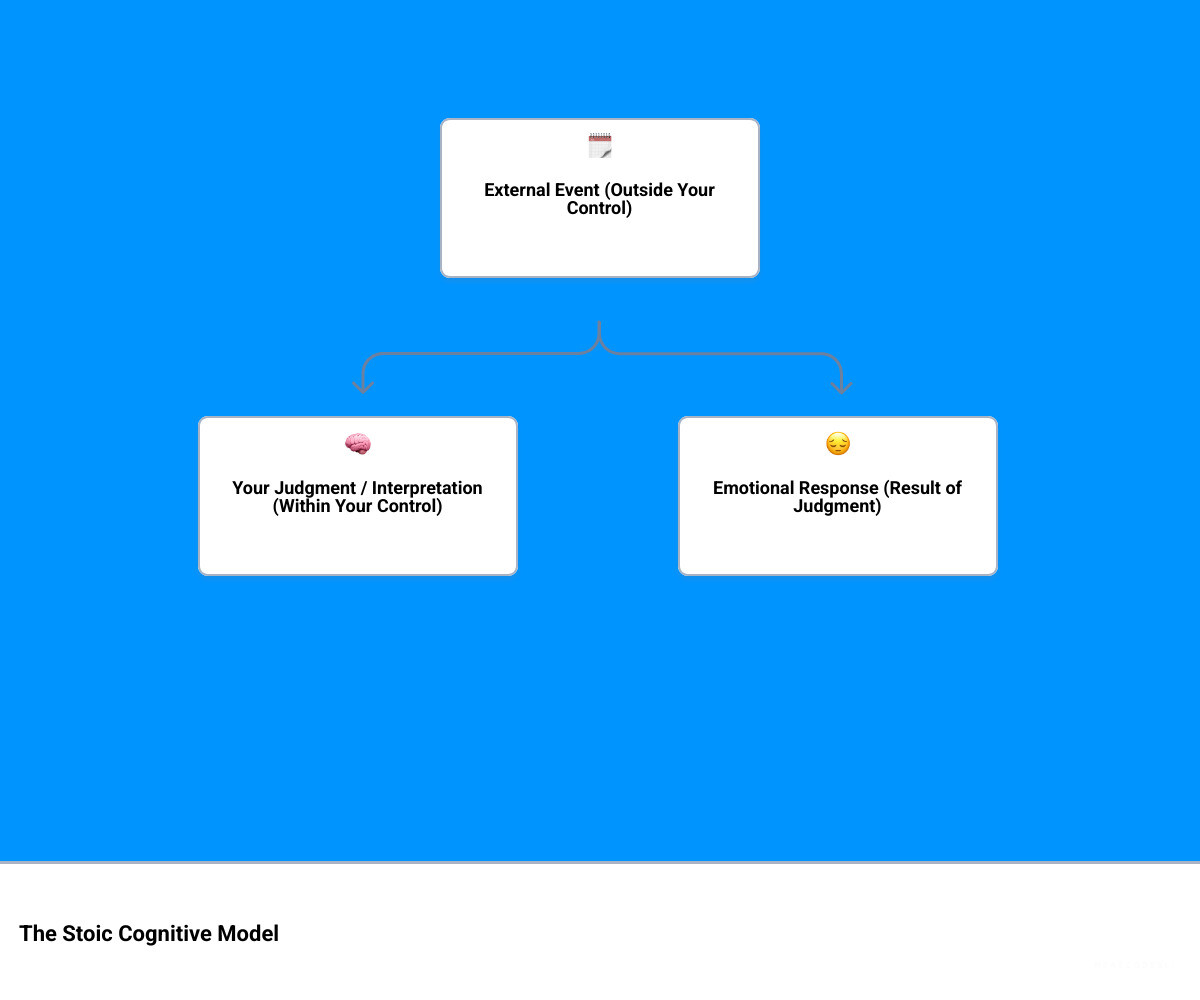
Stoicism and cognitive behavioral therapy share a powerful connection that spans over two thousand years. At their core, both teach that it’s not events themselves that disturb us, but rather our judgments and interpretations of those events. This fundamental insight—first articulated by Stoic philosopher Epictetus—forms the foundation of modern CBT and offers practical tools for managing anxiety, stress, and emotional overwhelm in our hyper-connected world.
Key Connections Between Stoicism and CBT:
- Core Principle: Our thoughts about events, not the events themselves, determine our emotional responses
- Focus on Control: Both emphasize distinguishing between what we can and cannot control
- Practical Techniques: Cognitive restructuring in CBT mirrors Stoic exercises like negative visualization and objective representation
- Historical Link: CBT founders Albert Ellis and Aaron Beck explicitly acknowledged Stoicism as the philosophical foundation of their therapeutic approaches
- Mindfulness: Stoic “prosoche” (attention to the present moment) predates and parallels modern mindfulness-based therapies
You never forget your first panic attack. For many people, that moment of overwhelming anxiety becomes a turning point—a search for tools to regain control over their inner world. While modern Cognitive Behavioral Therapy offers scientifically-validated techniques for managing emotional distress, its roots stretch back to ancient Rome, where Stoic philosophers like Epictetus, Seneca, and Marcus Aurelius developed a sophisticated system of psychological resilience.
The British government has placed CBT at the center of its National Mental Health Service, hoping to halve the number of people with depression and anxiety. But what makes CBT so effective? The answer lies partly in its ancient philosophical foundations. As Epictetus taught over 2,000 years ago: “Men are disturbed not by things, but by the views which they take of them.”
This isn’t just philosophical abstraction. Modern research shows that ruminating over events outside our control significantly impacts mental well-being, leading to increased anxiety, stress, and feelings of helplessness. Conversely, individuals who focus on what they can control—their thoughts, actions, and responses—demonstrate better psychological resilience.
I’m Jeffrey Castillo (digitaljeff), a tech entrepreneur and content strategist who has spent years helping creators build resilient personal brands while managing the mental challenges of the digital age. Through exploring stoicism and cognitive behavioral therapy in my own life and work with thousands of content creators, I’ve witnessed how these ancient principles offer practical solutions for modern stress, particularly for those of us navigating constant information overload and social media pressure.
Common stoicism and cognitive behavioral therapy vocab:
The Ancient Roots of Modern Healing: Stoicism and Cognitive Behavioral Therapy
What is Stoicism? The Philosophy of Inner Peace
At its heart, Stoicism is an ancient Greek philosophy that teaches us to focus on what we can control and accept what we cannot. Founded by Zeno of Citium around 350 BC in Athens, it emerged as a practical guide to living a good life, free from emotional suffering. The Stoics believed that true happiness, or eudaimonia, comes from living in harmony with nature and exercising virtue, regardless of external circumstances.
The core principles of Stoicism are beautifully simple yet profoundly impactful:
- The Dichotomy of Control: This is arguably the most fundamental Stoic principle. It posits that some things are within our control (our thoughts, judgments, desires, and actions) and some are not (external events, other people’s opinions, our health, wealth, or reputation). As Epictetus famously stated, “We should always be asking ourselves: ‘Is this something that is, or is not, in my control?'” By focusing our energy solely on what we can control, we avoid distress and cultivate inner tranquility. The adverse psychological effects of focusing on things outside of our control are significant; rumination over unchangeable past failures or future uncertainties can trap us in cycles of negative thoughts, leading to increased anxiety, stress, and feelings of helplessness.
- Virtue Ethics: For the Stoics, virtue was the sole good, encompassing wisdom, justice, courage, and temperance. They believed that living virtuously was the path to a flourishing life, and that these virtues were intrinsically valuable, not merely means to an end. This emphasis on character and moral excellence provides a robust internal compass, guiding our actions and responses regardless of external pressures.
- Living in Accordance with Nature: This principle encourages us to live rationally, aligning our actions with the universal order and our own rational faculty. It means accepting the natural flow of life, including its challenges, and understanding our place within the larger cosmos.
These principles combine to help us build what the Stoics called an “inner citadel”—a mental fortress that remains unperturbed by external disturbances. It’s a powerful metaphor for mental resilience, a state where our inner peace is not contingent on the unpredictable outside world. To dig deeper into this profound philosophy, we recommend exploring our Stoicism Complete Guide.

The Philosophical Blueprint: Core Tenets of Stoicism and Cognitive Behavioral Therapy
Now, let’s turn our attention to modern therapeutic approaches. Cognitive Behavioral Therapy (CBT) is widely recognized as the most effective form of psychotherapy for emotional disorders like depression, anxiety, and post-traumatic stress disorder. But how does CBT help individuals manage thoughts, emotions, and behaviors, and where do its principles overlap so profoundly with Stoicism?
CBT operates on the premise that our thoughts, feelings, and behaviors are interconnected. It helps individuals identify and modify dysfunctional thoughts, emotions, and behaviors by focusing on our reactions and perceptions rather than external events themselves. When we’re faced with a challenging situation, it’s not the event that directly causes our emotional response, but our interpretation of it. CBT techniques guide us to challenge these interpretations and replace unhelpful thought patterns with more balanced and realistic ones.
The overlap with Stoicism is striking. Both approaches teach us that:
- Our interpretations matter most: As the Stoics taught, and CBT reaffirms, it’s our “views” or “judgments” about events that cause us distress, not the events themselves. This is the cornerstone of cognitive restructuring, a primary CBT technique.
- Focus on what’s controllable: CBT empowers individuals to take responsibility for their internal world—their thoughts and reactions—recognizing that while we can’t always control external circumstances, we always have a choice in how we respond.
- Rationality over Emotion: Both emphasize the power of reason to overcome irrational beliefs and destructive emotions.
Indeed, the founders of modern cognitive therapies explicitly acknowledged this ancient lineage. Albert Ellis, who developed Rational Emotive Behavior Therapy (REBT), and Aaron Beck, the founder of CBT, both stated that Stoicism was the philosophical precursor to their treatment approaches. They saw in Stoic wisdom a blueprint for understanding and alleviating psychological suffering.
Beyond traditional CBT, its “third wave” approaches further strengthen this connection. Therapies like Dialectical Behavioral Therapy (DBT) and Acceptance and Commitment Therapy (ACT) incorporate elements like mindfulness, emotional regulation, and radical acceptance—all concepts deeply rooted in Stoic philosophy. For example, DBT’s emphasis on “radical acceptance” mirrors the Stoic practice of accepting what is not within our control, while ACT’s focus on values-based living aligns with Stoic virtue ethics.
The effectiveness of CBT is not just theoretical; it’s backed by substantial evidence. The British government’s initiative to integrate CBT into its ‘National Mental Health Service’ underscores its widespread acceptance and proven benefits for mental well-being.

Bridging Millennia: The Historical Link Between Stoicism and Cognitive Behavioral Therapy
The historical connection between ancient Stoic philosophy and contemporary therapeutic practices is not merely coincidental; it’s a direct lineage. Within a few generations of Socrates’ death, the idea of philosophy as psychotherapy became commonplace among Hellenistic schools, with the Stoics placing the most emphasis on this therapeutic dimension. They were, in essence, ancient psychotherapists, offering a system for healing the soul.
As we’ve noted, Albert Ellis and Aaron Beck, the pioneering figures of cognitive therapy, explicitly acknowledged Stoicism as the philosophical wellspring of their ideas. Ellis, for instance, frequently quoted Epictetus’s dictum about being disturbed by our views, not by things. Beck illustrated his cognitive model with Marcus Aurelius’s quote: “If thou art pained by any external thing, it is not the thing that disturbs thee, but thine own judgment about it.” This profound insight forms the bedrock of the cognitive model of emotion, which posits that our thoughts mediate our emotional and behavioral responses to events.
The Stoics also employed a method of inquiry strikingly similar to modern Socratic questioning. This technique, central to CBT, involves a collaborative dialogue where we systematically challenge and examine our beliefs to uncover underlying assumptions and cognitive distortions. The goal isn’t to prove someone wrong, but to foster curiosity and collaboratively explore different perspectives, leading to more rational and adaptive thought patterns.
Let’s look at some direct parallels between ancient Stoic exercises and modern CBT techniques:
| Stoic Exercise | Description | CBT Technique |
|---|---|---|
| Premeditatio Malorum (Negative Visualization) | Proactively thinking about worst-case scenarios to prepare emotionally and practically, reducing the shock and fear if they occur. This practice builds resilience by desensitizing us to potential misfortunes. | Decatastrophizing |
| Objective Representation | Describing events and experiences factually, without adding subjective judgments, emotional coloring, or interpretations. This helps to see situations for what they are, not what our fears or biases make them out to be. | Cognitive Restructuring / Thought Records |
| The View from Above | A meditative exercise where one visualizes events from a cosmic, detached perspective. This helps to put personal problems into a larger context, reducing their perceived magnitude and emotional weight. | Cognitive Distancing / Reframing |
| Dichotomy of Control | Clearly distinguishing between what is within our power (our thoughts, judgments, actions) and what is not (external events, others’ opinions). Energy is then focused exclusively on what we can control. | Responsibility Pie / Locus of Control |


About the author


How to Archive Posts on Instagram in 4 Easy Steps
Master archiving on Instagram in 4 easy steps to organize your profile and protect your content.

Beginner’s Guide to 10k free instagram followers app
Discover how a 10k free instagram followers app works, its risks, and safe organic growth strategies for real engagement in 2026.

Beginner’s Guide to Best Instagram Report App
Discover the best Instagram report app for real-time analytics, automated reports, and data-driven decisions in 2026.

How to Master Advanced SEO Search Techniques in 7 Steps
Master advanced search techniques in SEO with 7 proven steps to boost rankings, technical audits, and organic traffic.

Cheat Sheet to the Best Business Apps
Discover the best business apps to streamline operations, boost productivity, and scale your business in 2026.

How to Get Instagram Followers Free APK in 5 Steps
Discover how instagram followers free apk 2026 download works and learn safe organic growth strategies instead of risky third-party tools.
Related

Brad Lea x Digitaljeff talk CheatCodes
Digitaljeff on the Brad Lea Podcast - DROPPING BOMBS with the REAL BRAD LEA Key insights 🧠 In the world of AI, original thought is more valuable than ever, as people are easily distracted and struggle to come up with new ideas. 🤖 AI can enhance your ability to make money if you leverage it right, especially with GPT CU. 🔑 The key to communicating with AI is prompt engineering and knowing how to phrase questions to get the best result. 🤖 AI is getting smarter and better at an exponential rate, and it's only going to improve. 💰 Companies can use GPT chatbots to offer valuable advice and generate leads, potentially making a fortune. 📈 Leveraging AI like GPT can help scale your business by making operations more efficient and effective, potentially doubling or even tripling your workforce without […]

How To Escape The Matrix
Digitaljeff enters the matrix to interview Ryan Blair. Key Notes from the Interview: Spiritual Growth and Personal Development 🌟 Understanding what love is not is essential in order to truly value and attach to the fuel source of love in our lives. 🌟 "You have to have gratitude with ambition, patience with persistence, and marry opposing fuel sources to propel you." 🙏 Pray for the desire to have more desire, to build more positive energy within you. 🙏 Jesus was tempted three times, showing that even the most spiritual figures face temptation, but it's how we handle it that matters. 📚 The speaker opens up his "antenna" to receive revelations and shares them with as many people as possible in the movement he's building. 🌅 "I have morning rituals not morning routines. So I wake up I meditate I pray […]