



Stoicism: 5 Keys to a Resilient Mind
Introduction to Stoicism: A Practical Philosophy for Modern Life
The Foundations of Stoicism: Principles, People, and Perspectives
Core Principles: Virtue, Reason, and Living in Accord with Nature
Picture this: you’re scrolling through social media, watching others celebrate their wins while you’re stuck in a creative rut. Your first instinct might be to compare yourself or feel frustrated. But Stoicism offers a different approach – one that’s been helping people find peace and purpose for over 2,000 years.
At its core, Stoicism teaches us something that might sound counterintuitive: true happiness doesn’t come from getting what we want, but from wanting what we have and focusing on what we can control. The ancient Stoics believed that virtue – living according to wisdom, justice, courage, and self-discipline – is the only real good in life.
Everything else? Your follower count, your income, even your health – these are what Stoics called “indifferents” or adiaphora. They’re not inherently good or bad; they’re just circumstances. What matters is how we respond to them with virtue.
The four cardinal virtues form the foundation of Stoic practice. Wisdom helps us see situations clearly and make good decisions. Justice guides us to treat others fairly and consider the bigger picture. Courage gives us strength to face challenges, whether that’s launching a new project or having a difficult conversation. Temperance keeps us balanced and prevents us from going overboard in any direction.
When Stoics talk about “living according to nature,” they’re not suggesting we abandon modern life. Instead, they mean living according to our rational nature as human beings. We have the unique ability to think, reason, and make conscious choices. That’s our superpower – and Stoicism teaches us how to use it.
The dichotomy of control might be the most practical concept you’ll ever learn. Some things are completely up to us – our thoughts, judgments, and actions. Others are completely outside our control – other people’s opinions, market changes, or technical glitches. The magic happens when we stop wasting energy on what we can’t control and pour it into what we can.
Think about it this way: when your website crashes during a product launch, you can’t control the technical failure. But you can control whether you panic or calmly implement your backup plan. You can’t control if people criticize your content, but you can control how you respond and what you learn from it.
This isn’t just ancient philosophy – it’s the foundation of modern Cognitive Behavioral Therapy and countless self-help approaches. The Stoics figured out thousands of years ago what psychology confirms today: our thoughts about events affect us more than the events themselves.
The Three Great Roman Stoics: A Slave, a Statesman, and an Emperor

Here’s what makes Stoicism so compelling: it worked for people in completely different life situations. A wealthy advisor, a disabled slave, and a powerful emperor all found the same path to inner peace and wisdom.
Seneca the Younger was basically the Roman version of a billionaire tech executive. As advisor to Emperor Nero and one of Rome’s wealthiest men, he had everything our culture says should make us happy. Yet his Letters from a Stoic reveal someone who understood that external success meant nothing without inner virtue.
Seneca didn’t advocate for poverty – he advocated for freedom from the fear of poverty. He regularly practiced voluntary discomfort, sleeping on the floor or eating simple meals, to remind himself that he could handle whatever life threw at him. His approach was refreshingly practical: enjoy good fortune when it comes, but don’t let your happiness depend on it.
His most famous insight? “It is not the man who has too little, but the man who craves more, who is poor.” For content creators constantly chasing the next milestone, this hits different.
Epictetus started life with every disadvantage you can imagine. Born a slave with a physical disability, he had no control over his circumstances. Yet he became one of history’s most influential teachers precisely because he learned that true freedom comes from within.
His Enchiridion (which means “handbook”) reads like a practical guide for modern life. Epictetus taught that we always have the power to choose our responses, no matter what happens to us. When people criticize your work or ignore your content, Epictetus would remind you: their opinions aren’t up to you, but your response absolutely is.
Marcus Aurelius proves that Stoicism isn’t about avoiding responsibility – it’s about handling it better. As Roman Emperor during wars, plagues, and political chaos, he had more stress than most of us can imagine. His Meditations weren’t meant for publication; they were personal journal entries where he worked through challenges using Stoic principles.
Marcus Aurelius shows us what Stoicism looks like in practice. He started each day reminding himself of Stoic principles and ended each day reflecting on how well he’d lived them. This practice of morning preparation and evening review is something any creator can adopt today.
What’s remarkable is how these three men – from completely different backgrounds – all found the same truths. Whether you’re struggling with comparison, dealing with criticism, or feeling overwhelmed by responsibility, their wisdom applies. Many famous modern day Stoics continue to prove its relevance today.
Mastering Your Mind: The Stoic Approach to Emotions
Let’s clear up the biggest myth about Stoicism: it doesn’t teach you to become emotionless. That’s not healthy or even possible. Instead, it teaches you to understand the difference between natural emotional reactions and destructive emotional patterns.
The Stoics made a crucial distinction between initial impressions and our judgments about them. When your content gets harsh criticism, feeling hurt is natural and unavoidable. But if you spiral into self-doubt, rage, or despair, you’ve moved from a natural reaction to what Stoics called a “passion” – a destructive emotion based on false judgments.
Stoicism teaches us to examine our judgments. Is this criticism actually helpful? Does one person’s opinion define your worth? Are you catastrophizing about what this means for your future? Usually, we’ll find that our initial dramatic thoughts don’t hold up to scrutiny.
The concept of apatheia (often misunderstood as “apathy”) doesn’t mean not caring. It means achieving a state where you’re not controlled by destructive emotions. You can still feel joy, love, and appropriate concern – what Stoics called eupatheia or “good feelings.” The difference is that these emotions are based on accurate judgments rather than false beliefs.
Think of it as developing an “inner citadel” – a core part of yourself that external events can’t touch. Your worth as a creator doesn’t depend on likes, shares, or revenue. It depends on whether you’re doing your best work and acting with virtue.
This approach transforms how we handle setbacks. Instead of asking “Why is this happening to me?” we ask “How can I respond virtuously to this situation?” This shift from victim to agent is incredibly empowering, especially for creators dealing with algorithm changes, market shifts, or creative blocks.
Stoicism also teaches premeditation – not worrying about the future, but mentally preparing for challenges so they don’t catch us off guard. If you’ve already considered how you’d handle a project failure or negative feedback, you’re less likely to be overwhelmed when it happens.
The goal isn’t to eliminate all negative emotions – it’s to respond to them wisely. When you feel frustrated, jealous, or discouraged, Stoicism gives you tools to examine those feelings, learn from them, and choose your response consciously rather than reactively.
For more insights on applying these principles to challenging situations, check out our guide on Stoicism and Toxic Relationships and The Art of Focus.
Putting Stoicism Into Practice: Exercises and Modern Relevance
The Stoic’s Toolkit: 5 Practical Exercises for a Better Life

The beauty of Stoicism lies in its practicality. These aren’t abstract theories gathering dust on philosophy shelves—they’re tools you can start using today to transform how you handle stress, setbacks, and daily challenges.
Premeditatio Malorum (negative visualization) might sound like a recipe for anxiety, but it’s the opposite. By briefly imagining potential problems—what if your main traffic source disappeared, or a key client left?—you prepare backup plans and deepen gratitude for what you have.
Memento Mori (remember death) reshapes priorities. Marcus Aurelius reminded himself daily that life is finite, which pushed him to focus on virtue over petty distractions. For creators, contemplating mortality slices through perfectionism: publish the course, ship the product, help people now.
Amor Fati (love of fate) represents advanced practice. It means welcoming events—good or bad—as fuel for growth. When a planned launch fails, ask: “What lesson does this hold?” The obstacle becomes the way forward.
The View from Above delivers instant perspective. Picture your current problem from orbit or from the viewpoint of someone in the distant future. A flopped post or harsh feedback shrinks to a blip on the cosmic timeline.
Daily Journaling and Reflection was Marcus Aurelius’s secret weapon. Morning pages help set intentions; evening reviews extract lessons. Simple prompts—What went well? Where did I live the virtues? What can I control tomorrow?—keep you on track. Explore more ideas in our guide on Every Day Stoic.
From Ancient Rome to Modern Times: The Enduring Legacy of Stoicism
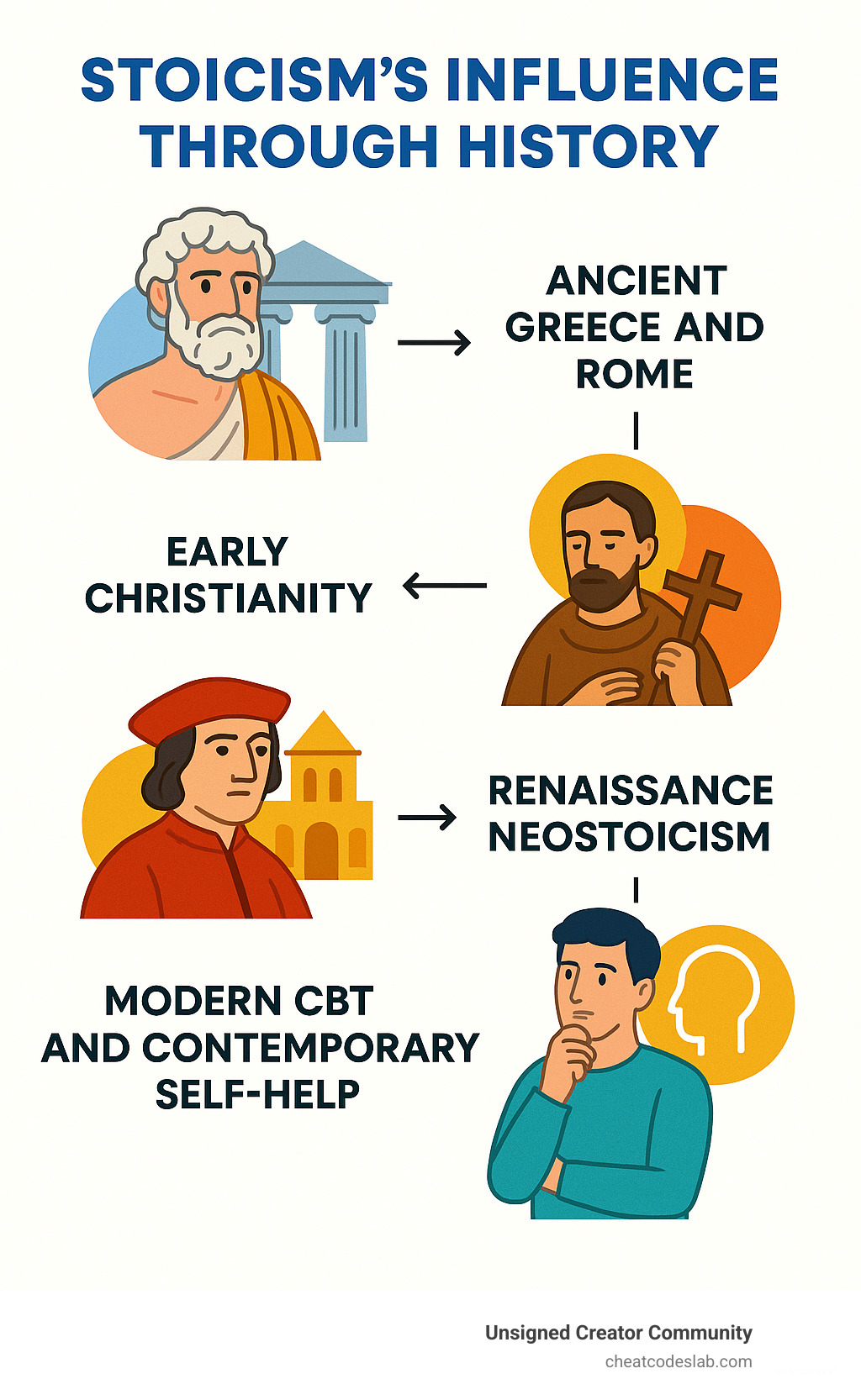
Stoicism has quietly influenced Western civilization for two millennia, and its impact keeps growing. Modern Cognitive Behavioral Therapy draws directly from Stoic principles, especially the insight that our thoughts shape our emotions more than events do.
Stoic Week, launched in 2012, now attracts thousands who commit to living like Stoics for seven days, proving the philosophy’s relevance to challenges such as social-media overwhelm and career uncertainty.
The philosophy shaped historical figures like George Washington, who carried Cato’s speeches and modeled his leadership on Stoic ideals. For more, see George Washington Stoicism. Early Christianity also absorbed Stoic ideas—our article on St Paul and Stoicism explores this overlap.
Today, entrepreneurs accept Stoicism to steer uncertain markets. The Stanford Encyclopedia of Philosophy offers deeper scholarly context.
The Stoic Path to Enduring Happiness
True happiness, according to Stoicism, isn’t fleeting pleasure from external wins. It’s eudaimonia—deep fulfillment from living in line with our highest values.
Even Marcus Aurelius struggled, as his Meditations reveal, but progress mattered more than perfection. For modern creators, that perspective is liberating: success is measured by how consistently we apply Stoic principles, not by never failing.
Stoicism shows we already have everything we need: the capacity to think clearly, act virtuously, and respond wisely. External success becomes a welcome bonus, not a prerequisite for happiness.
The journey is lifelong, yet benefits begin immediately. Start small, practice daily, and build your philosophical toolkit one step at a time. Our resources on Mastering the Stoic Way of Life can guide you further.
The ancient Stoics insisted that philosophy should be practical. In today’s world of constant change, their 2,000-year-old wisdom offers exactly what we need: clarity, resilience, and an inner peace rooted in what truly matters.


About the author


How to Archive Posts on Instagram in 4 Easy Steps
Master archiving on Instagram in 4 easy steps to organize your profile and protect your content.

Beginner’s Guide to 10k free instagram followers app
Discover how a 10k free instagram followers app works, its risks, and safe organic growth strategies for real engagement in 2026.

Beginner’s Guide to Best Instagram Report App
Discover the best Instagram report app for real-time analytics, automated reports, and data-driven decisions in 2026.

How to Master Advanced SEO Search Techniques in 7 Steps
Master advanced search techniques in SEO with 7 proven steps to boost rankings, technical audits, and organic traffic.

Cheat Sheet to the Best Business Apps
Discover the best business apps to streamline operations, boost productivity, and scale your business in 2026.

How to Get Instagram Followers Free APK in 5 Steps
Discover how instagram followers free apk 2026 download works and learn safe organic growth strategies instead of risky third-party tools.
Related

Get Your Feed Right with These Black Owned Social Media Companies
Discover top black owned social media agency options for 2026. Boost ROI, engagement & authentic storytelling with Clutch-rated leaders like Verbatim.
Stoicism Meets Jungian Psychology: A Powerful Pairing for Mental Fortitude
Unlock mental fortitude & self-understanding with carl jung stoicism. Integrate ancient wisdom and modern psychology for resilience.

Stoic Explained: More Than Just a Stiff Upper Lip
Want to define stoic? Uncover ancient Stoic philosophy, core principles, and practical wisdom for emotional resilience today.

Where to Find The Daily Stoic at Fully Booked Stores
Find The Daily Stoic even if it's daily stoic fully booked. Discover why this bestseller is so popular & where to get your copy now!

The Ancient Roots: How Stoicism Shaped Early Christianity
Explore stoicism in early christianity: uncover shared virtues, key differences, and its lasting historical influence.

The Crossroads of Faith and Philosophy: Exploring Stoicism and Christianity
Uncover the surprising parallels and core differences between stoicism and christianity for a meaningful life.