


Automated SEO Testing: Unlock Magic in 2025
What is Automated SEO Testing and Why It Matters
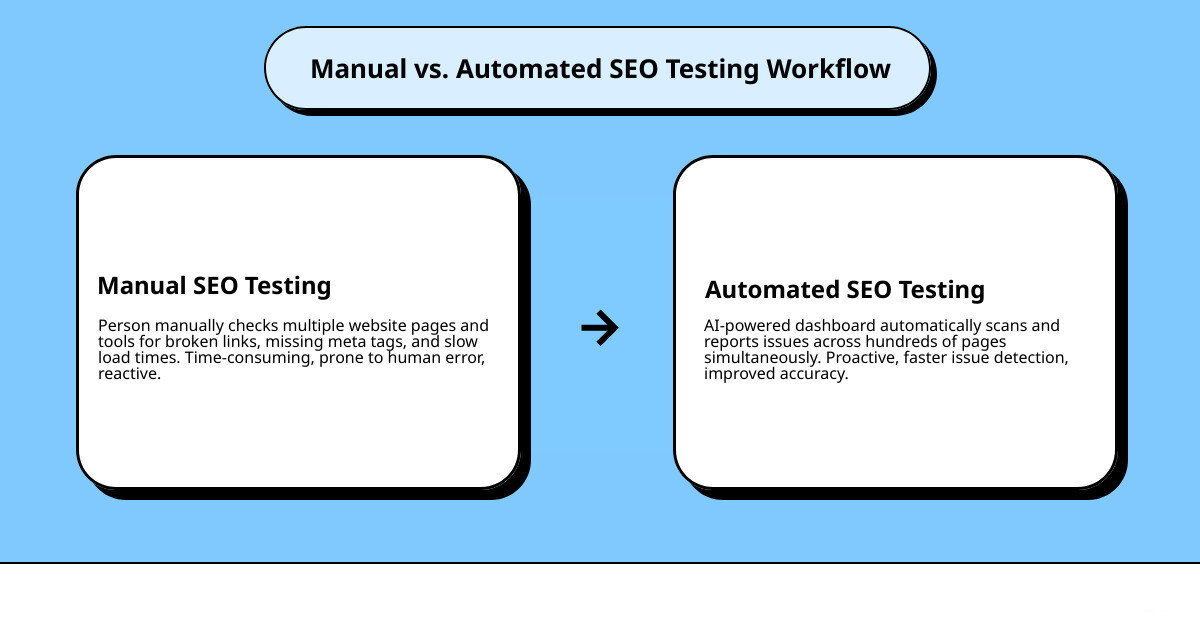
Automated SEO testing is the process of using software tools to continuously monitor, analyze, and validate your website’s search engine optimization performance without manual intervention. Instead of manually checking hundreds of pages for broken links, missing meta tags, or slow load times, automated testing runs these checks 24/7 and alerts you to issues before they impact your rankings.
Key benefits of automated SEO testing:
- Time savings – Reduce production time from 8 hours to 2-3 hours per landing page
- Faster issue detection – Identify problems before Google crawls your updated pages
- Improved accuracy – Eliminate human error in repetitive checking tasks
- Cost reduction – Lower than hiring manual SEO work if monthly tool cost < hourly rate
- Continuous monitoring – 24/7 surveillance of your site’s SEO health
- Scalability – Test thousands of pages simultaneously across multiple sites
The shift from manual to automated SEO testing has become essential as companies release software much faster today. With Google accounting for over 70% of desktop search traffic and using HTML title tags 87% of the time in search results, having reliable validation of your SEO data provides the confidence needed in today’s digital environment.
Modern automated SEO testing covers everything from technical crawl issues and on-page optimization to performance monitoring and structured data validation. Tools can now integrate directly into your development workflow, catching SEO mistakes before they go live and preventing the costly traffic drops that come from broken implementations.
I’m digitaljeff, and over the past 20 years building digital brands and content distribution strategies, I’ve seen how automated SEO testing transforms marketing workflows from reactive firefighting to proactive optimization. My experience scaling content to over 1 billion social media views has taught me that systematic automation beats manual processes every time.
Quick automated seo testing terms:
How to Implement Automated SEO Testing for Maximum Impact
Getting started with automated SEO testing might feel overwhelming at first, but think of it like setting up a smart home security system for your website. Once it’s running, you’ll wonder how you ever managed without it.

The beauty of automated testing lies in its ability to catch problems before they become expensive headaches. When your site’s technical SEO, on-page elements, and performance metrics are continuously monitored, you’re essentially giving yourself superpowers to maintain peak search engine visibility.
Your website’s health directly impacts how Google perceives and ranks your content. A site with broken links, missing meta tags, or slow load times sends mixed signals to search engines. But when everything runs smoothly, Google rewards that reliability with better rankings and increased organic traffic.
Identifying and Fixing Technical SEO Issues
Think of technical SEO as your website’s foundation. You can build the most beautiful house in the world, but if the foundation is cracked, everything else becomes unstable.
Crawlability is where it all begins. Search engines need to access your pages to understand what you offer. Automated tools act like digital detectives, simulating Google’s crawlers to spot blocked pages, infinite loops, or navigation dead ends before they hurt your rankings.
Indexability takes this one step further. Just because Google can crawl your page doesn’t guarantee it will appear in search results. Your automated testing should verify that important pages aren’t accidentally tagged with noindex and that JavaScript-heavy content renders properly for search engines. Learn how Google crawls and indexes sites to understand this process better.
Broken links are like potholes on a highway – they create terrible user experiences and waste Google’s crawl budget. Automated checkers work around the clock, testing every internal and external link to catch 404 errors before your visitors do.
Redirect chains might seem harmless, but they’re actually speed bumps that slow down both users and search engines. When you redirect Page A to Page B, which redirects to Page C, you’re creating unnecessary delays. Automated tools map these paths and help you create more efficient routes.
Your XML sitemap serves as a roadmap for search engines, guiding them to your most important content. Automated validation ensures this map stays current and error-free, especially crucial for sites that frequently add new pages or content.
Robots.txt validation prevents those heart-stopping moments when you accidentally block important sections of your site. Automated monitoring catches configuration errors that could hide your best content from search engines.
Verifying On-Page Elements for effective automated seo testing
On-page optimization is where your content strategy meets search engine requirements. Getting these elements right consistently across hundreds or thousands of pages would be impossible manually, but automated SEO testing makes it effortless.
Title tags deserve special attention since Google uses HTML title tags 87% of the time in search results. Your automated testing should verify that every page has a unique, compelling title within character limits that includes your target keywords.
Meta descriptions might not directly influence rankings, but they’re your sales pitch in search results. Automated checkers ensure these snippets are present, engaging, and optimized for click-through rates.
Header tags create the logical structure that both users and search engines rely on to understand your content hierarchy. Automated validation confirms you’re using one H1 per page and maintaining proper heading order throughout your site.
Alt text serves double duty – improving accessibility for visually impaired users while helping search engines understand your images. Automated tools flag missing or generic alt text, prompting you to add descriptive, keyword-rich alternatives.
Structured data using JSON-LD format helps search engines display rich snippets in results, potentially increasing your click-through rates. Automated validators ensure your schema markup is correctly implemented and error-free. For detailed guidance, check out More on Schema Markup.
These automated checks maintain consistency across your entire site, freeing you to focus on creating valuable content rather than manually auditing every page. For additional optimization strategies, explore our On-Page SEO Tips.
Monitoring Core Website Performance Metrics
Website speed has become a make-or-break factor for online success. Users expect lightning-fast experiences, and Google’s algorithms increasingly reward sites that deliver them.
Page speed monitoring catches performance issues before they impact your rankings. Automated tools continuously test load times, identifying bottlenecks like oversized images, inefficient code, or server response delays.
Core Web Vitals represent Google’s specific measurements of user experience quality. Largest Contentful Paint (LCP) measures how quickly your main content appears, First Input Delay (FID) tracks how responsive your site feels to user interactions, and Cumulative Layout Shift (CLS) ensures your page doesn’t jump around while loading. Additionally, Time to First Byte (TTFB) indicates how quickly your server responds to requests.
Mobile-friendliness isn’t optional anymore, with mobile traffic dominating web usage. Automated testing verifies your responsive design works flawlessly across different devices and screen sizes. Test your site with Google’s PageSpeed Insights tool to get detailed performance feedback.
Uptime monitoring provides peace of mind with instant alerts if your site becomes inaccessible. Every minute of downtime potentially costs you traffic, rankings, and revenue.
Regular performance monitoring helps you maintain the fast, reliable experience that keeps users happy and search engines impressed. For comprehensive monitoring strategies, visit Improve your Search Engine Monitoring.
Advanced Strategies and The Future of SEO Automation
As we move beyond the basics, automated SEO testing becomes even more powerful, integrating with broader marketing strategies and leveraging cutting-edge technologies like AI and machine learning. This is where the magic truly happens, changing our SEO efforts from a series of individual tasks into a cohesive, intelligent system that works around the clock.

Think of advanced automated SEO testing as upgrading from a basic calculator to a supercomputer. While the fundamentals remain important, we’re now entering territory where our tools can actually predict problems before they happen and suggest solutions we might never have considered.
The Role of AI and Machine Learning in automated seo testing
AI and Machine Learning are completely changing how we approach automated SEO testing. Instead of just telling us what’s broken, these smart tools can now predict what might break and even fix some issues automatically.
Predictive analytics takes the guesswork out of SEO planning. AI can analyze massive amounts of data to forecast how our website might perform in the coming weeks or months. It’s like having a crystal ball that actually works – we can spot potential ranking drops or traffic changes before they happen and adjust our strategy accordingly.
Anomaly detection is where AI really shines. These systems learn what normal looks like for our website, then immediately flag anything unusual. Maybe our bounce rate suddenly spiked on mobile devices, or certain pages are loading slower than usual. AI catches these patterns that human eyes might miss until it’s too late.
The real game-changer is automated content optimization. AI-powered tools can analyze top-ranking content for any keyword, then provide specific recommendations for our own content. They can suggest optimal keyword density, identify missing semantic entities, and even recommend the best content structure. Some advanced tools can generate optimized meta tags, image alt text, and link anchor text automatically – turning hours of manual work into minutes of automated magic. Explore AI SEO Automation to see how this works in practice.
Semantic analysis helps our content truly understand what users are searching for. Instead of just matching keywords, AI grasps the relationships between concepts and search intent. This means our automated SEO testing can optimize for the meaning behind queries, not just the words themselves.
AI-driven issue detection goes far beyond basic error flagging. These systems can identify complex problems like content decay (when older content slowly loses rankings) and suggest specific updates. They can also handle sophisticated tasks like topic clustering and internal linking strategies that would take human experts hours to plan. For more insights, check out our guide on AI Driven Content Strategy.
Choosing the Right Tools and Ensuring Data Accuracy
Picking the right tools for automated SEO testing can feel overwhelming with so many options available. The key is finding solutions that grow with us and integrate smoothly into our existing workflow.
Scalability should be our first consideration. Can this tool handle our website today and still work when we’ve doubled in size? Integration capabilities matter just as much – we need tools that play nicely with Google Search Console, Google Analytics, and our other marketing platforms. Reporting features should provide clear, actionable insights that we can actually understand and share with our team.
Customization separates good tools from great ones. Every website is unique, so we need testing that adapts to our specific needs rather than forcing us into a one-size-fits-all approach. Finally, reliable support and community resources ensure we’re never stuck when issues arise.
We want tools that combine technical SEO crawling (simulating how Google sees our site) with performance monitoring (tracking speed and Core Web Vitals) and on-page optimization checks (validating title tags, meta descriptions, and structured data). Rank tracking capabilities help us monitor keyword positions, while AI-powered content optimization platforms assist with creating and improving our content strategy.
Data accuracy requires constant vigilance. We always cross-reference data from multiple sources – if one tool flags an issue, we verify it with another tool or check manually. Data validation becomes especially important when ensuring consistency across our site, like making sure page titles match the headlines in our JSON-LD structured data.
Human oversight remains essential despite all this automation. While tools handle repetitive tasks brilliantly, we still need human expertise for strategic decisions and interpreting complex data. We also need to watch for over-reliance on automation, false positives and negatives, and challenges with handling dynamic content on JavaScript-heavy websites.
The investment in automation has been transformative for our workflow efficiency. We’ve seen production time drop from 8 hours per landing page to just 2-3 hours, with more predictable costs and better budget management. To find the right tools for your specific needs, explore our comprehensive guide to the Best SEO Tools.
Integrating with Your Workflow and Future Trends
The real magic of automated SEO testing happens when it becomes part of our daily operations rather than a separate task we remember to do occasionally.
CI/CD pipeline integration transforms how development teams handle SEO. Every time new code gets deployed, automated SEO checks run automatically, catching issues before they reach our live site. Some platforms can even halt a deployment if SEO quality standards aren’t met – preventing problems instead of fixing them later.
Marketing automation integration with platforms like HubSpot or Marketo creates a unified view of our digital performance. SEO data can trigger email campaigns about new content, or performance metrics can inform our paid advertising strategies. This ensures all our marketing efforts work together toward common goals.
Custom alerts keep the right people informed at the right time. Developers get notified about broken links, content creators hear about missing meta descriptions, and managers receive performance summaries. This targeted communication ensures rapid response and minimizes any negative impact.
The future of automated SEO testing looks incredibly exciting. Voice search optimization is becoming more important as people increasingly use conversational queries. Our tools need to optimize for how people actually talk, not just how they type.
AI Overviews and Google’s Search Generative Experience represent a major shift in how search results appear. Automated tools must adapt to analyze and optimize for these AI-powered features, helping our content appear prominently in Google’s AI-generated answers.
Deeper predictive capabilities will make AI even better at forecasting algorithm changes and recommending proactive adjustments. Hyper-personalization may eventually allow us to tailor content and SEO based on individual user behavior, not just broad keyword trends.
No-code and low-code solutions are making sophisticated automation accessible to everyone. Soon, setting up complex automated SEO testing workflows won’t require technical expertise – just good strategic thinking.
CheatCodesLab specializes in providing certified AI tools and cheat codes that make this future accessible today. We’re here to help you steer these exciting developments and stay ahead of the competition. Find more AI tools and software to transform your SEO strategy.
Open up Your Website’s Full Potential
Ready to transform your SEO strategy from manual to magical? Find how our certified AI tools and cheat codes can streamline your efforts and boost your rankings. Don’t let your competitors get ahead—take control of your SEO destiny today!


About the author


How to Archive Posts on Instagram in 4 Easy Steps
Master archiving on Instagram in 4 easy steps to organize your profile and protect your content.

Beginner’s Guide to 10k free instagram followers app
Discover how a 10k free instagram followers app works, its risks, and safe organic growth strategies for real engagement in 2026.

Beginner’s Guide to Best Instagram Report App
Discover the best Instagram report app for real-time analytics, automated reports, and data-driven decisions in 2026.
How to Master Advanced SEO Search Techniques in 7 Steps
Master advanced search techniques in SEO with 7 proven steps to boost rankings, technical audits, and organic traffic.

Cheat Sheet to the Best Business Apps
Discover the best business apps to streamline operations, boost productivity, and scale your business in 2026.

How to Get Instagram Followers Free APK in 5 Steps
Discover how instagram followers free apk 2026 download works and learn safe organic growth strategies instead of risky third-party tools.
Related
Beginner’s Guide to Best Instagram Report App
Discover the best Instagram report app for real-time analytics, automated reports, and data-driven decisions in 2026.
Cheat Sheet to the Best Business Apps
Discover the best business apps to streamline operations, boost productivity, and scale your business in 2026.

The Ultimate Guide to AI Generated SEO Content Tools
Master ai generated seo content with proven tools, Google guidelines, and GEO strategies that boost rankings and drive real results.

The Complete Guide to 1k Followers App
Discover how a 1k followers app can help you reach TikTok Live and boost Instagram growth fast with safe, organic strategies.

The Ultimate Guide to Best Local SEO Tools
Discover the best local seo tools to boost visibility, manage citations, and optimize your Google Business Profile in 2026.

Backlink Building Tool Survival Guide
Discover top backlink building tool strategies: Compare Ahrefs, Semrush, AI outreach like Linkee, free options, and penalty recovery tips for 2026 SEO success.