


AI tools for agriculture: 7 Ways to Grow
Why AI Tools for Agriculture Are Revolutionizing Modern Farming
AI tools for agriculture are changing how we grow food, manage resources, and feed a growing global population. Here are some of the top applications:
- Precision Crop Monitoring: Drones and sensors analyze plant health in real-time.
- Disease Detection: Computer vision identifies crop diseases with over 90% accuracy.
- Smart Weed Control: AI reduces herbicide use by up to 90%.
- Automated Irrigation: Systems optimize water usage based on soil conditions.
- Predictive Analytics: Forecasts yields and market demands.
- Robotic Harvesting: Autonomous machines pick crops 24/7.
- Livestock Health Monitoring: Wearable sensors track animal welfare.
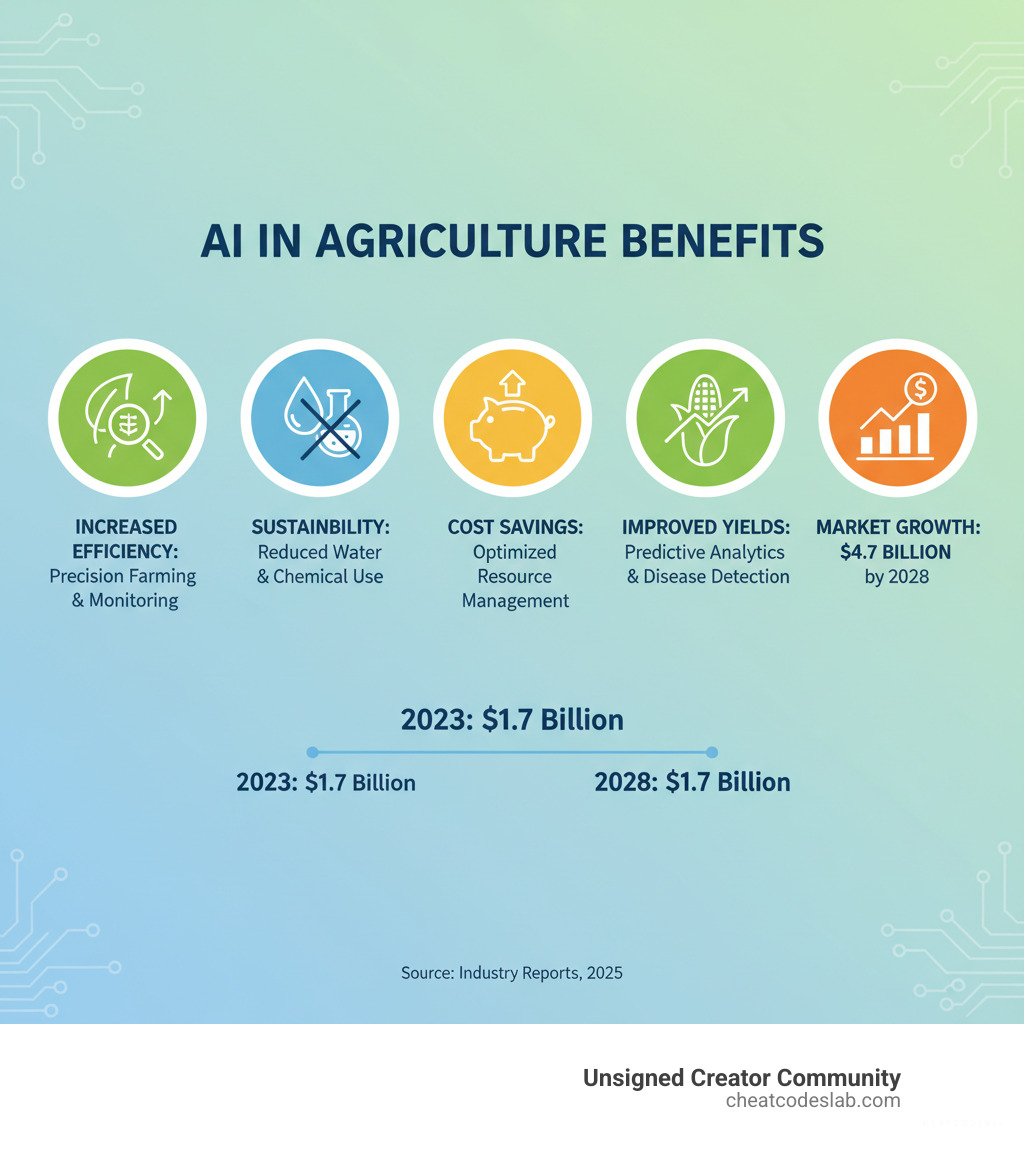
The AI in agriculture market is projected to grow from $1.7 billion in 2023 to $4.7 billion by 2028. This matters because traditional farming faces challenges like water scarcity, labor shortages, and climate change. AI offers solutions that increase yields while reducing environmental impact, with some farmers reporting profit increases as high as 120%.
From small family farms to large commercial operations, AI tools are becoming more accessible. These tools are making farming smarter, more sustainable, and more productive.
I’m digitaljeff, a tech entrepreneur with over 20 years of experience exploring how technology transforms industries. Through my work at CheatCodesLab, I’ve helped businesses apply AI in sectors like agriculture to reshape food production and rural economies.
Quick look at AI tools for agriculture:
The Digital Harvest: How AI is Changing Agriculture
By 2050, the world will need to feed 10 billion people, requiring 70% more food. Yet, agriculture contributes to a quarter of all greenhouse gas emissions. The challenge is clear: we must produce more food with less environmental impact. This is where AI tools for agriculture are making a massive difference.
Artificial intelligence in this context involves teaching machines to learn from data, recognize patterns, and make smart decisions by processing millions of data points instantly. In farming, this means using computer vision to spot a diseased plant from a drone image, machine learning to predict the perfect harvest time, and systems that can distinguish a weed from a crop. These technologies are changing agriculture from guesswork into a precise science.
This agricultural revolution addresses multiple challenges at once. AI-powered precision farming helps farmers apply the exact amount of water, fertilizer, or pesticide to the right spot, leading to healthier crops, lower costs, and less environmental damage. Some farmers using these methods report profit increases as high as 120%, proving that sustainable farming can also be highly profitable.
The potential extends beyond individual farms. Digital agriculture could boost GDP in low and middle-income countries by more than $450 billion annually, creating transformative economic impact.
Excitingly, this technology is not just for massive corporate farms. AI tools for agriculture are becoming more accessible and practical for operations of all sizes. Affordable drones, cheaper soil sensors, and simple smartphone apps for crop analysis are leveling the playing field.
This shift is about fundamentally rethinking how we grow food. Instead of treating an entire field uniformly, we can now manage each square meter based on its specific needs. Instead of reacting to crop destruction, we can spot problems weeks earlier. This digital change touches every part of farming, from plant monitoring to livestock management, making sustainability a practical reality.

7 Key Applications of AI Tools for Agriculture
The way we farm is changing, and it’s happening faster than you might think. AI tools for agriculture aren’t just fancy gadgets for tech enthusiasts—they’re practical solutions solving real problems that farmers face every day. Let’s walk through the applications that are making the biggest difference right now.
Precision Crop and Soil Management
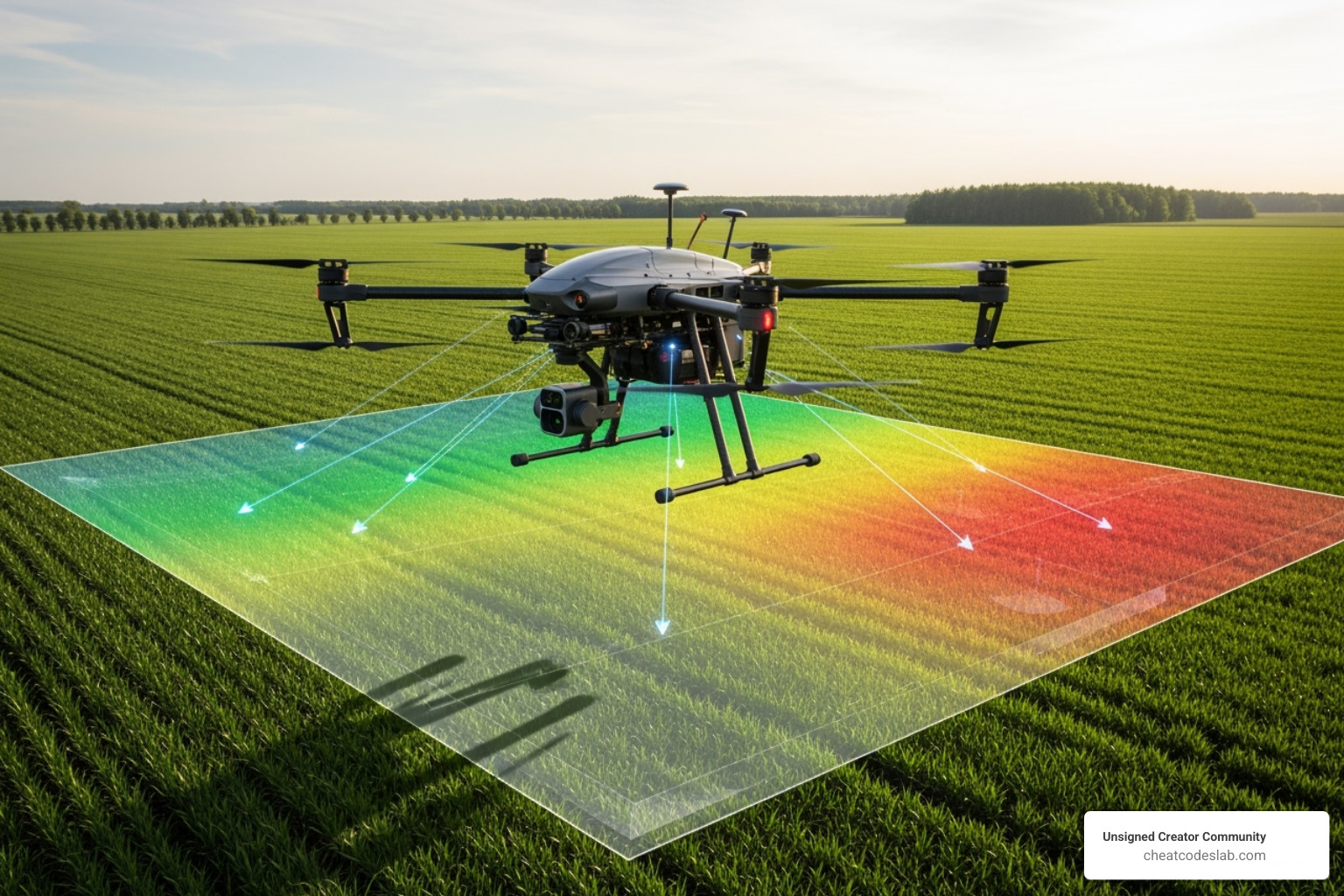
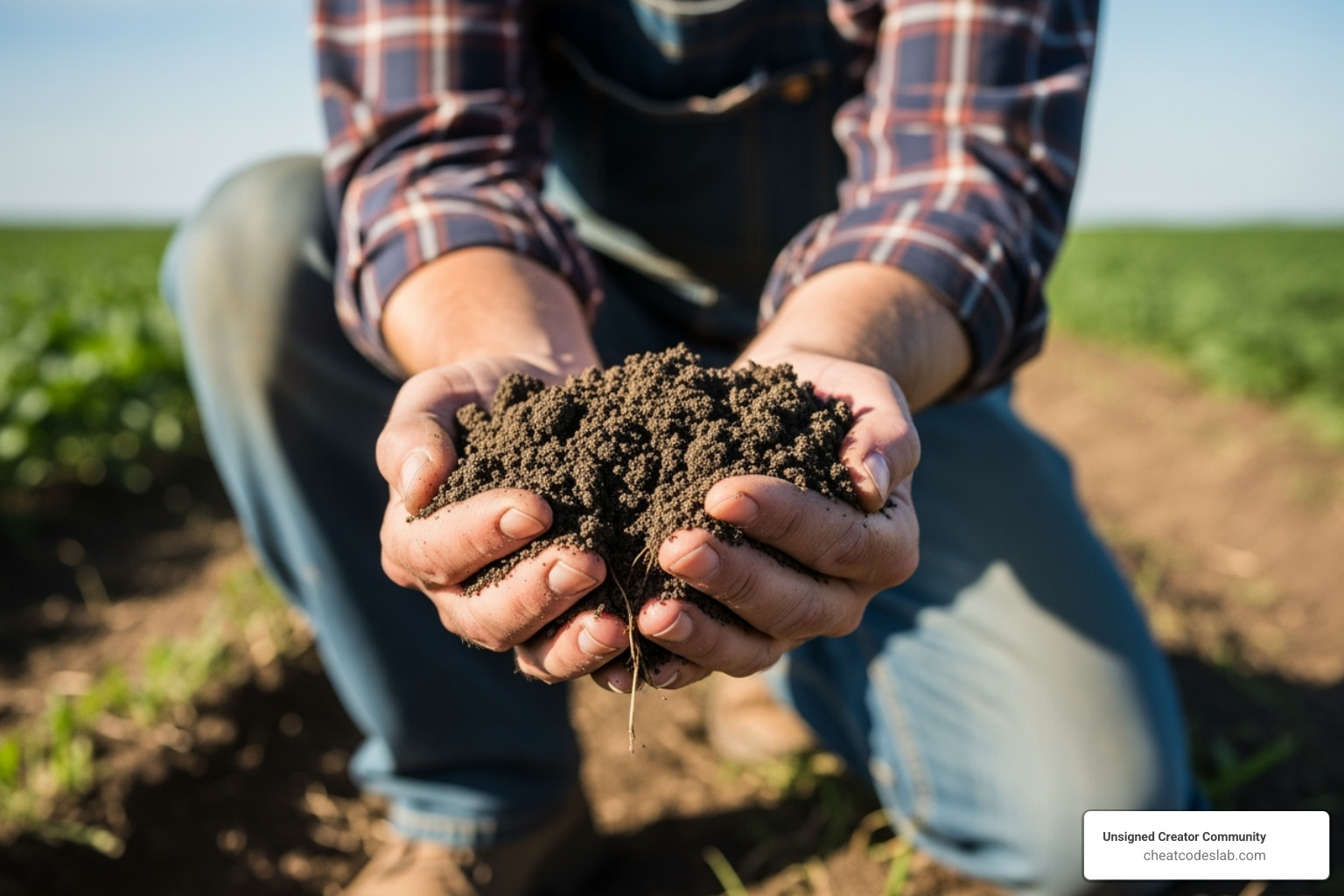
Precision crop and soil management allows farmers to understand the exact needs of their plants. Instead of uniform application, AI tools for agriculture target specific areas needing water, fertilizer, or pesticides. Drones, IoT soil sensors, and satellite imagery collect data on plant stress, moisture, and nutrient levels. AI systems analyze this data to create detailed maps, enabling variable rate application—giving each zone exactly what it needs.
Companies like FlyPix AI, EOSDA Crop Monitoring, and OneSoil use this data to provide farmers with actionable insights on plant health. The result is more efficient use of water and fertilizer, better planting and harvesting decisions, healthier crops, higher yields, and reduced waste.
AI-Powered Disease and Pest Detection
Diseases and pests can devastate crops before they are visible, but traditional field-walking inspections are slow and often miss early warning signs. AI tools for agriculture have changed this game. Image recognition technology analyzes photos from drones, sensors, or smartphones to identify diseases or pests in their earliest stages with impressive accuracy.
For example, AI systems can detect apple black rot with over 90% accuracy. Scientific research on wheat rust detection shows that machine learning successfully identifies infections early. Platforms like Agrio and Cropin offer apps that use AI to identify diseases, predict outbreaks, and recommend treatments. This allows for early, targeted treatment, preventing massive crop losses and saving money. It’s a shift from crisis management to preventative care.
Smart Weed Control and Herbicide Reduction
Weeds compete with crops for resources, reducing yields. Traditional solutions like manual weeding or broad herbicide application are inefficient and environmentally damaging, with the environmental risks of herbicides being a major concern. Smart weed control powered by AI tools for agriculture is a game-changer.
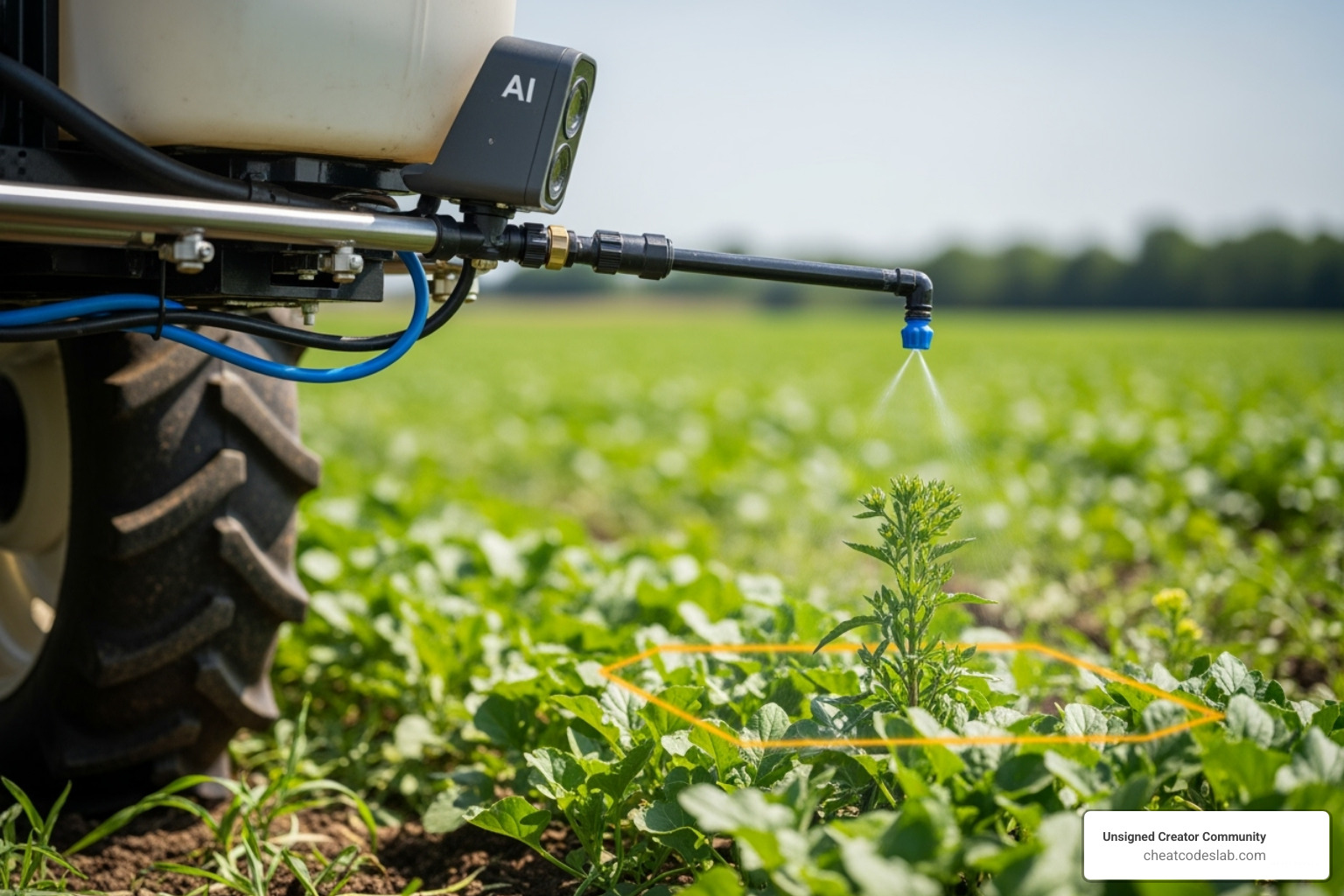
These systems use computer vision to distinguish between crops and weeds in real-time. Once identified, the system can precisely target the weed with a micro-dose of herbicide or remove it mechanically. Pioneered by technologies like Blue River Technology’s “See & Spray,” companies such as Carbon Robotics and FarmWise offer automated systems for precise weed removal. The impact is a reduction in herbicide use by up to 90%, leading to significant cost savings and environmental benefits, including cleaner water and healthier ecosystems.
The Future of Farming: Robotics and Automation
Labor shortages for physically demanding farm work are a growing problem. AI-powered robotics and automation, key AI tools for agriculture, offer a powerful solution. Autonomous tractors can plant and till with precision, while robotic harvesters can gently pick delicate crops like strawberries. Companies like Harvest CROO Robotics, FarmWise, and AgriBot are leaders in this space, developing machines for harvesting and weeding.
These robots can work 24/7 in any weather, ensuring tasks are completed at the optimal time. As they work, these robots also gather data, feeding it back into AI systems to continuously improve farming practices. This makes agriculture not just easier, but smarter and more resilient.
Enhancing Sustainability with AI Tools for Agriculture
AI tools for agriculture are essential for making farming both sustainable and profitable, particularly in the context of regenerative agriculture. This approach aims to improve soil health and biodiversity through practices like minimal tillage and cover crops. As detailed in resources about more on regenerative agriculture, this approach can increase farmer profits by up to 120%.
AI helps implement these practices by analyzing soil composition to recommend organic fertilizers, suggesting optimal crop rotations, and using drones to assess cover crop performance. Companies like MTG-Soil Monitoring and Sentek provide the advanced soil analysis tools needed for these data-driven decisions. AI-driven systems also optimize resource use by accurately predicting pest outbreaks and fine-tuning irrigation, which reduces waste. Agri-tech leaders like Syngenta are actively promoting these methods, even publishing an AI Manifesto to guide responsible development.
Overcoming Challenges in Adopting AI Tools for Agriculture
Adopting AI tools for agriculture has its challenges. The high initial cost of drones, robots, and software is a major barrier, especially for smaller farms, creating a potential “AI divide.” AI also requires large amounts of quality data, which can be difficult to collect in remote areas with poor internet connectivity. Data privacy and security are also significant concerns.
The human factor is also key. Overcoming skepticism requires accessible education and practical demonstrations of benefits. Organizations like land-grant universities and Cooperative Extension services are helping bridge this gap with tools like ExtensionBot, an AI assistant trained on specific agricultural data. To overcome these barriers, policy support is crucial. Government incentives, research funding, and collaboration between farmers, industry, and government can help encourage innovation and ensure AI benefits everyone.
The Path Forward: AI, Sustainability, and Global Food Security
AI tools for agriculture are fundamentally reimagining how we grow food. From soil microbes to satellite imagery, AI is making every layer of farming smarter, more responsive, and more sustainable. As we’ve seen, precision farming, early disease detection, smart weed control, and tireless robotic labor are practical solutions making a real difference on farms today.
The market’s projected growth to $4.7 billion by 2028 reflects tangible benefits for farmers, including improved efficiency, sustainability gains, and profit increases up to 120%. What truly matters is our ability to feed 10 billion people by mid-century while healing the planet. AI makes this possible, changing agriculture to be more resilient, productive, and restorative.
At CheatCodesLab, we see how AI transforms industries through data-driven decisions and intelligent automation. These same principles apply to agriculture, providing the right tools to solve real-world problems. While challenges like cost and data infrastructure exist, collaboration between farmers, tech providers, and policymakers can make these innovations accessible to all.
The agricultural revolution is happening now. With the right AI tools for agriculture, we’re cultivating a future where food abundance and environmental stewardship are complementary outcomes, not opposing goals.
If you’re curious about how AI can transform your work, whether in agriculture or other fields, I encourage you to keep exploring. The tools exist, the knowledge is growing, and the community is ready to support innovation. Explore certified AI tools to find what’s possible when technology meets purpose.


About the author


How to Archive Posts on Instagram in 4 Easy Steps
Master archiving on Instagram in 4 easy steps to organize your profile and protect your content.

Beginner’s Guide to 10k free instagram followers app
Discover how a 10k free instagram followers app works, its risks, and safe organic growth strategies for real engagement in 2026.

Beginner’s Guide to Best Instagram Report App
Discover the best Instagram report app for real-time analytics, automated reports, and data-driven decisions in 2026.
How to Master Advanced SEO Search Techniques in 7 Steps
Master advanced search techniques in SEO with 7 proven steps to boost rankings, technical audits, and organic traffic.

Cheat Sheet to the Best Business Apps
Discover the best business apps to streamline operations, boost productivity, and scale your business in 2026.

How to Get Instagram Followers Free APK in 5 Steps
Discover how instagram followers free apk 2026 download works and learn safe organic growth strategies instead of risky third-party tools.
Related

The Complete Guide to BrightLocal Local SEO
Master BrightLocal local seo with rank tracking, citation management, and review tools to boost visibility in 2026.

The Best AI Tools to Help Nonprofits Get Funded
Discover top AI tools for fundraising to boost nonprofit revenue, donor engagement, and efficiency with predictive & generative AI.

How Machine Learning is Teaching Old Ads New Tricks
Discover how machine learning in digital advertising revolutionizes bidding, targeting, and personalization for superior ROI.

The AI Muse: A Writer’s Guide to ChatGPT
Unlock ChatGPT for writers: Master prompts, beat writer's block, build plots, characters & workflows ethically.

The Robots Are Writing Now and Other AI Content Marketing Software Secrets
Discover ai-driven saas-based content marketing software secrets. Boost SEO, scale workflows, and dominate 2026 trends now!

Ghost Murmur CIA
Ghost Murmur: The Quantum Blueprint for the Impossible Deep inside a fortified bunker in Tehran, an American soldier is breathing—and the CIA is watching that breath through a solid lead wall using a technology that technically shouldn’t exist. This isn't just a scene from a Tom Clancy novel; it’s the frontline of what CIA Director William J. Burns calls the "Technological Mission Center," a pivot where the agency is prioritizing quantum sensing to regain the edge in denied areas. We have officially entered the era of the Quantum Cold War, where physical barriers like concrete and distance are becoming obsolete. As the U.S. government pours $1.8 billion into the National Quantum Initiative to ensure "quantum supremacy," the line between hard science and the supernatural is blurring before our eyes. If you’re a solopreneur or a creator, you need to […]