
How to Master Advanced SEO Search Techniques in 7 Steps
Why Advanced Search Techniques in SEO Separate Page-One Winners from Everyone Else
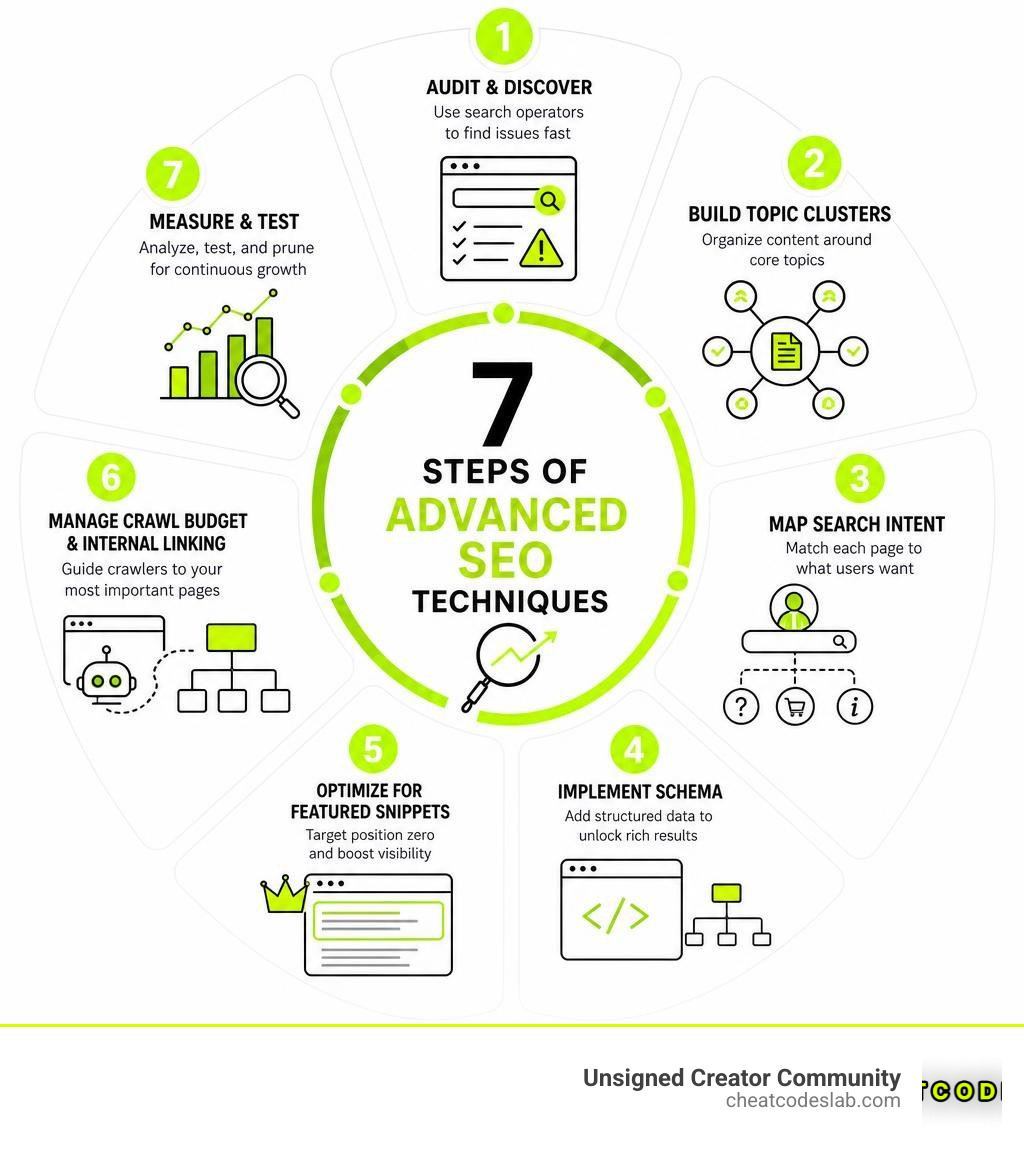
Mastering advanced search techniques in SEO is the difference between sitting on page one and being invisible to your audience. Here is a quick overview of the 7 steps covered in this guide:
- Use search operators to run fast technical audits and spot indexation issues
- Build topic clusters to establish topical authority around your core subjects
- Map search intent to ensure every page matches what users actually want
- Implement schema markup to unlock rich results and SERP features
- Optimize for featured snippets to capture position zero and more organic clicks
- Manage crawl budget and internal linking so search engines find your best pages first
- Measure and test using log file analysis, Google Search Console, and content pruning
Here is the hard truth: 75% of search engine users never scroll past the first page of results. If your content is not there, it simply does not exist for most people.
Basic SEO — writing keyword-rich content and building a few links — used to be enough. Not anymore. Google now evaluates content using AI-powered systems that assess intent, topical depth, and site-wide authority together. Competitors who understand this are pulling ahead fast.
The good news? Advanced SEO is not magic. It is a repeatable system of smart techniques layered on top of the fundamentals you already know.
I’m digitaljeff — over the past 20 years I’ve built and scaled digital brands across content, media, and technology, applying advanced search techniques in SEO to grow online properties to millions of monthly visitors. In this guide I’ll break down exactly how to do the same, step by step.
Advanced search techniques in seo terms to know:
Step-by-Step Guide to Advanced Search Techniques in SEO
To win in the modern search landscape, we must understand the core differences between basic and advanced SEO. Basic SEO focuses on the visible surface—sprinkling target keywords on a page and filling out meta tags.
Advanced SEO goes far deeper. It coordinates technical infrastructure, semantic topic structures, and search engine crawler behavior to build an authoritative digital presence. With search engines shifting from simple keyword matching to understanding entities and user intent, our strategy must evolve to treat websites as connected networks of knowledge.
By mastering advanced search techniques, we can guide search engine crawlers through our sites efficiently, satisfy complex user intent, and optimize for retrieval-augmented generation (RAG) systems used by modern AI search engines. Let us dive into the seven steps to master these advanced tactics.
Steps 1 & 2: Leverage Advanced Search Techniques in SEO for Audits and Operators
The Google search bar is more than a way to find information; it is a real-time technical SEO diagnostic tool. By using Google search operators, we can perform instant indexation checks, identify duplicate content, and spot keyword cannibalization without immediately opening expensive software.

To start, the site: operator allows us to approximate how many of our pages are indexed. For example, searching site:yourdomain.com displays your indexed pages. If this number is vastly different from the count in your XML sitemap, you may have index bloat or crawling issues.
We can refine this search further to uncover security flaws or duplicate staging environments. Using the query site:*.yourdomain.com -site:www.yourdomain.com helps us expose hidden subdomains that should not be indexed.
For a deeper dive into search operators, you can consult the official guide on how to Refine Google searches. Google also offers a dedicated Google Geavanceerd zoeken interface to help build complex queries.
While search operators are excellent for quick diagnostics, we must remember that Google has slightly degraded some operators over time. For example, traditional commands like inurl: are less reliable for finding complex parameter URLs today. To run a flawless audit, we combine operators with Google Search Console data.
For a complete breakdown of operator combinations, check out the Search Operators for Technical SEO: The Audit Guide (2026) and explore our own breakdown of Advanced SEO Techniques to elevate your diagnostic skills.
Steps 3 & 4: Build Topic Clusters and Map Search Intent
Modern search engines do not just rank individual pages; they reward topical authority. This is why we organize our content using topic clusters and content hubs. Instead of writing isolated articles, we create a central pillar page that covers a topic broadly, surrounded by closely related supporting pages that dive into specific subtopics.
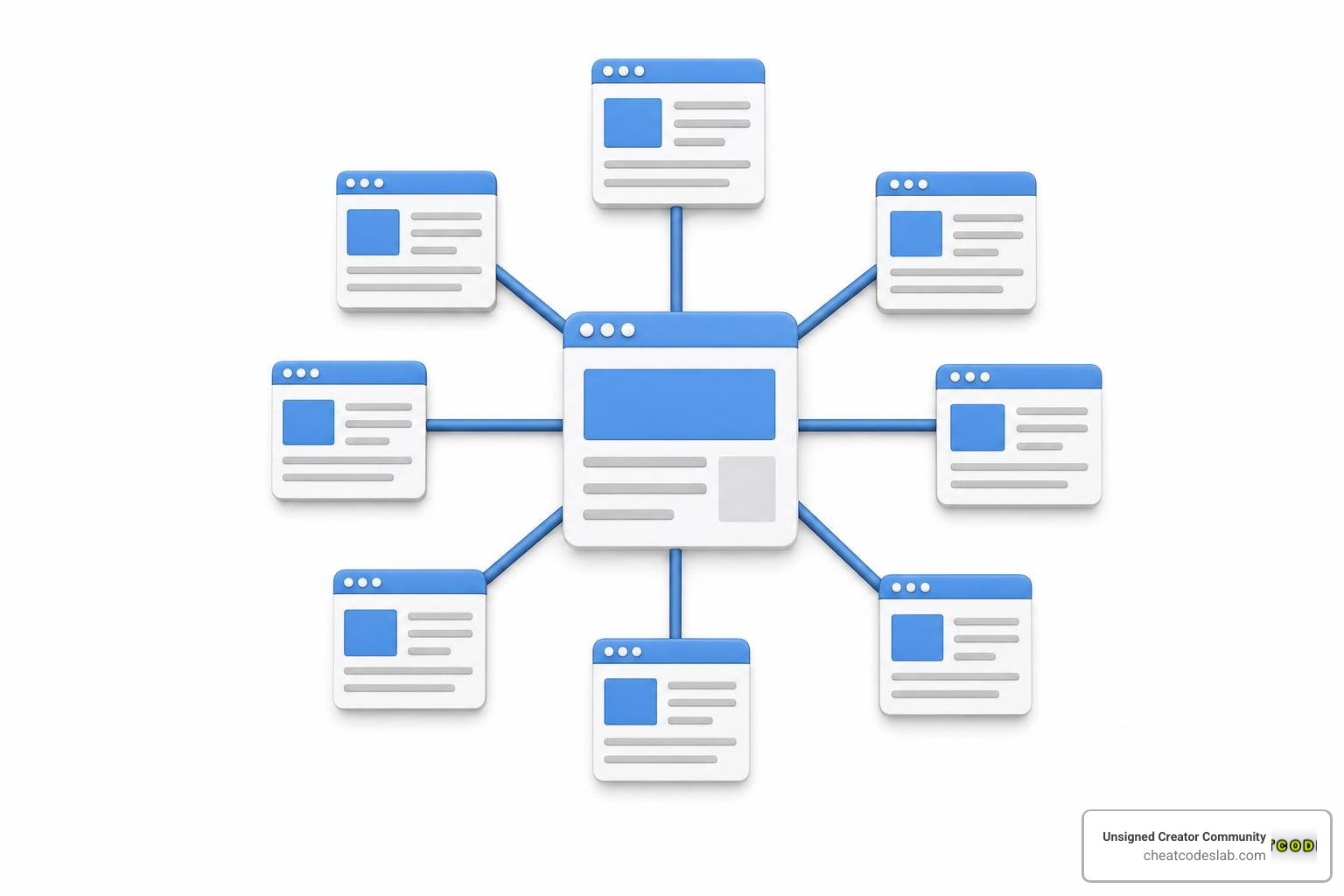
This structure is highly effective: data shows that up to 19% of organic traffic can come directly from well-optimized content hubs. It signals to search engines that we cover a topic with both depth and breadth.
To make this work, we must move beyond basic search volume and focus on advanced keyword research. This involves mapping keywords directly to user intent and stages of the user journey:
- Informational Intent: The user wants to learn (e.g., “what is semantic search”).
- Commercial Investigation: The user is comparing options (e.g., “Tool A vs Tool B”).
- Transactional Intent: The user is ready to buy (e.g., “buy certified SEO tools”).
When we cluster keywords, we group semantically related terms under a single piece of comprehensive content rather than creating ten thin, competing pages. To prevent keyword cannibalization, we ensure each page targets a unique, primary intent. For step-by-step guidance, explore our resource on Advanced Keyword Research and learn how to naturally integrate LSI Keywords in SEO to satisfy semantic search systems.
Step 5: Implement Schema Markup and Structured Data
Structured data is the language we use to talk directly to search engine crawlers. By implementing schema markup, we help search engines understand the context, entities, and relationships on our pages, which translates into rich results, star ratings, and enhanced SERP real estate.
Using JSON-LD format is the industry standard for structured data. Rather than using basic, disconnected schemas, advanced practitioners use nested schemas to connect entities (for example, linking an Author schema directly to an Organization and a specific Article).
| Schema Level | Implementation Type | SERP Impact |
|---|---|---|
| Basic Schema | Flat, isolated JSON-LD blocks (e.g., only Article schema) | Standard search snippets, basic metadata recognition |
| Advanced Schema | Nested JSON-LD connecting Author, Organization, and Product entities | Rich snippets, Knowledge Graph inclusion, and eligibility for AI answer citations |
By explicitly defining who we are and what our content represents, we feed Google’s Knowledge Graph. This is a critical step for modern optimization. To learn the exact codes to implement this, check out our SEO Cheat Codes.
Step 6: Optimize for Featured Snippets and SERP Real Estate
Securing the top spot on page one is great, but capturing “position zero” through featured snippets is even better. The #1 organic result in Google gets about 32% of all clicks, but featured snippets can steal a massive share of that traffic.
To optimize for featured snippets and maximize our SERP real estate, we use several on-page techniques:
- Provide Direct Answers: Place a concise, 40-to-80-word definition or direct answer immediately below a question-based heading.
- Use Structured Formats: Use clean HTML lists (
- Target People Also Ask (PAA): Since 57.47% of Google search results contain a PAA section, building dedicated Q&A sections that address these exact questions is highly effective.
Additionally, we must optimize for daily search habits. Almost 40% of adult consumers now use mobile voice search at least once a day. Voice search queries are highly conversational, meaning we should write our content in a natural, spoken tone to match these queries.
Step 7: Manage Crawl Budget and Internal Linking
Crawl budget refers to the number of pages a search engine crawler is willing to discover and analyze on your site within a given timeframe. If your site has thousands of pages, a wasted crawl budget means your newest or most important content might go unindexed for weeks.
To manage crawl budget efficiently, we keep our XML sitemaps clean and updated, containing only index-worthy URLs. We use the robots.txt file to block crawlers from wasting time on duplicate parameter pages, internal search results, or thin tag pages. However, we never use robots.txt to handle indexation; instead, we use the noindex tag for pages we want to keep hidden from search results.
Our internal linking strategy acts as a roadmap for crawlers. We link from our high-authority, high-traffic pages to newer cluster pages that need a visibility boost, always using descriptive, natural anchor text.
This technical foundation directly influences user experience. Over 60 percent of the global internet population uses a mobile device to go online, and Google now uses a mobile crawler as the default.
Mobile performance is critical: 46% of users say waiting for pages to load is the most annoying part of mobile browsing, and Google reports that 53% of mobile visitors will abandon a site if it takes more than three seconds to load. Prioritizing Core Web Vitals, compressing images, and minifying code are no longer optional—they are essential technical requirements.
For a deeper dive into technical best practices, read the Advanced Technical SEO: Best Practices & Advanced Guide – Metket.
Advanced Search Techniques in SEO: Measuring and Testing Success
Advanced SEO is an ongoing cycle of testing and refinement. We cannot rely on guesswork; we must use data to prove what works.
An advanced audit strategy includes:
- Log File Analysis: This is the ultimate source of truth. Analyzing server log files shows us exactly how search engine bots behave on our site, letting us spot crawl waste and server errors instantly.
- Google Search Console Monitoring: We track crawl stats, indexation errors, and CTR trends to find quick-win opportunities (like pages ranking on page two that need a small optimization boost).
- E-A-T (Expertise, Authoritativeness, Trustworthiness) Audits: We ensure our content is backed by credible sources, clear author bios, and accurate data to satisfy search quality guidelines.
- Content Pruning: More content is not always better. Regularly removing, redirecting, or merging underperforming and duplicate pages improves overall site authority and stops keyword cannibalization.
- SEO A/B Testing: We test elements like title tags, heading structures, and visual layouts to measure their direct impact on search performance.
To build a professional tool stack for these tasks, check out our guide on the Best SEO Tools. For more context on why old-school approaches fail, see the Advanced SEO Guide 2026: Why Basic SEO No Longer Works and read Advanced SEO – SEO Jerry to stay ahead of search engine updates.
Conclusion
Mastering advanced search techniques in SEO is a continuous journey of optimizing for both search engine crawlers and real human users. By moving beyond basic keywords and focusing on technical precision, topic clusters, structured data, and search intent, we build a search-friendly infrastructure that stands the test of time.
At the Unsigned Creator Community, we are dedicated to helping online creators and agencies scale their digital presence. Through our partnership with CheatCodesLab, we provide certified AI tools, templates, and actionable resources designed to simplify complex optimization tasks.
Ready to take your organic strategy to the next level? Explore our curated collection of CheatCodesLab SEO Strategy Tools and start turning your content into a powerful driver of organic traffic today.


About the author


How to Archive Posts on Instagram in 4 Easy Steps
Master archiving on Instagram in 4 easy steps to organize your profile and protect your content.

Beginner’s Guide to 10k free instagram followers app
Discover how a 10k free instagram followers app works, its risks, and safe organic growth strategies for real engagement in 2026.

Beginner’s Guide to Best Instagram Report App
Discover the best Instagram report app for real-time analytics, automated reports, and data-driven decisions in 2026.
How to Master Advanced SEO Search Techniques in 7 Steps
Master advanced search techniques in SEO with 7 proven steps to boost rankings, technical audits, and organic traffic.

Cheat Sheet to the Best Business Apps
Discover the best business apps to streamline operations, boost productivity, and scale your business in 2026.

How to Get Instagram Followers Free APK in 5 Steps
Discover how instagram followers free apk 2026 download works and learn safe organic growth strategies instead of risky third-party tools.
Related
Beginner’s Guide to 10k free instagram followers app
Discover how a 10k free instagram followers app works, its risks, and safe organic growth strategies for real engagement in 2026.
How to Get Instagram Followers Free APK in 5 Steps
Discover how instagram followers free apk 2026 download works and learn safe organic growth strategies instead of risky third-party tools.

How to Get 500 Instagram Followers Free
Claim your 500 follower instagram free trial safely and grow your account with real engagement.

How to Get 1000 Instagram Followers Fast
Learn how to get 1000 followers instagram fast with proven strategies, Reels, and profile optimization for real growth in 2026.

Step-by-Step Guide to Download Instagram Followers Pro
Learn how to download Instagram Followers Pro on iOS, Android, and PC with this complete step-by-step guide and safety tips.

Ultimate Checklist for Analyzing Local SEO Competition
Analyze local SEO competition with this step-by-step checklist covering Google Business Profiles, geo-grid audits, and proven ranking tactics.