


Ultimate Checklist for Analyzing Local SEO Competition
Why You Need to Analyze Local SEO Competition (And How to Do It Fast)
When you analyze local SEO competition, you’re doing more than spying on rivals — you’re finding the fastest path to ranking in Google Maps and the Local Pack.
Here’s a quick-start breakdown:
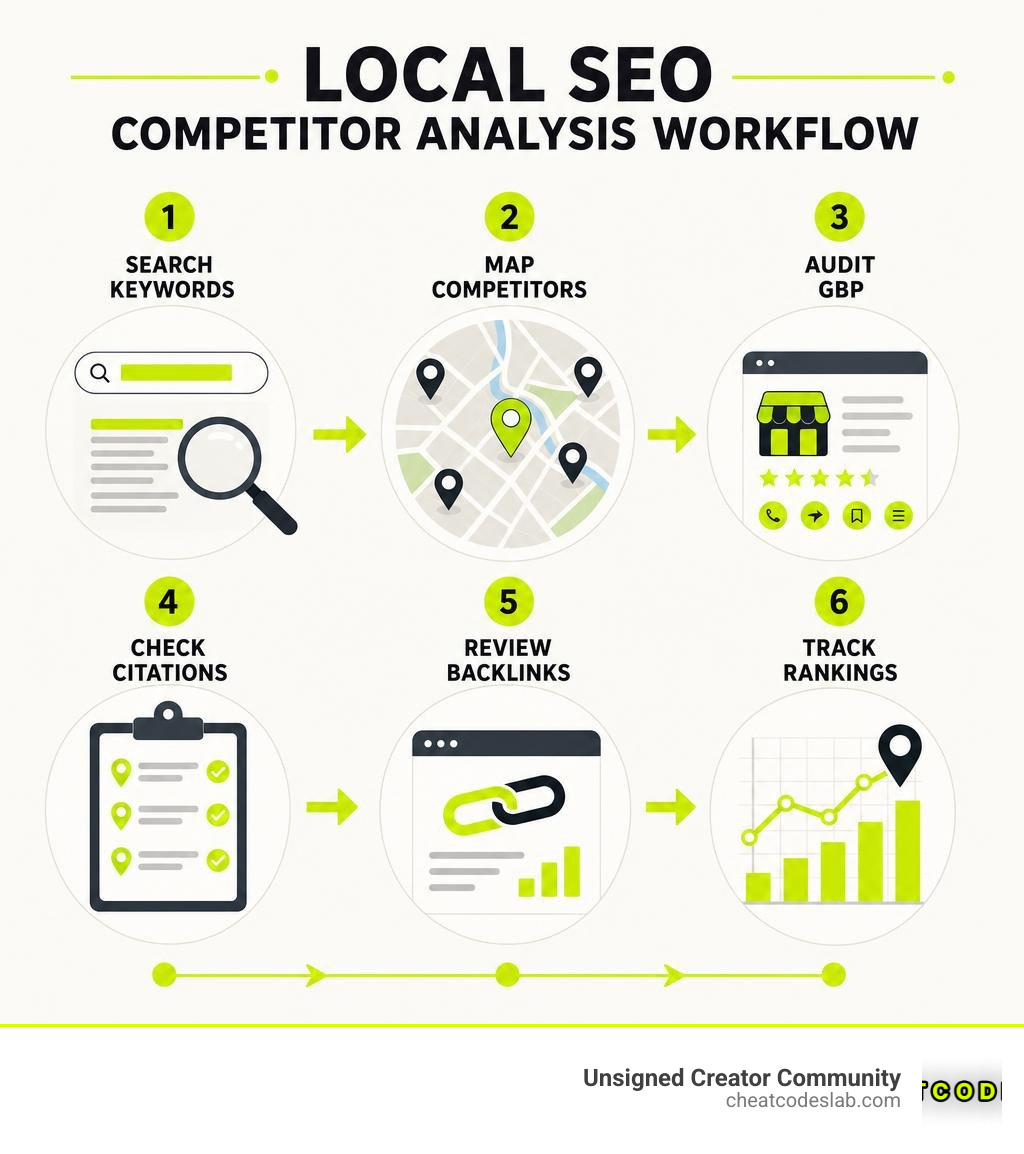
- Search your target keywords in Google and Google Maps to see who ranks in the Local Pack
- Compare Google Business Profiles — categories, reviews, photos, and posts
- Audit citations — find directories where competitors are listed that you’re not
- Review backlink profiles — identify local publications linking to competitors
- Check on-page SEO — title tags, headers, schema markup, and landing pages
- Track rankings over time using geo-grid tools to measure share of voice
That’s the core process. The sections below go deep on each step.
Here’s why this matters right now: 46% of all Google searches have local intent, and the Local Pack grabs 7.5x more clicks than standard organic results. If you’re not showing up in that top-3 map listing, you’re invisible to a massive chunk of ready-to-buy customers. Research shows that 78% of local mobile searches lead to an offline purchase — often within hours.
The businesses showing up above you aren’t just lucky. They’ve optimized something you haven’t yet. A proper competitor analysis tells you exactly what that is.
I’m digitaljeff — over the past 20 years building brands and digital strategies across industries, I’ve used local SEO competitor analysis as one of the sharpest tools for helping businesses cut through crowded markets and win local visibility fast. Let’s break down exactly how to do it.
Analyze local seo competition terms at a glance:
How to Analyze Local SEO Competition: The Step-by-Step Framework
To build a repeatable roadmap for dominating your physical market, you need a structured framework. Think of competitor intelligence as your ultimate reality check. Instead of guessing which keywords to target or how many reviews you need, you can look at the search engine results pages (SERPs) and reverse-engineer exactly what is working in your market right now.
Google’s local ranking algorithm relies heavily on three core pillars: relevance (how well a business matches the search query), distance (how close the business is to the searcher), and prominence (how well-known and authoritative the business is online).
While you can’t control distance, you have absolute control over relevance and prominence. By running structured audits on your competitors, you can spot the gaps in their strategies and optimize your own. To make this process seamless, we recommend utilizing The Ultimate Guide to Best Local SEO Tools to automate your data collection.
Local vs. Organic: Why You Must Analyze Local SEO Competition Differently
Many agencies make the mistake of using the same playbook for local SEO that they use for national, organic SEO. This is a shortcut to wasted budgets.
Organic SEO focuses on ranking websites globally or nationally for informational search intent. Local SEO, however, is hyper-focused on the Google Map Pack and localized transactional searches. Local search is highly sensitive to the proximity factor—rankings can shift drastically from one block to the next.
| Feature / Metric | Local SEO Competitor Analysis | General Organic SEO Competitor Analysis |
|---|---|---|
| Primary Target | Google Map Pack & Google Maps | Traditional “blue link” search results |
| Key Ranking Factor | Proximity, GBP categories, review velocity | Backlink authority, page speed, content depth |
| Competitor Pool | Local brick-and-mortar businesses | Global websites, blogs, and massive directories |
| Primary Toolset | Geo-grid trackers, citation audits | Traditional rank trackers, backlink crawlers |
| Conversion Focus | Phone calls, physical visits, local bookings | Form fills, newsletter signups, online checkouts |
Identifying True Competitors and Mapping the Local Pack
Your true online competitors aren’t always the physical businesses you see down the street. Sometimes, a business miles away dominates the Map Pack because of superior SEO. Conversely, massive directory listings like Yelp, TripAdvisor, or Angi often clog organic results. While directories are valuable for citation building, they are not your direct competitors—ignore them during your local business audits.
To find your real competitors, start with local keyword research using target queries that combine your service and your city (e.g., “dentist in Austin” or “emergency plumber near me”). To learn how to dig up high-intent terms, explore our guide on Advanced Keyword Research.
Because Google personalizes results based on where you are standing, you must use location spoofing tools or specialized search parameters to see what local searchers actually see. If you want a quick, automated way to scan your market, you can use the Local Competitor Tracking | Free Local SEO Competitor Analysis — SEOScaleUp tool to uncover every competitor ranking in your target location in under 60 seconds.
Auditing Google Business Profiles and Tracking Key Metrics
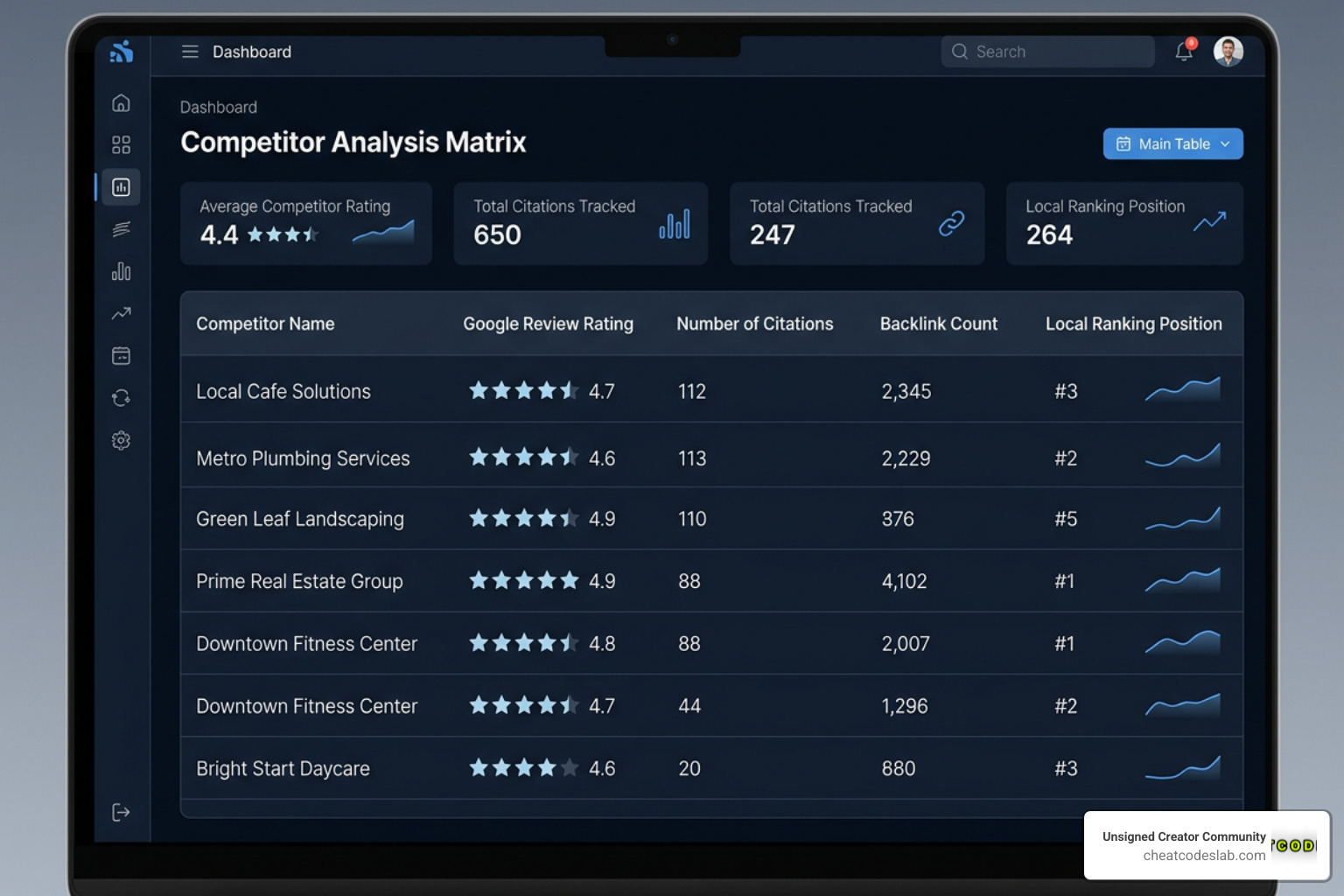
Your Google Business Profile (GBP) is the cornerstone of your local search presence. Since businesses with complete Google Business Profiles see 70% more engagement, auditing how your competitors set up their profiles is non-negotiable.
When analyzing competitor GBPs, track these critical metrics:
- Primary Category: This carries the most weight in Google’s local algorithm. Note exactly what primary category your top-3 rivals use.
- Secondary Categories: Competitors often use these to capture secondary search terms.
- Business Description & Attributes: Are they highlighting specific keywords or unique selling points (e.g., “locally owned”, “wheelchair accessible”)?
- Owner Engagement & Google Posts: How frequently are they posting updates, offers, or photos? Google rewards active profiles.
For a step-by-step breakdown of how to fine-tune these settings once you’ve gathered competitor data, read The Complete Guide to Google Business Profile Optimization.
How to Analyze Local SEO Competition Using Geo-Grid and Citation Audits
Traditional rank trackers only give you a single ranking position from a single data point. In local SEO, this is incredibly misleading. To get the real picture, you need geo-grid tracking. This technology measures your rankings at multiple geographic points simultaneously, creating a visual heatmap of your local search presence.
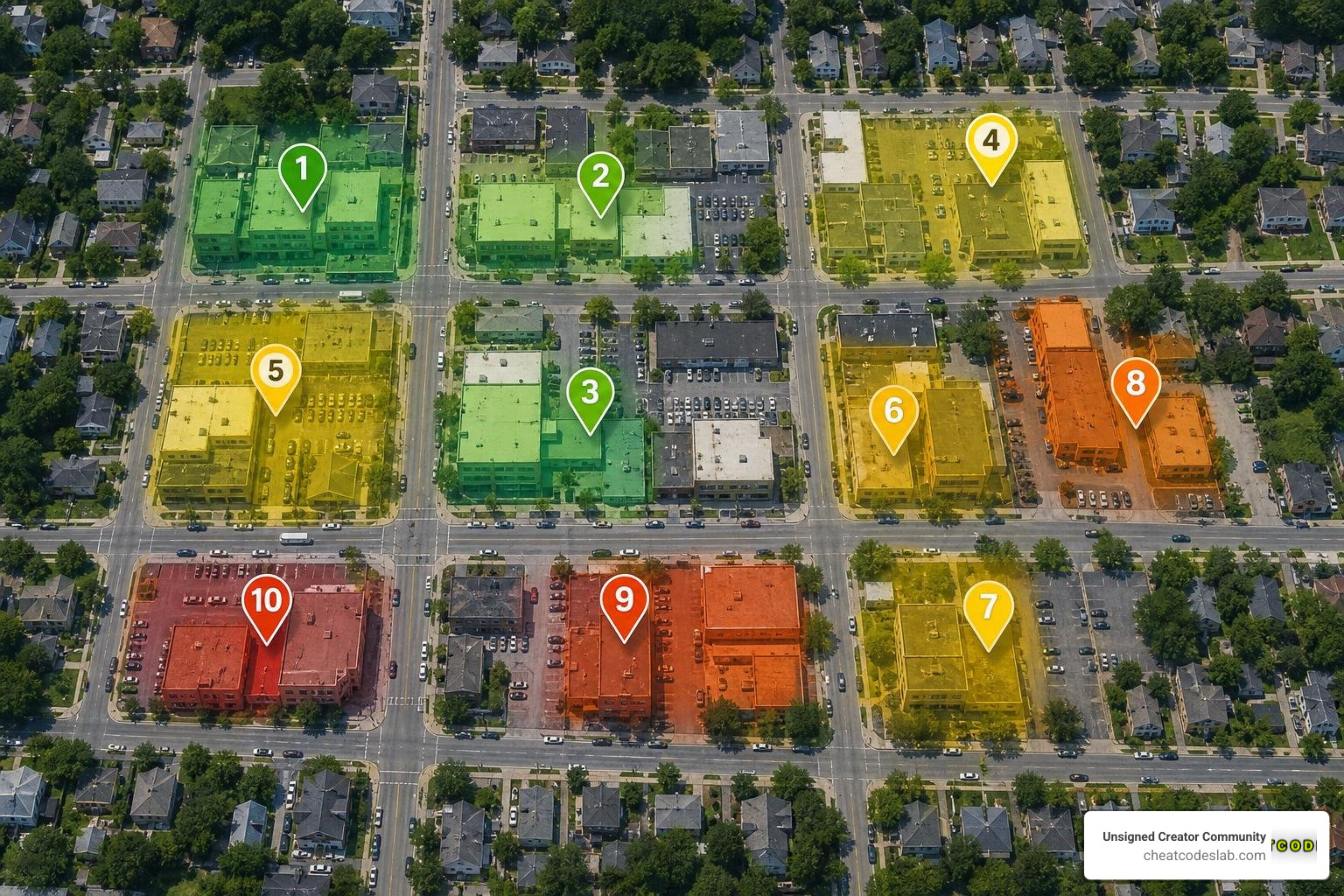
This allows you to calculate your Share of Local Voice (SoLV)—the percentage of times your business appears in the top three positions across the entire target grid.
Alongside geo-grids, you must perform a citation analysis. Citations are online mentions of your business’s Name, Address, and Phone number (NAP). Consistent NAP data across local directories builds trust with Google’s algorithm. By running a citation gap analysis, you can see which local directories your competitors are listed on that you have missed. Implementing these citations is one of the most reliable Local SEO Techniques to boost prominence.
To make this process faster, tools like the Local Competitor Analysis Tool for SEO | Flento offer 24/7 AI-powered tracking to monitor geo-radius rankings and citation gaps in real time. If you prefer utilizing developer tools or command-line scripts, you can run automated audits using the Local Competitor Analysis: Claude Code SEO Skill | CC for SEO to quickly extract comparison profiles.
Actionable Strategies to Outrank Your Local Rivals
Once you have gathered your data, it’s time to transition from reporting to execution. You now hold your competitors’ playbook—your job is simply to execute it better.
By prioritizing your optimization roadmap, you can systematically close the gaps in your GBP, website, and local authority. Let’s look at how to implement these findings using the Best SEO Tools at your disposal.
On-Page SEO, Schema Markup, and Conversion Funnel Comparison
Your website’s on-page SEO directly influences your Map Pack rankings. When evaluating your competitors’ websites, look closely at their landing pages. Are they using localized headers (H1s and H2s containing the city name)? How structured is their internal linking?
Crucially, check if they are using local schema markup (JSON-LD). Schema tells search engine crawlers exactly what your business does, your operating hours, and your physical coordinates. If your competitors aren’t using schema, adding it to your site is an instant competitive advantage.
Beyond search bots, compare their conversion funnels. Do they make it easier for customers to book an appointment, start a live chat, or request a quote? Local SEO is about driving real business results, not just traffic. To discover what content topics your competitors are ranking for that you are completely missing, conduct a thorough Content Gap Analysis.
For advanced teams looking to optimize for both traditional search engines and conversational AI platforms (like ChatGPT or Google Gemini), you can leverage open-source intelligence tools like the usood/seo-aeo-geo-analyzer repository to analyze schema structure, content gaps, and generative engine visibility.
Review Velocity, Local Backlinks, and Actionable Next Steps
Reviews are a massive local ranking factor. Because reviews influence 93% of consumers’ purchasing decisions, Google heavily weighs review quantity, average rating, and review velocity (how frequently you receive new reviews).
Analyze your competitors’ review profiles. If the market leader gets 15 reviews a month, your target should be 20. Look at the language customers use in their reviews—Google often pulls keyword-rich phrases from reviews to justify ranking a business for specific search terms.
Next, audit their backlink profiles. In local SEO, a backlink from a highly relevant local source—like a local chamber of commerce, a community blog, or a neighborhood news outlet—carries far more weight than a generic guest post on a global site. Focus on finding and closing the authority gap. For a deep dive into how to analyze and acquire these high-value links, check out Don’t Guess, Check: The Ultimate Guide to SEO Backlink Analysis.
To get a complete, high-level overview of how your competitors are earning their visibility, you can also use resources like the SEO Competitor Analysis Tool to Check Traffic, Keywords, and Backlinks or request a tailored audit from SEO Competitor Analysis That Puts You First | Local Howl to map out your local market dominance.
Your 30-Day Local SEO Action Plan
- Days 1–7 (Discovery): Run a geo-grid scan and identify your top 3 local competitors. Audit their GBP categories and citation coverage.
- Days 8–15 (On-Page & Schema): Optimize your local landing pages, inject local keywords into your headers, and implement Local Business JSON-LD schema.
- Days 16–22 (Review & Citation Push): Launch an automated review generation campaign to increase review velocity. Submit your business to the high-value local directories you identified in your citation gap audit.
- Days 23–30 (Local Outreach): Reach out to local business associations, charities, or blogs to secure hyper-local backlinks.
If you’re ready to stop guessing and start dominating your local market, equip your marketing team with our certified AI-driven insights and optimization toolsets. Explore the SEO-Strategy-Tools at CheatCodesLab today to unlock your business’s true local search potential.


About the author


How to Archive Posts on Instagram in 4 Easy Steps
Master archiving on Instagram in 4 easy steps to organize your profile and protect your content.

Beginner’s Guide to 10k free instagram followers app
Discover how a 10k free instagram followers app works, its risks, and safe organic growth strategies for real engagement in 2026.

Beginner’s Guide to Best Instagram Report App
Discover the best Instagram report app for real-time analytics, automated reports, and data-driven decisions in 2026.
How to Master Advanced SEO Search Techniques in 7 Steps
Master advanced search techniques in SEO with 7 proven steps to boost rankings, technical audits, and organic traffic.
Cheat Sheet to the Best Business Apps
Discover the best business apps to streamline operations, boost productivity, and scale your business in 2026.

How to Get Instagram Followers Free APK in 5 Steps
Discover how instagram followers free apk 2026 download works and learn safe organic growth strategies instead of risky third-party tools.
Related
Beginner’s Guide to 10k free instagram followers app
Discover how a 10k free instagram followers app works, its risks, and safe organic growth strategies for real engagement in 2026.
How to Master Advanced SEO Search Techniques in 7 Steps
Master advanced search techniques in SEO with 7 proven steps to boost rankings, technical audits, and organic traffic.
How to Get Instagram Followers Free APK in 5 Steps
Discover how instagram followers free apk 2026 download works and learn safe organic growth strategies instead of risky third-party tools.

How to Get 500 Instagram Followers Free
Claim your 500 follower instagram free trial safely and grow your account with real engagement.

How to Get 1000 Instagram Followers Fast
Learn how to get 1000 followers instagram fast with proven strategies, Reels, and profile optimization for real growth in 2026.

Step-by-Step Guide to Download Instagram Followers Pro
Learn how to download Instagram Followers Pro on iOS, Android, and PC with this complete step-by-step guide and safety tips.