


What Is SEO for Affiliate Sites (And Why It Matters)
SEO for affiliate sites is the process of optimizing your affiliate website to rank higher in search engines, drive organic traffic, and earn consistent commissions — without paying for every click.
Here’s a quick breakdown of what it involves:
| What | Why It Matters |
|---|---|
| Keyword research | Find terms buyers are already searching for |
| On-page SEO | Help search engines understand your content |
| Technical SEO | Make your site fast, secure, and crawlable |
| Off-page SEO | Build authority through backlinks and signals |
| Content quality | Earn trust from both Google and your readers |
The core idea is simple: when someone searches for a product you’re promoting, you want your page to show up first.
And the numbers back this up. According to industry data, 78.3% of affiliate marketers use SEO as a core traffic strategy. Meanwhile, 68% of all online experiences start with a search engine. That’s not a coincidence — organic search traffic is high-intent, free, and builds on itself over time.
Unlike paid ads, which stop the moment you stop spending, a well-optimized affiliate page can bring in visitors and commissions for years.
But here’s the catch: most affiliate marketers either skip SEO entirely or do it wrong — chasing high-volume keywords they can’t rank for, publishing thin content, or ignoring the technical basics. The result? Pages buried on page three that nobody ever clicks.
This guide cuts through the noise. You’ll get a clear, actionable cheat sheet for building affiliate SEO that actually works in 2024 and beyond.
I’m digitaljeff — content strategist, tech entrepreneur, and founder of Unsigned Creator Community. Over the past two decades, I’ve built and scaled digital publications, online shows, and content brands from zero, using many of the same organic growth principles behind SEO for affiliate sites. Everything in this guide is grounded in real-world strategy, not theory.
Glossary for SEO for affiliate sites:
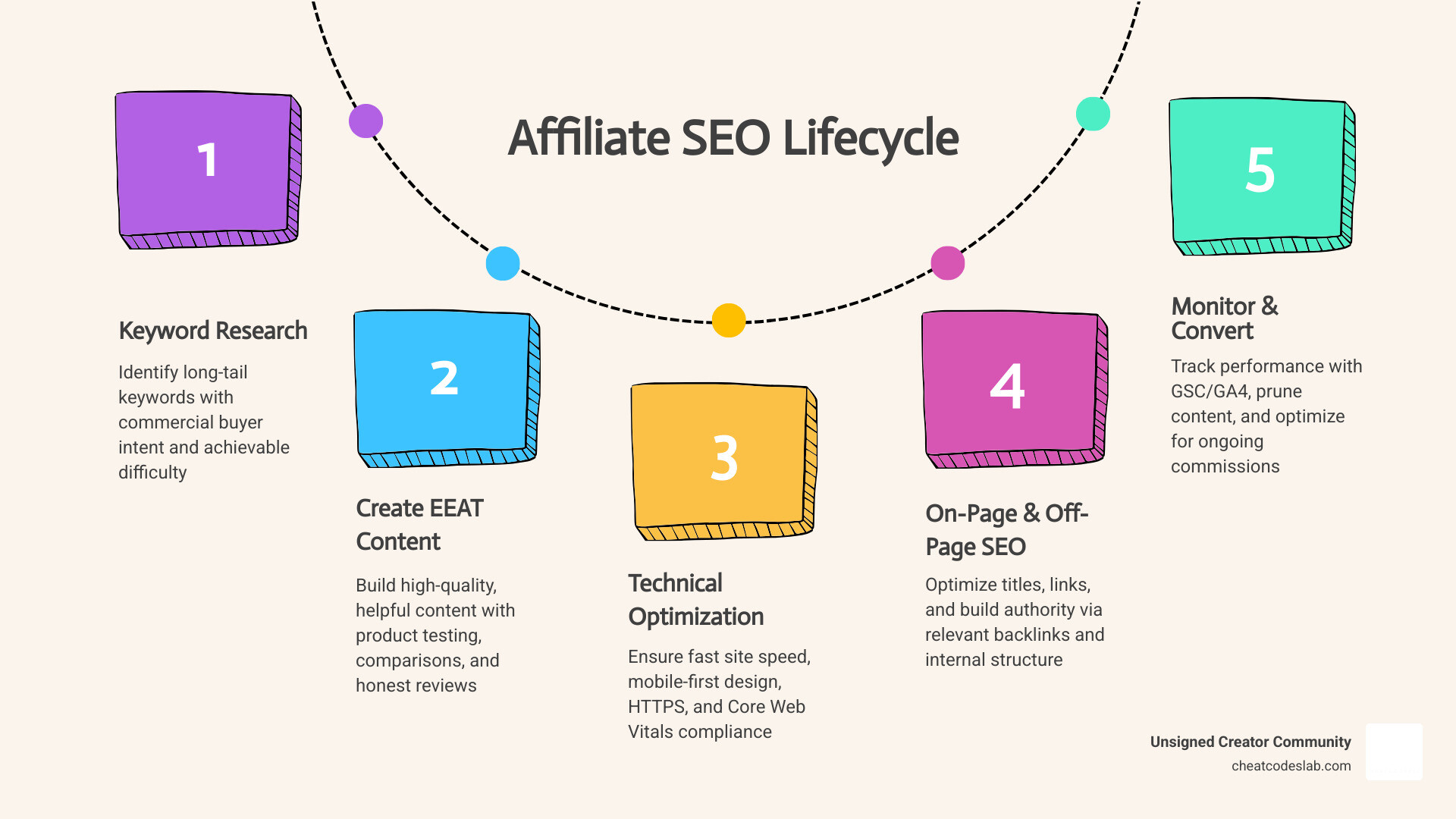
The Four Pillars of SEO for Affiliate Sites
To succeed in the competitive world of affiliate marketing, we need to treat our websites like digital assets, not just a collection of links. We think of SEO for affiliate sites as a four-legged stool. If one leg is weak, the whole thing topples over.
As we mentioned, 68% of all online experiences begin with a search engine. To capture that traffic, we focus on these four pillars:
- Keyword Research: Finding the “money” terms that indicate a user is ready to buy.
- On-Page SEO: Structuring our content so both humans and bots love it.
- Technical SEO: Ensuring the site is fast, secure, and mobile-friendly.
- Off-Page SEO: Building the “votes of confidence” (backlinks) that tell Google we are an authority.
Many beginners ask if they should just run ads (PPC) instead. While PPC can give you an immediate spike, it’s expensive and eats into your margins. SEO is the long game that results in 100% profit margins once your content starts ranking.
SEO vs. PPC for Affiliate Marketers
| Feature | SEO (Organic) | PPC (Paid) |
|---|---|---|
| Cost | Free traffic (time investment) | Pay-per-click (monetary investment) |
| Sustainability | Traffic continues even if you stop working | Traffic stops the moment you stop paying |
| Trust | Organic results often earn more trust | Users sometimes skip “Sponsored” results |
| Speed | Takes 3-12 months to see results | Results can happen in 24 hours |
| Scalability | High (content compounding) | Limited by your daily budget |
Strategic Keyword Research and Buyer Intent for SEO for Affiliate Sites
Keyword research is the most critical step. If we target the wrong words, we get the wrong visitors. We don’t just want “traffic”; we want “buyers.”
In SEO for affiliate sites, we categorize keywords by intent. Someone searching for “what is a camera” is just looking for info. Someone searching for “best mirrorless camera under $1000” has their credit card on the desk.
Long-Tail Keywords: Your Secret Weapon Instead of fighting giant corporations for broad terms like “shoes,” we go for long-tail keywords. These are longer, more specific phrases. They have lower search volume but much higher conversion rates. Research shows that buyer-intent long tails can convert 5-10 times better than “vanity” keywords.
For example:
- Broad (Hard): “Treadmill”
- Long-tail (Easier & Profitable): “Best folding treadmill for small apartments”
We use tools to find keywords with a Keyword Difficulty (KD) of 30 or less when starting a new site. We also look for “commercial intent” modifiers like:
- Best…
- Review…
- [Product A] vs [Product B]
- Top 10…
- Affordable…
To dive deeper into this, check out our More info about advanced keyword research guide. Understanding the buyer’s journey—from awareness to consideration to the final transaction—allows us to create a “content web” that catches users at every stage.
Creating High-Quality EEAT Content for SEO for Affiliate Sites
Google has become incredibly smart at sniffing out “thin” affiliate content—those sites that just copy-paste Amazon descriptions and call it a review. To rank today, we must follow the E-E-A-T guidelines: Experience, Expertise, Authoritativeness, and Trustworthiness.
The “Experience” part is the newest and perhaps most important for us. Google wants to see that we’ve actually used the product.
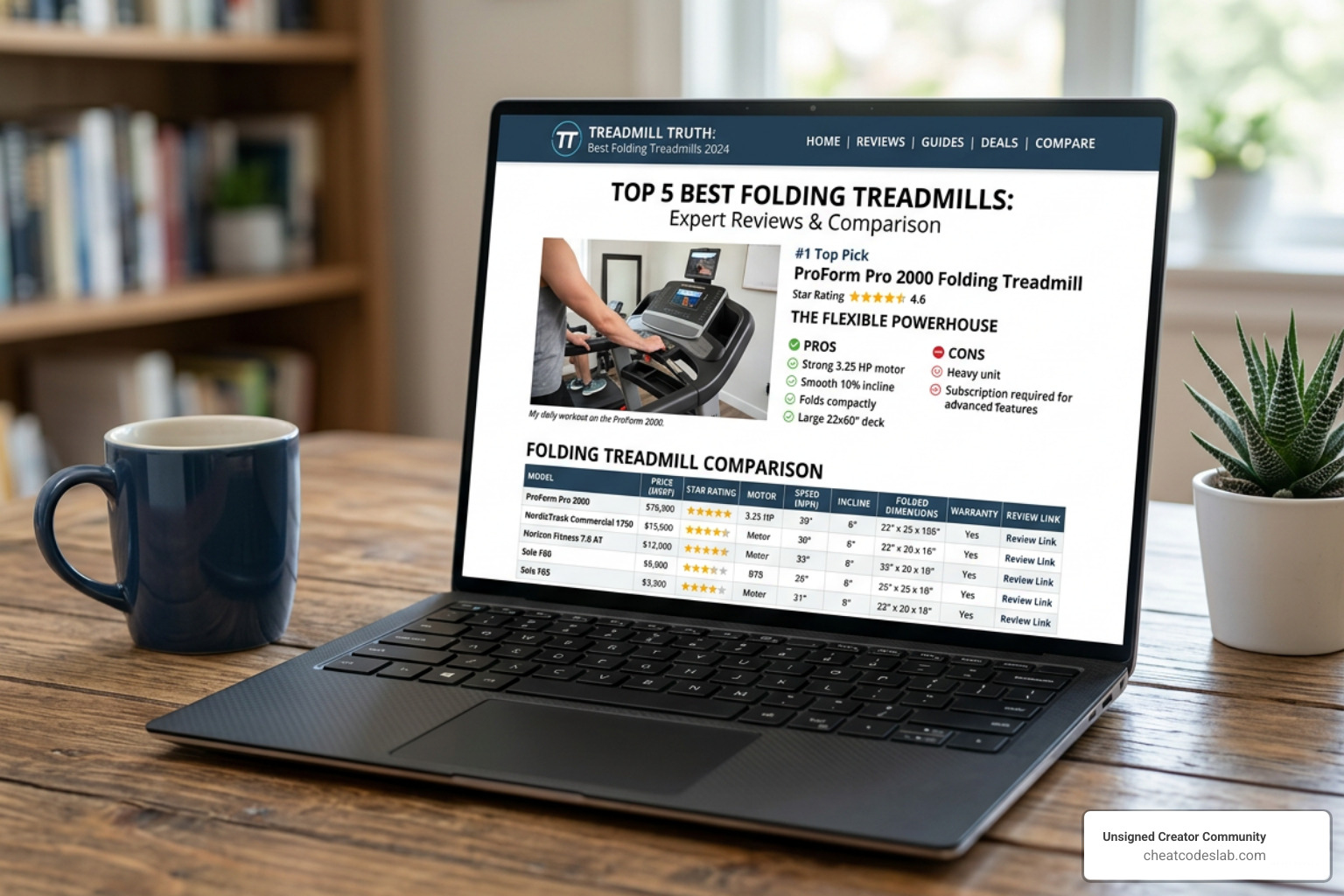
- Original Photography: Don’t just use stock photos. Take a picture of the product in your hand.
- Honest Pros and Cons: No product is perfect. Mentioning a flaw actually builds more trust with your reader (and Google) than a glowing, fake review.
- Comparison Tables: Most users are in a hurry. A scannable table at the top of the post comparing 3-5 top picks can drastically improve your conversion rate.
According to the official E-E-A-T guidelines, “Helpful Content” is the priority. We aim for 2,000 to 4,000 words for major “pillar” reviews, ensuring we answer every possible question a buyer might have.
Technical Foundations and Mobile Optimization
You could have the best reviews in the world, but if your site takes 10 seconds to load, 90% of your visitors will leave before reading a single word. In fact, website bounce rates increase by up to 50% whenever a page takes more than 2 seconds to load.
The Mobile-First Reality Today, 92.3% of internet users access the web via mobile phones. Google now uses “mobile-first indexing,” meaning it looks at the mobile version of your site to determine your rankings, even for desktop users.
Key technical elements we always check:
- Site Speed: Use caching tools and compress your images. Large, unoptimized images are the #1 killer of affiliate site speed.
- HTTPS: Security is a non-negotiable ranking factor. Ensure you have an SSL certificate.
- Core Web Vitals: These are specific metrics Google uses to measure user experience, such as how fast the main content loads and if elements jump around while loading.
- XML Sitemaps: This is like a map for Google’s bots, helping them find and index all your pages.
For a full checklist, see our More info about mobile-first SEO resource. A fast site isn’t just good for SEO; it’s good for your wallet. A 1-second delay in mobile load times can impact conversion rates by up to 20%.
On-Page Best Practices and Link Tagging
On-page SEO is about making our content “legible” for search engines. This includes using the primary keyword in the title, the first 100 words, and in at least one H2 header.
The Golden Rule of Affiliate Links One of the most common questions in SEO for affiliate sites is how to tag links. Google is very clear: affiliate links must be disclosed and tagged correctly.
- Use rel=”sponsored” for all affiliate links.
- rel=”nofollow” is also acceptable, but “sponsored” is the preferred modern standard.
Failing to tag these links can lead to your site being flagged for “link spam,” which is a quick way to lose all your rankings. As John Muller from Google has stated, you don’t need to hide your links with weird JavaScript or cloaking—just declare them properly.
Scannability and Structure Most people don’t read; they skim. We use:
- Short paragraphs (2-3 sentences max).
- Bullet points to break up data.
- Descriptive anchor text for internal links (e.g., “read our full on-page SEO tips” instead of “click here”).
- Header Hierarchy: Use H1 for the title, H2 for main sections, and H3 for sub-points. This helps Google understand the relationship between your topics.
Scaling Your Strategy and Monitoring Performance
Once we have a few articles ranking, it’s time to scale. We don’t just write random reviews; we build Topical Authority. This means we try to become the “go-to” resource for a specific niche.
If we have a site about coffee, we don’t just review one espresso machine. We write about:
- The best espresso machines (Pillar page)
- How to clean an espresso machine (Supporting content)
- Espresso vs. Drip coffee (Comparison content)
- The best coffee beans for espresso (Related product)
This creates a “Content Cluster.” By interlinking these pages, we tell Google, “We aren’t just an affiliate; we are experts in coffee.”
Essential Affiliate SEO Metrics to Track
We don’t just look at rankings. We look at the data that actually puts money in our pockets:
- Organic Traffic: How many people are finding us via search?
- Click-Through Rate (CTR): Are people actually clicking our affiliate links?
- Earnings Per Click (EPC): Which products are making us the most money?
- Keyword Rankings: Are we moving from page 2 to page 1?
- Bounce Rate: Are people leaving too fast? (A high bounce rate usually means we aren’t matching the search intent).
Off-Page Tactics and Building Topical Authority
Backlinks are like digital “votes” for your website. If a high-authority site like a major news outlet or a well-known blog links to us, Google sees us as more trustworthy.
However, we have to be careful. Buying cheap links on Fiverr is a one-way ticket to a Google penalty. Instead, we use “white-hat” tactics:
- Guest Posting: Writing a high-quality article for another site in our niche in exchange for a link.
- HARO (Help A Reporter Out): Answering queries from journalists who need expert quotes. This can land you links from massive sites like Forbes or the New York Times.
- Link Magnets: Creating original research, a free tool (like a calculator), or a unique infographic that people want to link to.
- Niche Relevance: One link from a small blog in your specific niche is often more valuable than five links from unrelated sites.
Building authority takes time, but it’s the most durable way to protect your site from algorithm updates. For advanced strategies, check out our More info about advanced link building guide.
Auditing and Optimizing for Conversions
The work doesn’t end when you hit “publish.” SEO for affiliate sites requires regular maintenance. We perform an SEO audit every quarter to find “content decay.” This is when an old article starts losing traffic because the information is outdated or a competitor wrote something better.
Content Pruning and Refreshing Sometimes, the best way to grow is to delete or merge underperforming pages. We also “refresh” our top-performing articles by:
- Updating prices and product availability.
- Adding new sections to answer “People Also Ask” questions from Google.
- Improving the call-to-action (CTA) buttons to increase clicks.
The Future: Voice Search and Snippets As we move into 2024 and 2025, we must optimize for how people actually search. Around 50% of all searches now come from voice assistants. These queries are usually questions (e.g., “What is the best dog food for puppies?”). By adding an FAQ section to our articles, we increase our chances of winning the “Featured Snippet”—that box at the top of Google that earns 54.4% of all clicks.
At CheatCodesLab, we specialize in the “cheat codes” that simplify this process. Whether it’s using AI to help structure your content clusters or technical tools to monitor your rankings, the goal is always the same: sustainable, passive income.
Final Thoughts: Get Started with the Affiliate SEO Cheat Code
Building a successful affiliate site isn’t about luck; it’s about following a proven system. Focus on the user first, provide genuine value, and stay consistent with your technical and on-page basics.
If you’re ready to stop guessing and start ranking, it’s time to implement these strategies. The gap between where you are and where you want to be is bridged by action. Start with your keyword research today, and by this time next year, you could be looking at a thriving, organic-traffic-driven business.
Ready to level up? Explore more of our guides:


About the author


How to Archive Posts on Instagram in 4 Easy Steps
Master archiving on Instagram in 4 easy steps to organize your profile and protect your content.

Beginner’s Guide to 10k free instagram followers app
Discover how a 10k free instagram followers app works, its risks, and safe organic growth strategies for real engagement in 2026.

Beginner’s Guide to Best Instagram Report App
Discover the best Instagram report app for real-time analytics, automated reports, and data-driven decisions in 2026.
How to Master Advanced SEO Search Techniques in 7 Steps
Master advanced search techniques in SEO with 7 proven steps to boost rankings, technical audits, and organic traffic.

Cheat Sheet to the Best Business Apps
Discover the best business apps to streamline operations, boost productivity, and scale your business in 2026.

How to Get Instagram Followers Free APK in 5 Steps
Discover how instagram followers free apk 2026 download works and learn safe organic growth strategies instead of risky third-party tools.
Related
Beginner’s Guide to 10k free instagram followers app
Discover how a 10k free instagram followers app works, its risks, and safe organic growth strategies for real engagement in 2026.
How to Master Advanced SEO Search Techniques in 7 Steps
Master advanced search techniques in SEO with 7 proven steps to boost rankings, technical audits, and organic traffic.
How to Get Instagram Followers Free APK in 5 Steps
Discover how instagram followers free apk 2026 download works and learn safe organic growth strategies instead of risky third-party tools.

How to Get 500 Instagram Followers Free
Claim your 500 follower instagram free trial safely and grow your account with real engagement.

How to Get 1000 Instagram Followers Fast
Learn how to get 1000 followers instagram fast with proven strategies, Reels, and profile optimization for real growth in 2026.

Step-by-Step Guide to Download Instagram Followers Pro
Learn how to download Instagram Followers Pro on iOS, Android, and PC with this complete step-by-step guide and safety tips.